
Cost & Management Spoilage & Scrap • Rework • Normal Spoilage • Abnormal Spoilage • Quality Cost
Accounting for spoilage and scrap: A practical guide to differentiating between Normal and Abnormal Spoilage, when scrap costs are charged to the product vs. recorded as a Period Loss, and the impact on quality costs and profitability—Digital Salla.
Establish correctly: Standard Costing Guide — To understand how to build "Normal Spoilage" into your standard cost benchmarks.
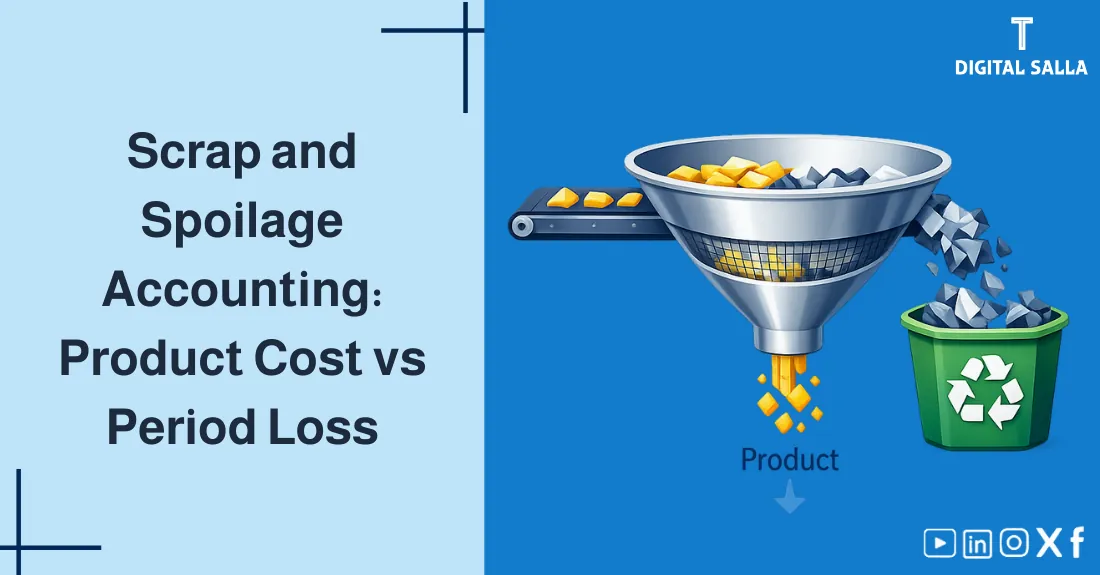
Core Principle: "Normal Spoilage" is a cost of producing good units, while "Abnormal Spoilage" is a cost of inefficiency that must be isolated and reported as a loss.
What will you learn in this guide?
- Fundamental definitions: Spoilage, Scrap, and Rework.
- Criteria for Normal vs. Abnormal Spoilage and their different accounting treatments.
- How to record Scrap Sales and their impact on inventory or overhead.
- Accounting for Rework costs and identifying the root cause.
- Operational checklist to control spoilage and enhance production quality.
Practical Note: Total waste is visible on the factory floor, but "Accounting Waste" is hidden in the unit cost. If you don't separate abnormal spoilage, your product margins will be misleadingly low.
Table of Contents Updates automatically while scrolling
1) Spoilage, Scrap, and Rework: Definitions 2) Normal vs. Abnormal Spoilage (The Core Distinction) 3) Accounting Treatment for Spoilage 4) Accounting for Rework Costs 5) Accounting for Scrap (Sale & Treatment) 6) Summary Table: Spoilage vs. Rework vs. Scrap 7) The Importance of the Inspection Point 8) Operational Controls & Readiness Checklist 9) Common Errors and How to Prevent Them 10) Frequently Asked Questions 11) Conclusion
Spoilage Types Scrap Treatment
1) Spoilage, Scrap, and Rework: Definitions
In manufacturing, not everything that enters the production line comes out as a perfect unit. We must distinguish between three outcomes:
1.1 Spoilage
Units that do not meet quality specifications and are discarded or sold for a fraction of their value (e.g., broken glass, burnt bread).
Inventory Write-off Template - Excel Template
1.2 Rework
Defective units that can be repaired and brought up to quality standards through additional material/labor (e.g., a shirt with a missing button).
1.3 Scrap
Residual material left over from the production process that has minimal or no value (e.g., sawdust, metal offcuts).
2) Normal vs. Abnormal Spoilage (The Core Distinction)
This is the most critical decision in Cost Accounting.
Comparison: Normal vs. Abnormal Spoilage
| Aspect | Normal Spoilage | Abnormal Spoilage |
|---|---|---|
| Nature | Expected/Inherent to the process. | Unexpected/Result of inefficiency. |
| Cause | Chemical reactions, evaporation, standard cutting waste. | Machine breakdown, poor materials, unskilled labor. |
| Accounting View | A Product Cost (Part of the unit cost). | A Period Loss (Charged to the Income Statement). |
| Goal | Incurred to produce "Good Units." | Avoidable and should be eliminated. |
Related topic: Manufacturing Cost Elements — To see how normal spoilage is allocated as part of Manufacturing Overhead (MOH).
3) Accounting Treatment for Spoilage
The difference in "Meaning" leads to a massive difference in "Recording":
Diagram showing normal spoilage increasing unit cost and abnormal spoilage going to the loss account.
Key Insight: Abnormal spoilage is a "Red Flag" for management that should not be hidden inside the product cost.
4) Accounting for Rework Costs
Rework is essentially the cost of "fixing a mistake."
- Normal Rework (Specific Job): If a specific client requested high precision, extra rework costs are charged directly to that Job Cost Sheet.
- Normal Rework (Common): If it happens to all products, it is charged to Manufacturing Overhead.
- Abnormal Rework: Always charged as a period loss.
Deep dive: Job Order Costing — To see how rework costs are added to a specific project’s ledger.
5) Accounting for Scrap (Sale & Treatment)
Scrap is usually not "Inventoried" because its value is too low. However, when sold, the revenue can be treated in two ways:
- Direct Deduction: Subtract the scrap sale proceeds from the specific job’s cost (if traceable).
- Overhead Credit: Deduct the proceeds from Total Manufacturing Overhead (if not traceable).
Management Rule: If scrap has a high recovery value (e.g., precious metal offcuts), it should be treated as a By-product and recorded in inventory at its net realizable value.
6) Summary Table: Spoilage vs. Rework vs. Scrap
Summary of Accounting Treatment
| Category | Primary Outcome | Cost of "Good Units" includes? |
|---|---|---|
| Normal Spoilage | Discarded Unit | Yes |
| Abnormal Spoilage | Discarded Unit | No (Period Loss) |
| Normal Rework | Repaired Unit | Yes |
| Scrap | Residual Material | Cost is reduced by sales |
7) The Importance of the Inspection Point
The moment you identify spoilage matters for valuation.
- If the Inspection Point is at 50% completion, all units that passed 50% must carry a share of the "Normal Spoilage" cost.
- Units that haven't reached the inspection point yet carry no spoilage cost in their WIP value.
Related topic: Process Costing — To learn how to include normal spoilage in "Equivalent Unit" calculations.
8) Operational Controls & Readiness Checklist
To ensure waste and spoilage are managed effectively:
Waste Control Quality Gate
- Is the "Normal Spoilage Rate" (e.g., 2%) reviewed and updated annually?
- Is there a formal "Spoilage Report" signed by both Quality and Production?
- Are defective units physically isolated in a "Quarantine Area" to prevent accidental use?
- Is scrap sale revenue matched with weight/quantity logs from the factory gate?
- Do we perform "Root Cause Analysis" for every abnormal spoilage incident?
9) Common Errors and How to Prevent Them
- Hiding Abnormal Spoilage: Treating all waste as "Normal" to avoid management scrutiny (results in overstating product costs).
- Double Counting Rework: Recording the labor of rework in general payroll without isolating it (results in wrong efficiency variances).
- Ignoring the Net Realizable Value: Selling spoiled units but not recording the revenue as a cost reduction.
- Weak Inspection Points: Only inspecting at the very end (makes it impossible to know where the waste started).
Deep dive: Payroll Reconciliation — To ensure rework labor costs match the actual overtime or wages paid to the repair team.
10) Frequently Asked Questions
What is Spoilage?
It refers to units that are defective and cannot be economically repaired to meet quality standards.
Why is abnormal spoilage treated as a loss?
Because it is not an inherent part of the production process. Including it in the unit cost would reward inefficiency and hide performance issues.
Can scrap become a main product?
If its value becomes significant due to market changes or new technology, it may be reclassified as a By-product or even a Joint Product.
11) Conclusion
Mastering the accounting treatment for spoilage, scrap, and rework is the difference between "Accepting Waste" and "Controlling Waste." By separating Normal from Abnormal Spoilage and accurately recording Rework costs, you provide management with the clarity needed to improve production efficiency, set accurate prices, and protect the entity’s profit margins from hidden inefficiencies.
Action Step Now (30 minutes)
- Ask your production manager for the "Standard Waste Rate."
- Compare this with the actual waste in the last month.
- If actual > standard, calculate the cost of that Abnormal Spoilage and ensure it’s recorded as a separate loss, not hidden in the unit cost.
© Digital Salla Articles — General educational content for management and cost accounting purposes.