
Subsidiary Ledgers (Sub-ledgers) and Control Accounts: How to Balance Detail and Summary?
Imagine if your company has 1,000 customers. If you record every customer as a separate account in your Trial Balance, your financial statements would be hundreds of pages long and impossible to read. The solution is the Control Account system and Subsidiary Ledgers. In this guide, we explain how to link the "Big Picture" in the General Ledger with the "Tiny Details" in the sub-ledgers, ensuring accuracy, speed in reporting, and strong internal control.
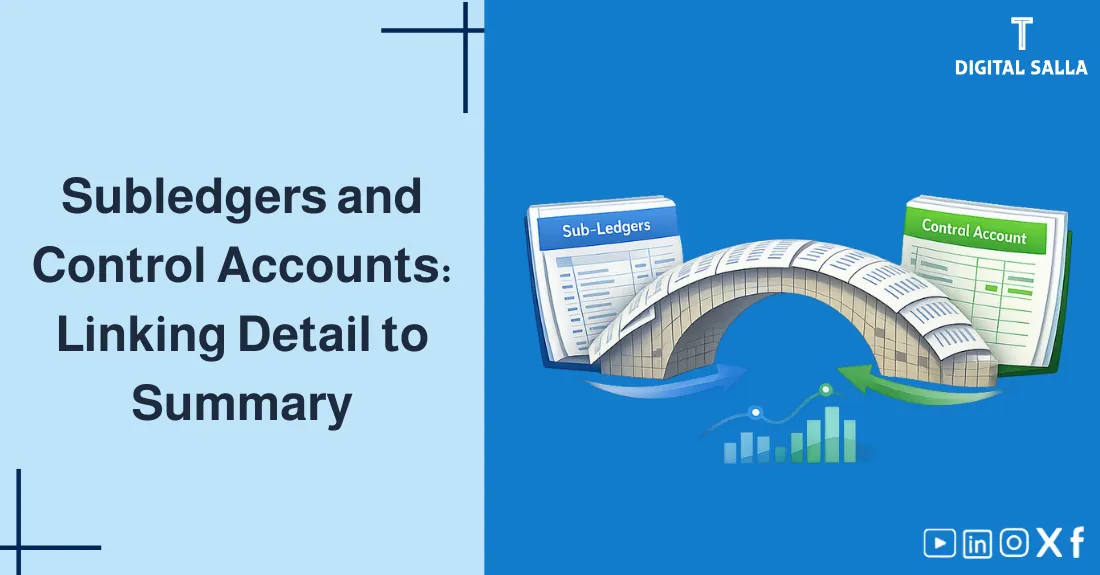
The Control Account is the "Summary," while the Subsidiary Ledger is the "Story" behind the numbers.
What will you gain from this guide?
- A clear definition of Subsidiary Ledgers and their types.
- What is a Control Account and why is it essential for a clean Trial Balance?
- A practical comparison table between the General Ledger and Sub-ledgers.
- Visual model (SVG) explaining the Hierarchy of Detail.
- Reconciliation strategies: How to ensure the sum of parts equals the whole.
- The role of Aging Reports in managing subsidiary details.
- A checklist for reviewing sub-ledger integrity.
Contextual Link: To understand where these accounts live in your system, read Chart of Accounts Design.
Table of Contents Auto-highlights on scroll
1) Summary vs. Detail: The Basic Concept 2) Common Types of Subsidiary Ledgers 3) General Ledger vs. Sub-ledger Comparison 4) Visual Hierarchy Map (SVG) 5) Reconciling Control Accounts and Sub-ledgers 6) Detail Analysis: Aging Reports 7) Benefits of Using Sub-ledgers 8) Common Maintenance Mistakes 9) Frequently Asked Questions 10) Conclusion
1) Summary vs. Detail: The Basic Concept
Accounting systems need to serve two different masters:
- External Reporting: Investors and banks only want to see "Total Accounts Receivable" (The Summary).
- Internal Management: The collection team needs to know exactly how much "Customer A" owes (The Detail).
The Solution: The Control Account lives in the General Ledger (Summary), while the Subsidiary Ledger holds the individual records (Detail).
2) Common Types of Subsidiary Ledgers
The most frequent use cases for sub-ledgers are:
Smart Journal Entries System - Excel File
- Accounts Receivable (A/R) Ledger: Breakdown of total money owed by individual customers.
- Accounts Payable (A/P) Ledger: Breakdown of total money owed to individual suppliers.
- Inventory Ledger: Detail of every SKU or product item in the warehouse.
- Fixed Asset Ledger: Detailed records of every piece of equipment, its cost, and depreciation.
3) General Ledger vs. Sub-ledger Comparison
| Feature | General Ledger (Control) | Subsidiary Ledger (Detail) |
|---|---|---|
| Purpose | Financial Statements Preparation | Operational Tracking & Analysis |
| Content | Summary Totals | Individual Transaction Detail |
| Account Example | Accounts Receivable (Total) | Balance for "Customer XYZ" |
| Audience | CFO, External Auditors, Banks | Credit Managers, Accountants, Sales |
4) Visual Hierarchy: Summary to Detail
Hierarchy: Summary to Detail Control Account General Ledger (Total) Sub-ledger Detail Customer A: $500 Customer B: $300 Periodic Reconciliation Sum of Details must equal the Control Balance
The system automatically (or manually) ensures that the total of individual pieces matches the "Big Picture" total.
5) Reconciling Control Accounts and Sub-ledgers
Reconciliation is the "Quality Check." At the end of every month, you must verify:
Sum of Sub-ledger Balances = Control Account Balance
If they don't match, you likely have:
- Posting Error: An entry made to the sub-ledger but forgotten in the General Ledger.
- Direct Entry Error: Someone made a journal entry directly to the control account without selecting a sub-ledger entity.
6) Detail Analysis: Aging Reports
The biggest advantage of subsidiary ledgers is the ability to generate Aging Reports.
- Definition: A report that categorizes balances by how long they have been outstanding (e.g., 0-30 days, 31-60 days).
- Value: Identifying high-risk debts and managing cash flow collection effectively.
7) Benefits of Using Sub-ledgers
- Trial Balance Efficiency: Keeps the TB short and focused on main categories.
- Error Isolation: Errors in one customer's account don't clutter the rest of the financial reporting.
- Information Security: You can give a clerk access to the "Vendor Sub-ledger" without giving them access to the "Bank" or "Capital" accounts.
9) Frequently Asked Questions
Do I need sub-ledgers if I only have 5 customers?
Technically, no. But as soon as your business starts growing, starting with a sub-ledger structure now saves you from a messy migration later.
Does modern accounting software handle this automatically?
Yes. In most ERPs, when you record a sale to a customer, the system automatically updates both the individual customer balance and the total A/R control account.
10) Conclusion
The summary is simple: Control Accounts are for the "Result," and Subsidiary Ledgers are for the "Operation." By maintaining this separation and performing periodic reconciliations, you ensure that your financial statements are accurate, your operational details are clear, and your internal control system is robust.
Your Next Step: Check your Trial Balance. Does it contain individual customer names? If yes, it's time to move them into a proper Subsidiary Ledger system.
© Digital Salla Articles — General educational reference. For professional system setup or reconciliation services, consult a certified public accountant.