
Trial Balance: How to Detect Balancing and Posting Errors?
You finished recording the daily journal entries and posting them to the ledger, but how can you be sure you didn't miss an entry or swap a number? The Trial Balance is your first line of defense. It is an internal report that ensures the sum of Debits equals the sum of Credits. In this guide, we explain how to prepare a trial balance professionally: What are its types? What are the errors it can detect—and more importantly, the errors it cannot detect?
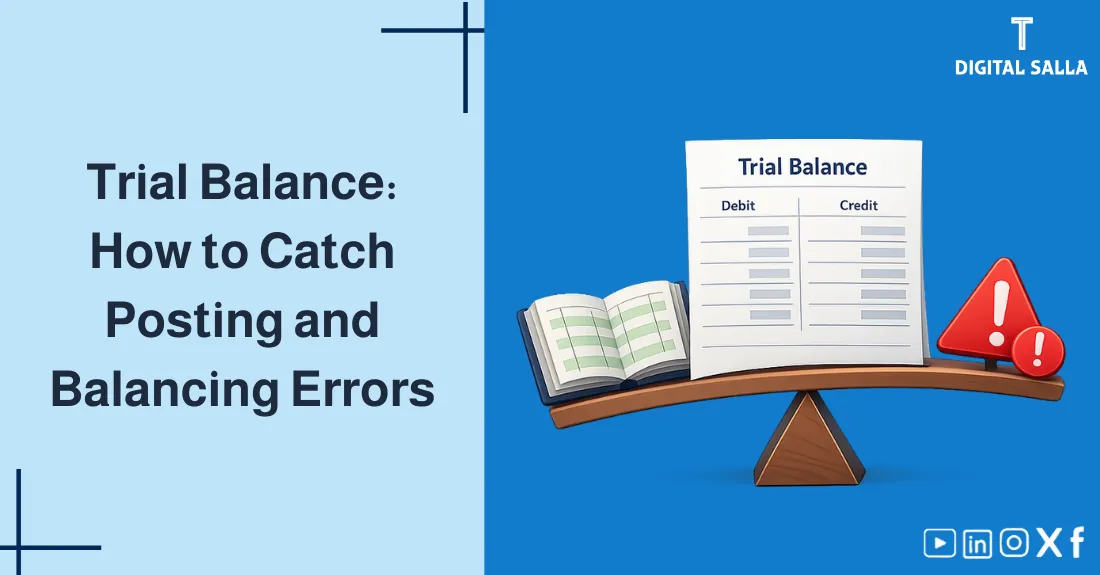
A balanced Trial Balance is a prerequisite for preparing reliable financial statements.
What will you gain from this guide?
- A clear definition of the Trial Balance and its goal in the accounting cycle.
- The difference between a Trial Balance by Totals and by Balances.
- Detailed steps for preparation (From Ledger to Report).
- Visual model (SVG) explaining the balancing logic.
- Errors that cause an imbalance and how to trace them.
- Critical warning: The 5 errors a trial balance cannot detect.
- A checklist for verifying balance integrity before period closing.
Step-by-Step Context: To understand where the data comes from, read Double-Entry System and Documentary Cycle first.
Table of Contents Auto-highlights on scroll
1) What is a Trial Balance? 2) Types of Trial Balance 3) Key Comparison Table 4) Visual Model: The Balance Scale (SVG) 5) Steps to Prepare a Trial Balance 6) Errors the Trial Balance DETECTS 7) Errors the Trial Balance CANNOT Detect 8) Pro Tips for Balancing 9) Frequently Asked Questions 10) Conclusion
1) What is a Trial Balance?
A Trial Balance is an internal report prepared at the end of an accounting period. It lists all the accounts in the General Ledger and their respective debit or credit balances.
The Golden Goal: To prove that Total Debits = Total Credits. This equality confirms the arithmetic accuracy of the entire bookkeeping process during the period.
2) Types of Trial Balance
There are two primary ways to present a trial balance:
Financial Closing Checklists - Excel Templates
- Trial Balance by Totals: Lists the sum of all debit and credit movements for each account. Useful for auditing the volume of activity.
- Trial Balance by Balances: Lists only the net final balance for each account. This is the most popular form as it leads directly to the Financial Statements.
3) Key Comparison Table
| Feature | By Totals | By Balances |
|---|---|---|
| Data Source | Sum of Dr. and Cr. movements in Ledger | Ending net balances of Ledger accounts |
| Purpose | Verifying the integrity of posting | Preparing P&L and Balance Sheet |
| Popularity | Mainly used by auditors | Standard for all accountants |
| Equality Rule | Total Dr. movements = Total Cr. movements | Total Dr. balances = Total Cr. balances |
4) Visual Model: The Balancing Logic
Trial Balance Concept: Equality Test Debit Accounts • Assets (Cash, Receivables...) • Expenses (Rent, Salaries...) • Drawings Credit Accounts • Liabilities (Loans, Payables...) • Equity (Capital, Retained...) • Revenues (Sales, Services...) Total Debit = Total Credit ✅
The trial balance tests if the "Weight" of debits matches credits across all accounts.
5) Steps to Prepare a Trial Balance
- Close the Ledger: Calculate the final balance for every account in the General Ledger.
- List Accounts: Write the name and code of every account in a vertical list.
- Enter Balances: Place debit balances in the "Debit" column and credit balances in the "Credit" column.
- Sum Columns: Add up both columns.
- Verify Equality: If they match, you can proceed to adjustments.
6) Errors the Trial Balance DETECTS
If the columns do not match, the error is likely one of the following:
- Posting Error: Forgetting to post one side of a balanced entry to the ledger.
- Transposition Error: Swapping numbers (e.g., recording 54 instead of 45).
- Calculation Error: Mistakes in summing a ledger account or the trial balance itself.
- Direction Error: Placing a debit balance in the credit column or vice versa.
7) The "Dangerous" Errors (What it CANNOT Detect)
Critical Warning: A balanced trial balance does not guarantee that your books are 100% correct. It only proves that your errors are "Balanced."
- Errors of Omission: Forgetting to record a transaction entirely (Invoice lost).
- Errors of Commission: Recording a correct amount in the wrong account of the same type (e.g., Debit Customer A instead of Customer B).
- Errors of Principle: Violating accounting rules (e.g., recording an Asset purchase as an Expense).
- Compensating Errors: Two unrelated errors that accidentally cancel each other out.
8) Pro Tips for Balancing
- The Rule of 9: If the difference between your totals is divisible by 9, you probably have a transposition error (swapped digits).
- The Rule of 2: If the difference is an even number, look for an entry of half that amount posted in the wrong column.
- Internal Reconciliation: Always reconcile your sub-ledgers (Customers/Vendors) with the control accounts before preparing the TB.
9) Frequently Asked Questions
Is the Trial Balance a financial statement?
No. It is an internal working document used as a basis for preparation and error checking. It is not shared with external parties like banks.
What is an 'Adjusted' Trial Balance?
It is the trial balance prepared after recording adjusting entries (accruals, prepayments, depreciation) to ensure all revenues and expenses are in the correct period.
10) Conclusion
The Trial Balance is the bridge between recording and reporting. While it isn't a perfect shield against all errors, it is the most efficient tool for ensuring arithmetic balance. By mastering the detection of balancing errors and understanding the "hidden" errors, you ensure that your Financial Statements are built on a solid, accurate foundation.
Your Next Step: Check your current Trial Balance. Do you have any "Suspense Accounts" or "Clearing" balances that need to be resolved before the final closing?
© Digital Salla Articles — General educational reference. For professional auditing or complex trial balance reconciliation, consult a certified public accountant.