
FP&A & Management Budget Types • ZBB • Flexible Budget • Static Budget • Incremental
Types of Budgets: Zero-Based (ZBB) vs. Flexible Budgeting (The Pro Choice)
Types of Budgets: A comparative guide between Zero-Based Budgeting (ZBB), the Flexible Budget, and the Traditional Static Budget. Learn when to choose each type based on the nature of your business and demand volatility—Digital Salla.
Establish correctly: Master Budget Preparation Guide — To understand how schedules are interlinked before choosing the "Methodology" of preparation.
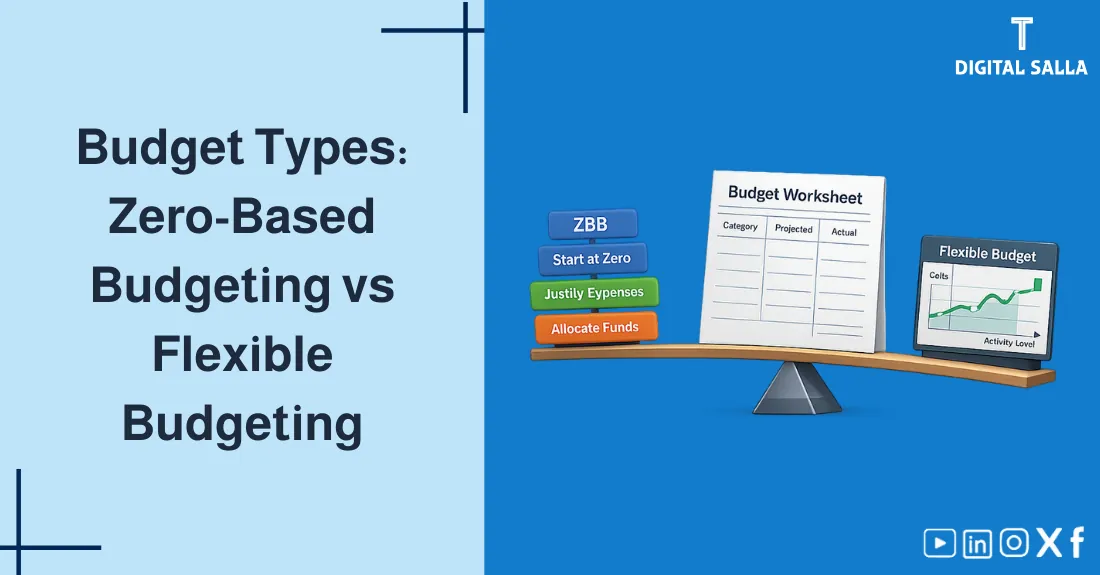
Core Concept: Static budgets plan for the Best Guess. Flexible budgets plan for Reality. ZBB plans for Efficiency. Choosing the right type is a strategic decision.
What will you learn in this guide?
- What is Incremental Budgeting and why is it the most common (but riskiest)?
- In-depth view of Zero-Based Budgeting (ZBB): Cutting the fat from operations.
- Flexible Budget: How to evaluate performance fairly when volume changes.
- Static vs. Flexible: A numerical comparison of performance reports.
- Practical criteria to choose the best budget type for your entity.
Practical Note: Most companies use a "Hybrid Approach." They might use ZBB for administrative costs every 3 years, while using a Flexible Budget for the factory every month.
Table of Contents Updates automatically while scrolling
1) Incremental Budgeting (Traditional) 2) Zero-Based Budgeting (ZBB) 3) Flexible Budget: Evaluation King 4) Numerical Example: Static vs. Flexible 5) Comparison Summary Table 6) How to Choose the Right Type? 7) Operational Controls & Readiness Checklist 8) Common Errors and How to Prevent Them 9) Frequently Asked Questions 10) Conclusion
1) Incremental Budgeting (Traditional)
This is the simplest type. It takes Last Year's Actuals and adds or subtracts a percentage (e.g., 5% for inflation).
- Pros: Extremely fast and easy to prepare.
- Cons: Carries over last year's inefficiencies and "Waste." It encourages managers to "Spend it or Lose it."
Related topic: Cost Behavior — Incremental budgeting often fails because it ignores how some costs are fixed and don't need a percentage increase.
2) Zero-Based Budgeting (ZBB)
In Zero-Based Budgeting, last year doesn't matter. Every department starts at $0. Every single line item must be justified based on its Contribution to Strategy.
Diagram showing the process of justifying every expense from zero base.
ZBB is time-consuming but highly effective for administrative and discretionary costs (Marketing, Training, Travel).
3) Flexible Budget: The Performance Evaluation King
A Flexible Budget uses the Standard Variable Cost per Unit to adjust the plan based on Actual Volume achieved.
Budgeting & Forecasting Model - Excel File
- Scenario: We planned for 10,000 units but actually produced 12,000.
- Static View: "You spent more than the budget!" (Unfair).
- Flexible View: "For 12,000 units, you spent less than you should have." (Fair).
Related topic: Standard Costing — To learn how to determine the standard variable costs that make the flexible budget possible.
4) Numerical Example: Static vs. Flexible (Fairness Test)
Planned: 1,000 units | Variable Cost: $10/unit | Fixed: $5,000. Actual: 1,200 units produced.
Performance Report Comparison
| Element | Static Budget (Plan) | Actual Results | Flexible Budget (Fair) |
|---|---|---|---|
| Volume | 1,000 Units | 1,200 Units | 1,200 Units |
| Variable Costs | $10,000 | $11,500 | $12,000 (1.2k x $10) |
| Fixed Costs | $5,000 | $5,200 | $5,000 |
| Total Cost | $15,000 | $16,700 | $17,000 |
The Result: Using the Static budget, the manager looks $1,700 over. Using the Flexible budget, the manager is actually $300 under the fair benchmark.
5) Comparison Summary Table
Which methodology fits which situation?
| Budget Type | Starting Point | Best Used For | Effort Level |
|---|---|---|---|
| Incremental | Historical Actuals | Stable, predictable environments. | Low |
| ZBB | Zero / Activities | Cost-cutting / Strategic pivots. | Very High |
| Flexible | Variable Rate × Volume | Performance evaluation & Manufacturing. | Medium |
| Continuous (Rolling) | Update every month/qtr | Dynamic markets (e.g., Tech). | High |
6) How to Choose the Right Type?
Choose ZBB if:
- You feel the company has too much "Bloat" or unnecessary spending.
- Strategic priorities have changed drastically.
Choose Flexible Budgeting if:
- Your sales and production volumes are highly volatile.
- You want to hold managers accountable for Efficiency, not just totals.
Choose Incremental if:
- You have a small team and very limited time.
- Operations are 95% the same as last year.
7) Operational Controls & Readiness Checklist
To ensure your chosen Budget Type is effective:
Budgeting Quality Gate
- Are variable and fixed costs accurately separated in the GL?
- In ZBB, is there a formal "Justification Form" for every new expense?
- Is the Flexible Budget used for the monthly variance review?
- Is the Master Budget updated with a rolling forecast quarterly?
- Are departmental goals matched with KPI Dashboards?
8) Common Errors and How to Prevent Them
- Using ZBB Every Year: It's too exhausting. Pro Tip: Use ZBB every 3-5 years for a deep clean, then incremental in between.
- Ignoring Fixed Cost Jumps: Assuming a fixed cost stays the same in a flexible budget even if you double volume (Ignoring the Relevant Range).
- Padding in Incremental: Managers adding 10% "Just in case." Solution: Demand justification for any increase above inflation.
- Static Evaluation: Punishing a sales team for higher costs when they actually sold 30% more than the plan.
Deep dive: Payroll Reconciliation — To ensure that your "Fixed vs Variable" labor assumptions in the budget match actual bank payment reality.
9) Frequently Asked Questions
What is Zero-Based Budgeting (ZBB)?
It is a method where every expense must be justified from zero for each period, rather than relying on historical spending.
Why is a Flexible Budget better for manufacturing?
Because production volumes fluctuate. A flexible budget adjusts to the actual volume, providing a fair benchmark for material and labor efficiency.
Can I use ZBB for some departments and Incremental for others?
Yes. This is a "Hybrid Approach" and is often the best balance between control and effort.
10) Conclusion
There is no "One Size Fits All" in Budget Types. By understanding the rigorous control of Zero-Based Budgeting and the evaluative fairness of Flexible Budgeting, you can design a planning system that truly supports your company's strategy. Move away from "Last year + 5%" and start building budgets that drive efficiency, manage risks, and reflect the actual operational reality of your entity.
Action Step Now (30 minutes)
- Pick one department (e.g., Marketing).
- Try to apply ZBB logic: List their top 5 expenses and ask "What happens if we spend $0 on this? Is it vital?".
- Review your last monthly report: Was the variance caused by Price/Efficiency or just Volume change?
© Digital Salla Articles — General educational content for management and financial planning purposes.