

Users of Accounting Information (Stakeholders): What Do the Bank, Investor, and Management Want?

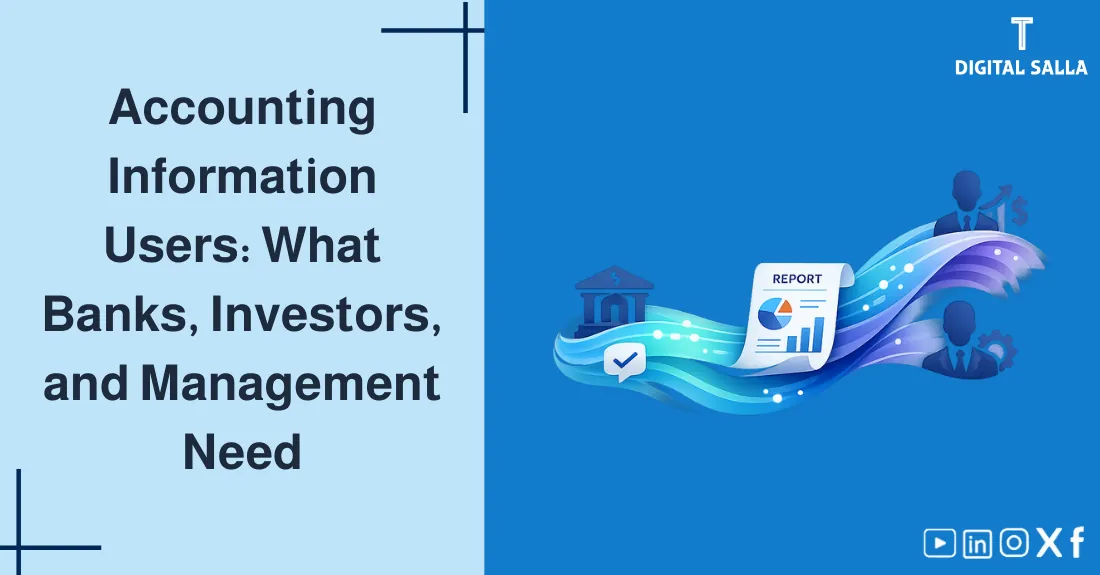
Users of Accounting Information and Their Objectives: What do Banks, Investors, and Management want?
Accounting reports are not ends in themselves; they are a means to help accounting information users make decisions. But who exactly are these users? And why does an investor want to see a different report than a bank manager? This guide explores the world of stakeholders and how accounting bridges the gap between raw data and strategic action—Digital Salla.
- Precise classification of Internal vs External users.
- What Investors look for: Profitability and Dividends.
- What Creditors (Banks) look for: Liquidity and Repayment Ability.
- Management’s need for detailed reports to guide daily operations.
- Stakeholder interest map (SVG) to visualize the reporting ecosystem.
- Interactive assessment to match user needs with report types.
1) Who are Accounting Information Users? (The Broad View)
In accounting terminology, any person or entity that has a “stake” in the company’s financial performance is called a Stakeholder. To simplify reporting, these users are grouped into two main categories:
2. Internal Users: Personnel within the company who need data for planning and control (Management, Department heads).
2) External Users: Looking from the Outside
External users generally do not have access to daily ledger entries; they rely on General-Purpose Financial Statements to make decisions:
- Investors (Actual & Potential): They want to know “Will my money grow?” and “Will I get dividends?”.
- Lenders & Banks: Their primary concern is “Can the company pay back the loan and interest on time?”.
- Government & Tax Authorities: They monitor compliance with Zakat, VAT, and labor laws.
- Customers: They want to ensure the company is stable enough to provide long-term service or fulfill warranties.
3) Internal Users: Managing from Within
Internal users use Managerial Accounting reports which are often more detailed, frequent, and not shared with the public:
- Top Management (C-Suite): Using reports to decide on expansion, mergers, or cost-cutting.
- Department Managers: Monitoring budget vs. actual performance to adjust their team’s activities.
- Employees: They look for financial stability to ensure job security and potential bonuses.
4) Stakeholder Map: The Reporting Ecosystem (SVG)
This diagram visualizes how accounting information flows from the company to various stakeholders.
Operating Lease Accounting Model - Excel File
5) Information Needs: Who wants What?
Every user asks a specific question when they open a financial report:
| User Group | Key Question | Primary Metric |
|---|---|---|
| Equity Investors | Is this company worth my investment? | Earnings per Share (EPS) / ROI |
| Commercial Banks | Can they pay back the loan? | Current Ratio / Debt-to-Equity |
| CEO / Managers | Are we operating efficiently? | Profit Margin / Budget Variance |
| Zakat/Tax Authority | Is the reported profit legally accurate? | Adjusted Net Profit |
6) Ethics and Transparency for Users
Since external users cannot “check the books” themselves, they rely on Transparency and External Audits. High-quality accounting ensures that the information provided is:
- Relevant: Helps in making a difference in a decision.
- Reliable: Free from error and bias.
- Comparable: Can be matched against other companies or previous years.
7) Interactive Assessment: Match the User
8) Frequently Asked Questions
Who are the primary users of accounting information?
They are divided into two categories: External (Investors, Creditors, Government) and Internal (Management, Employees).
Why do employees care about financial reports?
Employees seek stability and security; they want to know if the company will continue to pay salaries and if there is a chance for future bonuses or raises.
Do all users get the same reports?
No. External users get “General-Purpose Statements.” Internal users (Management) get “Special-Purpose Reports” which are much more detailed and private.
Can a customer be an accounting information user?
Yes. Especially in long-term contracts (e.g., construction or software), a customer needs to ensure the company won’t go bankrupt before finishing the job.
9) Conclusion & Summary
Accounting is not just for accountants. It is for everyone who needs to know “How is the company doing?”. By identifying stakeholders and their specific needs, accounting fulfills its ultimate goal: Converting financial events into meaningful actions.