


Value Added Tax (VAT): The Comprehensive Accounting Guide (From Invoice to Declaration)

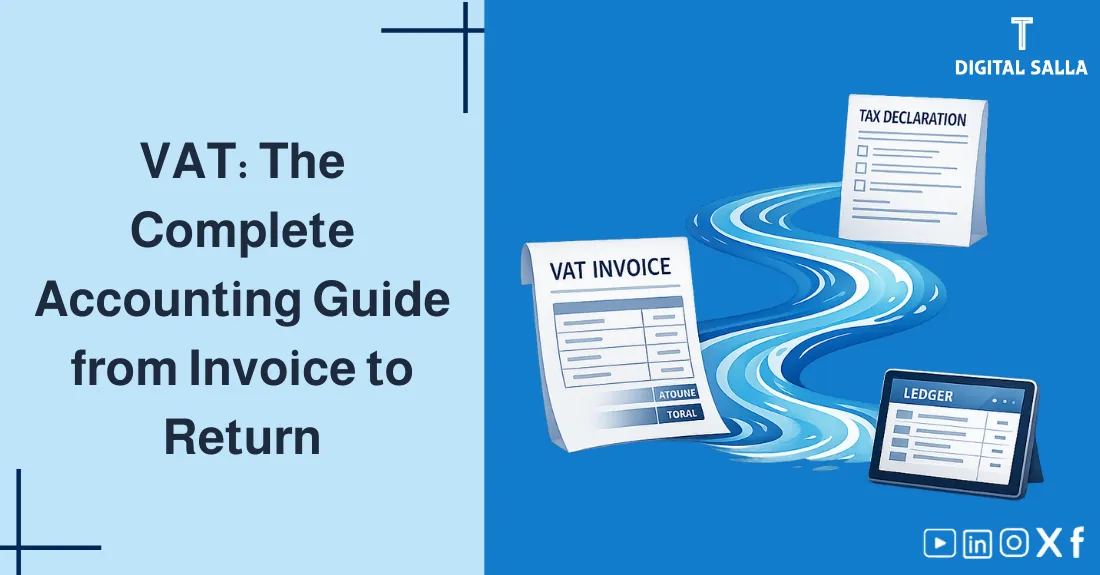
Value Added Tax (VAT): The Comprehensive Accounting Guide (From Invoice to Return)
Value Added Tax (VAT) is not just a percentage added to an invoice; it is a complete accounting cycle that starts from the moment of purchase or sale and ends with the tax return and reconciliation. Managing it correctly protects the company from heavy penalties and improves cash flow. To understand the foundations of accounting before the tax stage: Your reference: Accounting Principles.
- What is VAT and how does the tax cycle work in the accounting system?
- The difference between Output Tax (Sales) and Input Tax (Purchases).
- How to record VAT Journal Entries for various scenarios (Sales, Purchases, Returns).
- VAT Reconciliation: How to match the GL with the return to avoid ZATCA audit findings.
- Managing VAT Liabilities and the impact of the “Tax Point” on reporting.
1) The Concept of VAT in Accounting
Value Added Tax (VAT) is an indirect tax imposed on the consumption of goods and services. For a business, it is a “Neutral Tax”; you collect it from customers (Liability) and pay it to suppliers (Asset/Deductible), then settle the difference with the tax authority.
2) Output Tax vs. Input Tax
Understanding this duo is the foundation of tax accounting:
- Output VAT (Sales): Tax you collect on your sales. It is a Current Liability until paid to the authority.
- Input VAT (Purchases): Tax you pay on your business purchases. It is a Current Asset (Deductible) that reduces your liability.
3) VAT Journal Entries (Practical Examples)
Let’s look at how to record these transactions in the General Ledger (assuming a 15% rate):
3.1 Sales Entry (Output Tax)
Selling goods for 10,000 + 1,500 VAT:
Pre-filing Review Checklist: Zakat/VAT/WHT/CIT - Excel File
- Dr. Accounts Receivable / Cash: 11,500
- Cr. Sales Revenue: 10,000
- Cr. VAT Output Account: 1,500
3.2 Purchase Entry (Input Tax)
Buying materials for 5,000 + 750 VAT:
- Dr. Inventory / Expense: 5,000
- Dr. VAT Input Account: 750
- Cr. Accounts Payable / Cash: 5,750
4) VAT Reconciliation: Matching GL & Returns
This is the most critical audit step. Tax Reconciliation ensures that the numbers in your return match your trial balance.
| Check Point | Equation / Source | Objective |
|---|---|---|
| Sales Match | GL Revenue ↔ VAT Return (Box 1) | Ensure all taxable sales are reported |
| Output VAT Match | VAT Output Account ↔ Return Calculation | Verify correct rate application (15%, 0%, Exempt) |
| Input VAT Match | VAT Input Account ↔ Purchase Register | Ensure only “Deductible” tax is claimed |
| Liability Match | Total Net in Return ↔ GL VAT Liability | Verify the final amount to be paid/refunded |
6) The Tax Point (Date of Supply)
The Tax Point determines “When” VAT should be recorded and reported. In most jurisdictions (like Saudi Arabia), it is the earliest of:
- The date of the supply of goods or services.
- The date of the tax invoice issuance.
- The date of receipt of payment (partial or full).
7) E-Invoicing & Compliance (ZATCA)
In Saudi Arabia, VAT accounting is now inseparable from Fatoora (E-Invoicing). Compliance requires:
- Issuing invoices in XML or PDF/A-3 format with a QR code (Phase 2 – Integration).
- Archive invoices for the statutory period (usually 6-10 years).
- Linking your ERP/Accounting system directly with ZATCA’s platform.
8) Common Mistakes & How to Avoid Them
- Claiming Non-Deductible Input Tax: Like VAT on entertainment, luxury cars, or personal expenses.
- Timing Issues: Reporting sales in the wrong period due to confusion over the “Tax Point.”
- Zero-Rated vs. Exempt: Misclassifying an exempt service as zero-rated, which affects your right to deduct input tax (Pro-rata calculation).
- Ignoring Credit Notes: Failing to reflect sales returns in the tax return, leading to overpaying tax.
9) Frequently Asked Questions
Can I deduct VAT on all my purchases?
No. You can only deduct VAT on purchases related to your taxable business activities. Non-deductible items include entertainment services, restricted motor vehicles, and expenses related to exempt supplies.
What is a Tax Credit Note?
It is a document issued to adjust a previously issued tax invoice (e.g., due to a return or discount). It reduces the Output VAT liability in the period it is issued.
What happens if the Input VAT is higher than the Output VAT?
In this case, you have a “VAT Refundable” position. You can carry forward the credit to future periods or request a refund from the tax authority.
10) Conclusion & Next Step
Mastering VAT Accounting is about building a “Clean Audit Trail.” When your journal entries, tax invoices, and reconciliation reports are aligned, tax returns become a simple reporting task rather than a monthly crisis.