
What is ESG? And Why Should the Modern CFO Care?
What is ESG? Simply put: standards that transform "sustainability" into measurable and manageable figures. The CFO cares because it affects funding, investor trust, risk management, and investment decisions. In this concise guide, you will understand the concept of ESG, its relationship to sustainability reporting, and why it is central to responsible investment and green finance.
Start with the big picture: Back to General Framework: ESG Standards
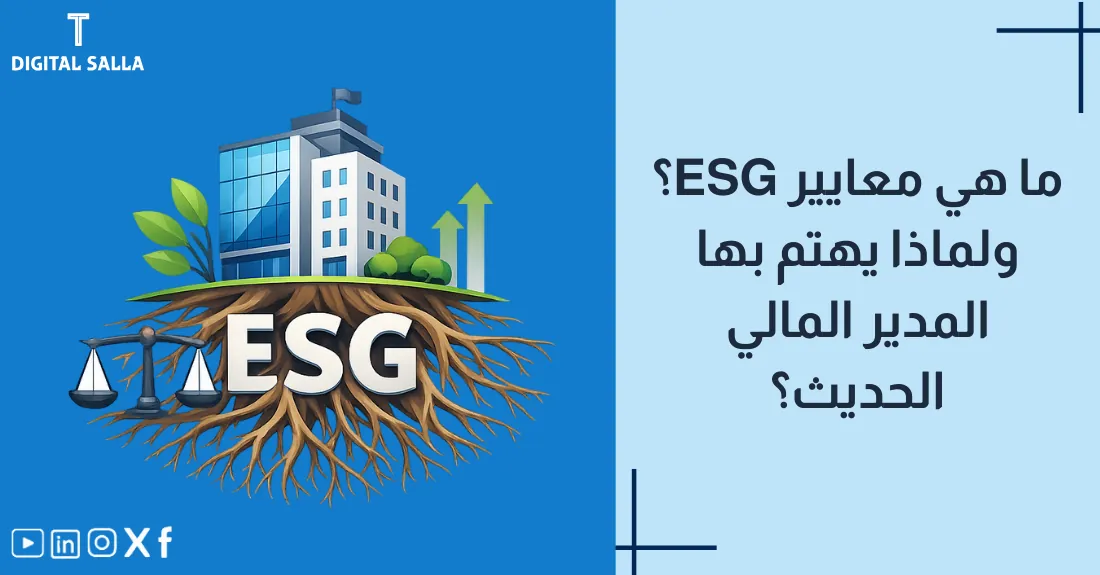
ESG = (Environment + Society + Governance) — when managed as indicators, they become part of financing and investment decisions.
What will you gain from this article?
- A clear definition of ESG and how it differs from CSR.
- Why ESG is a "financial topic" and not just administrative or marketing.
- Examples of common indicators and disclosures in sustainability reports.
- Practical steps for accountants to build measurable and auditable data.
- A quick calculator to measure your company's readiness for ESG disclosure.
Table of Contents Updates automatically during scroll
1) What is ESG? Simple Definition 2) Why Does the CFO Care About ESG? 3) E, S, and G Pillars: What Do We Measure? 4) Difference Between ESG and CSR 5) Sustainability Reports: What Do They Include? 6) Responsible Investment and Green Finance 7) Examples of ESG Indicators (Measurable) 8) How Does an Accountant Start Implementing ESG? 9) ESG Readiness Calculator 10) Frequently Asked Questions 11) Conclusion
1) What is ESG? Simple Definition
ESG is an acronym for three pillars used to evaluate an entity's performance beyond traditional financial numbers: Environmental, Social, and Governance. Practically, this means transforming issues like energy, emissions, employee safety, and governance integrity into indicators that are measured, tracked, and disclosed—just like financial KPIs.
Quick Tip for the CFO: The value of ESG appears when it moves from "narrative" to a "data system" with definitions, sources, measurement frequency, and approval controls.
The simplified system: “Materiality → Indicators → Data → Controls → Report” then continuous improvement.
2) Why Does the CFO Care About ESG?
ESG is no longer peripheral. Any change in disclosure requirements, investor standards, or financing terms will eventually appear in the CFO's files: cost of capital, risk assessment, and investment plans.
Top 4 Direct Financial Reasons
- Cost of Capital: Organizations with stronger disclosure and better risk management may enjoy better financing terms.
- Risk Management: Climate, supply chain, and compliance risks can turn into actual costs.
- Operational Efficiency: Energy, waste, and safety are not just "values"—they are cost items.
- Investor Confidence: ESG is a core element in evaluating responsible investment.
Operational Rule: If an indicator can change a financing/investment decision or create a fine/operating cost, it is a "CFO topic".
3) E, S, and G Pillars: What Do We Measure?
Quick summary of measurable ESG examples
| Pillar | Topic Examples | What does "Measurable" mean? |
|---|---|---|
| E — Environmental | Energy, Emissions, Water, Waste | kWh, tonnes CO2e, m3, waste ratio... with clear source. |
| S — Social | Safety, Training, Labor Rights, Supply Chain | Injury rate, training hours/employee, supplier compliance rates... |
| G — Governance | Policies, Compliance, Anti-corruption, Risk Mgt | Policy logs, compliance tests, ERM updates, audit findings... |
Important: The goal is not to measure everything. Start with what is "material" and financially impactful for your company and sector.
4) Difference Between ESG and CSR
The terms are often confused, but the practical difference is that ESG is closer to a "measurement, management, and disclosure framework," while CSR is often voluntary "initiatives" or social responsibility "programs".
ESG vs CSR from an administrative and financial perspective
| Comparison Point | ESG | CSR |
|---|---|---|
| Goal | Risk/opportunity management + comparable disclosure | Social/environmental impact initiatives (often voluntary). |
| Measurement | Specific indicators + data sources + controls | Diverse measurement, often narrative. |
| Financing Link | High (responsible investment/green finance) | Medium (reputation, impact, and relations). |
5) Sustainability Reports: What Do They Include?
Sustainability reports are the disclosure channel that gathers ESG data in an organized way. They typically include:
Audit-Ready Guide - Word/PDF File
- Policies and Governance: Who is responsible? What are the roles of the Board/Committees?
- Indicators and Results: Trends in energy/emissions/safety/suppliers...
- Risks and Opportunities: Concise analysis of what might raise costs or create growth opportunities.
- Measurement Methodology: Definitions, scope, sources, and any assumptions.
Linking financial to non-financial: Complementary Point: Integrated Reporting
Integrated Reporting helps the CFO provide a single picture: how value is created financially and non-financially.
6) Responsible Investment and Green Finance
Investors increasingly rely on ESG to evaluate long-term risks. With the expansion of responsible investment and green finance, good disclosure and verifiable data become vital for trust and favorable terms.
How does this translate financially? Good ESG data helps: reduce uncertainty, improve risk management, and clarify the "company story" for financiers.
Financial tools to help practically with governance and financing:
- Bank Facility Usage Tracker Template
- Use the Loan and Bank Facility Management Model
- IFRS 16 Lease Management Model Ready-to-use
These models improve financial discipline and operational transparency—elements that strengthen the Governance (G) side of ESG.
7) Examples of ESG Indicators (Measurable)
The following is a "strong start" set suitable as an initial framework, then customized by sector:
Common indicator examples: simple and applicable
| Axis | Indicator | Measurement Tool/Source | How does the CFO benefit? |
|---|---|---|---|
| E | Energy consumption/unit | Meters + Invoices + Operation | Improve efficiency and lower costs. |
| Emissions (CO2e) Intensity | Fuel/Electricity + Conversion factors | Risk management and regulatory expectations. | |
| Waste/Loss Rate | Inventory/Production/Quality | Reduce shrinkage and improve margins. | |
| S | Workplace Injury Rate | HSE/HR Records | Reduce downtime and compensation. |
| Training Hours/Employee | LMS/HR | Boost productivity and lower turnover. | |
| Supplier Compliance | Supplier Audit/Procurement | Reduce supply chain risks. | |
| G | Policy Completion & Adherence | Policy logs + tests | Lower compliance risks and fines. |
| Risk Register Update (ERM) | Risk Committee/Reports | More balanced investment decisions. | |
| Audit Findings/Correction | Internal Audit + Follow-up | Boost trust and auditability. |
For more standard details: You may also like: International Sustainability Standards
8) How Does an Accountant Start Implementing ESG?
- Identify Materiality: 5–10 topics impacting the sector and financial performance.
- Create a Data Dictionary: Indicator definition + unit + scope + source + owner.
- Establish Approval Cycle: Monthly/quarterly closing for ESG data similar to accounts.
- Set Matching Controls: Energy (Meter/Invoice), Fuel (Procurement/Ops), Safety (Logs/Incidents).
- Build a Dashboard: Trends + goals + variance explanations.
- Prepare for Disclosure: Measurement methodology + assumptions + any data limits.
Implementation Tip: Do not start with dozens of indicators. Start with 6–9 "verifiable" indicators and expand as data matures.
9) ESG Readiness Calculator
Evaluate your company's readiness for ESG disclosure across 5 axes. Choose a score from 0 to 5 for each (0 = Not present, 5 = Implemented, documented, and reviewed).
Materiality & Strategy 0 — Not present 1 — General ideas 2 — Partially defined 3 — Defined and acceptable 4 — Linked to business plan 5 — Managed and updated
Governance & Policies 0 — Not present 1 — Scattered policies 2 — Unclear responsibilities 3 — Policies and responsibilities 4 — Committees & periodic follow-up 5 — Mature governance + review
Data & Indicator Dictionary 0 — Not present 1 — Scattered data 2 — Inconsistent definitions 3 — Basic data dictionary 4 — Clear sources + unification 5 — Mature data system
Controls & Documentation 0 — Not present 1 — Weak documentation 2 — Irregular controls 3 — Quarterly controls 4 — Quality assurance tests 5 — Ready for assurance/review
Reports & Dashboards 0 — Not present 1 — Internal presentation 2 — Inconsistent reporting 3 — Periodic dashboard 4 — Organized disclosure 5 — Mature report + improvement
Sector Sensitivity (Optional) 1.0 — Normal 1.1 — Medium 1.2 — High (Industrial/Energy/Transport)
— Score (0–100)
— Level
— Best Next Step
Quick Interpretation: The goal is not a "perfect number" but knowing where to focus: data definitions? controls? dashboards? then implement gradually.
10) Frequently Asked Questions
What is ESG?
A framework to measure performance in Environment, Society, and Governance to manage non-financial risks and link them to financial results.
Is ESG mandatory for all companies?
It varies by country, sector, and regulators. Even without direct mandates, it may be required indirectly via financiers, investors, or supply chains.
Can ESG data be audited?
Yes, with clear definitions, identified data sources, evidence, and matching controls. Many start with limited assurance and expand.
11) Conclusion
Now you know what ESG is and why it is both a financial and administrative tool. The path is clear: Identify materiality → Set measurable indicators → Build data & controls → Submit sustainability reports with confidence → Improve performance. As responsible investment and green finance grow, ESG becomes the shared language between finance and stakeholders.
Step for Today: Choose just 6 indicators, write a one-page data dictionary, and close their data monthly for 3 months—you will see the difference immediately.
© Digital Salla Articles — General educational content. Disclosure requirements and standards vary by country, sector, and regulators.