


Statement of Changes in Equity: Track the Movement of Reserves, Earnings, and Share Distributions

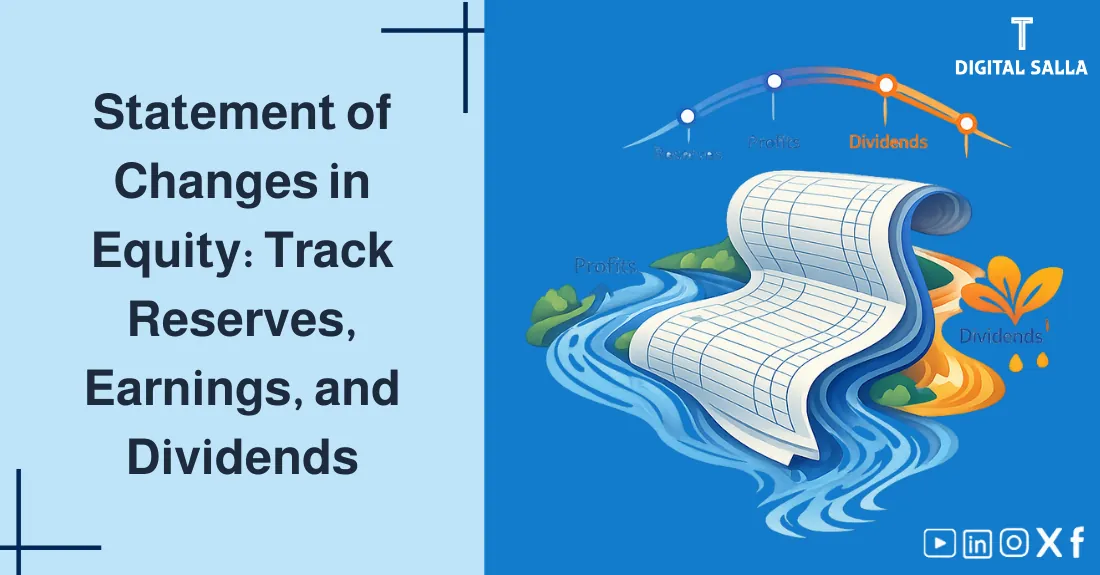
Statement of Changes in Equity: Tracking Owners’ Wealth
Profit in the Income Statement is not enough. Owners want to know: “How much of this profit stayed in the company? And how much was distributed?” The Statement of Changes in Equity is the missing link that connects the Income Statement to the Balance Sheet. It details the movement of Capital, Reserves, and Retained Earnings. In this guide, we explain its components and how to prepare it professionally to reflect the true growth of wealth.
- Definition of the Statement of Changes in Equity and its importance.
- Key components: Share Capital, Reserves, and Retained Earnings.
- The Movement Equation: Beginning Balance + Additions – Deductions = Ending Balance.
- Visual model (SVG) illustrating the flow of funds within equity.
- How to treat Dividends and Capital Increases?
- Interactive Tool: Track the movement of equity from Opening to Closing.
- Relationship with Comprehensive Income (OCI).
1) What is the Statement of Changes in Equity?
It is a financial statement that summarizes the changes in the owners’ equity components during a specific period. It clarifies the sources of equity increase (like Net Profit or Capital Increase) and the sources of decrease (like Dividends or Net Loss).
2) Key Components (The Columns)
| Component | Definition |
|---|---|
| Share Capital | The nominal value of shares issued to owners. |
| Retained Earnings | Accumulated profits that have not been distributed as dividends. |
| Reserves | Amounts set aside by law (Statutory) or by choice (Voluntary) for future use. |
| Treasury Shares | Shares bought back by the company (Deducted from Equity). |
3) The Movement Equation (The Rows)
For every component (column), the logic is vertical:
+ Comprehensive Income (Profit)
+ Capital Injections
– Dividends Paid
= Closing Balance
4) Visual Logic: The Equity Flow
5) Focus: Retained Earnings Movement
This is the most active column. It represents the “Storage Tank” for profits:

Financial Statements Builder - Excel File
- Inflow: Net Profit for the year transfers here.
- Outflow: Dividends declared are taken from here. Transfers to Statutory Reserve are also deducted from here.
6) Interactive Equity Tracker
Calculate the Closing Balance for Retained Earnings:
7) Other Comprehensive Income (OCI)
Some gains, like “Revaluation Surplus” from Land revaluation, do not go to the Income Statement. Instead, they go directly to Equity (specifically, the Revaluation Reserve) through OCI.
8) Frequently Asked Questions
Can Retained Earnings be negative?
Yes, if the company incurs cumulative losses greater than its past profits. This is called an “Accumulated Deficit.”
Are Dividends an expense?
No. Dividends are a distribution of profit to owners, not an expense. They appear in the Statement of Changes in Equity, not the Income Statement.
9) Conclusion
The summary is simple: The Statement of Changes in Equity tells the story of the owners’ investment. It shows whether the company is growing its wealth through retained profits or shrinking it through excessive dividends or losses. Understanding this statement is crucial for evaluating the sustainability of shareholder value.