


Tax and Zakat Audit: How to Prepare a Strong Defense File and Supporting Documents?

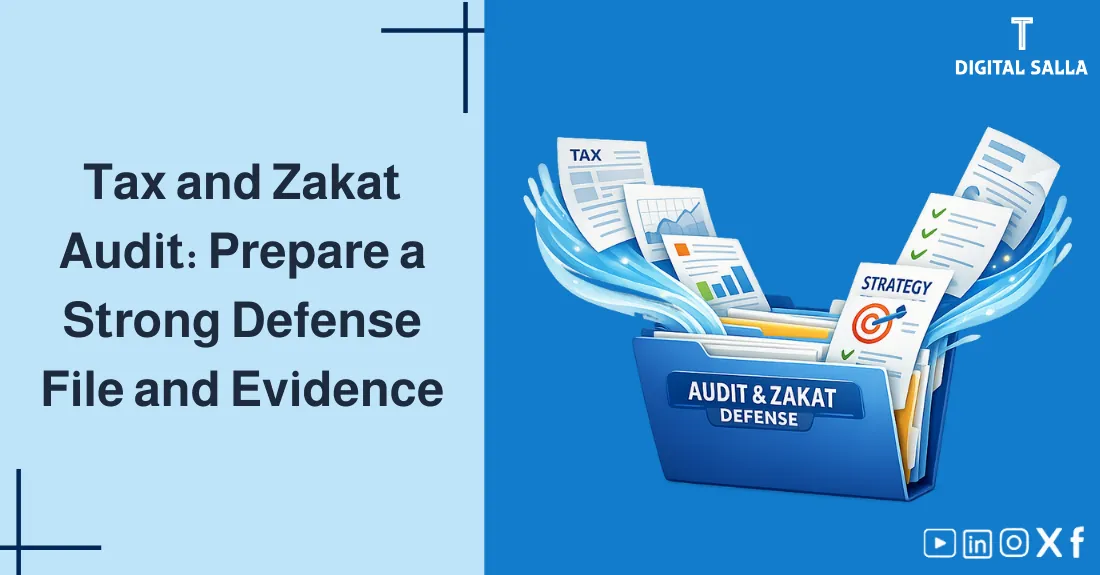
Tax and Zakat Audit: How to Prepare a Strong Defense File and Supporting Documents?
Tax and Zakat Audit: A practical guide on how to manage audit inquiries, prepare the required document file, and support your professional positions before ZATCA to avoid penalties—Digital Salla.
- What is a Tax Audit and what are the most common audit triggers?
- How to build a Defense File that answers ZATCA inquiries before they are even asked.
- A detailed list of Required Documents for Zakat, VAT, and Income Tax audits.
- Methodology for Revenue Reconciliation: The first line of defense.
- Checklists for pre-audit readiness and managing the audit process.
1) What is a Tax Audit?
A Tax Audit is a formal review by the authority (ZATCA) to verify that the entity has correctly determined its tax/zakat base and complied with all reporting and documentation requirements.
2) Building a “Defense File” (The Audit Pack)
Successful audit management means having an organized file ready before the auditor asks for it. Do not wait for the inquiry to start searching for invoices.
2.1 Components of a Strong Audit Pack
- Reconciliation Schedule: Showing how Trial Balance figures match the Return.
- Source Data: Clean Excel exports of all transactions in the period.
- Evidence Folder: Scanned copies of the top 20 invoices/contracts by value.
- Explanatory Memos: Short notes justifying any unusual adjustments or professional judgments.
3) Revenue Reconciliation (First Line of Defense)
The first thing an auditor checks is: “Does the revenue reported in the Zakat/CIT return match the sum of revenue reported in the 12 VAT returns?”
4) VAT Audit Specific Requirements
In a VAT Audit, the focus is on the “Invoice Level” and “Right to Deduct.”
Accounting Documents Visual Guide - PDF Files + Images
VAT Evidence Checklist
- Tax Invoice Fulfillment: Do purchase invoices have all mandatory data?
- Output Tax Matching: Linking sales reports to the GL Output VAT account.
- Deduction Eligibility: Proving that deductible expenses relate to taxable business activities.
- Credit/Debit Notes: Original invoice links for all returns and discounts.
- Exports: Customs/shipping documents for zero-rated supplies.
5) Zakat and Income Tax Audit Specifics
Here, the focus shifts to “Base Adjustments” and “Profit Reconciliation.”
Base & Profit Checklist
- Zakat Base Schedule: Matching additions/deductions with ledger balances.
- Non-Deductible Expenses: Invoices and reasons for every add-back to profit.
- Ownership: Official documents proving nationality/percentages (especially for mixed companies).
- Provisions: Monthly rollforward showing creation vs usage of provisions.
- Intercompany Transactions: Contracts and transfer pricing documentation if applicable.
6) Withholding Tax (WHT) Audit Controls
Withholding Tax is often the most scrutinized area because it relates to payments leaving the country.
| Component | Audit Proof | Risk Point |
|---|---|---|
| Nature of Service | Contract + Scope of Work | Misclassifying Royalties as Services |
| Payment Trigger | Bank Transfer Confirmation | Reporting by Invoice instead of Payment |
| Treaty Application | Tax Residency Certificate (TRC) | Applying reduced rates without a valid TRC |
7) How to Manage Audit Inquiries Professionally
The way you communicate with the auditor can determine the length and outcome of the process.
The Golden Rules of Inquiry Management
- Be Precise: Answer only what is asked. Don’t provide extra information that might trigger new inquiries.
- Deadlines: Respond within the statutory timeframe. If you need more time, request an extension formally.
- Electronic Delivery: Provide documents in the format requested (PDF/Excel) and ensure they are clearly labeled.
- Consistency: Ensure the same person (or team) manages all communications to maintain a consistent technical position.
8) Operational Readiness Checklist (CFO / Tax Manager)
Use this checklist to evaluate your audit readiness today:
- Is there a unified digital archive for all tax invoices (Sales & Purchases)?
- Have you performed a Revenue Reconciliation for the last closed year?
- Do all Zakat/Tax base adjustments have supporting memos and documents?
- Is the relationship between the Trial Balance and the Returns mapped and locked?
- Are all contracts with foreign vendors reviewed for WHT impact?
Download the comprehensive audit file pack that helps you organize reconciliations and documents: VAT & Tax Audit Readiness Pack (Excel/Templates)
9) Common Mistakes that Lead to Assessments
- Inconsistent Data: Discrepancies between E-invoicing, Customs, and VAT returns.
- Missing Documents: Being unable to prove the deduction eligibility of a material expense.
- Weak Reconciliations: Mismatch between the Return Net and the GL Balance at period-end.
- Ignoring WHT on Services: Failing to withhold tax on imported services or royalties.
- Late Responses: Failing to provide documents within ZATCA deadlines, which can lead to “Estimated Assessments.”
10) Frequently Asked Questions
How long does a tax audit usually take?
Duration varies based on the size of the entity and the complexity of transactions. It can range from a few weeks (for limited scope desk audits) to several months (for comprehensive field audits).
Can I appeal an audit assessment?
Yes. Tax systems (like ZATCA) have formal appeal and settlement procedures. However, you must usually file the appeal within a specific timeframe (e.g., 60 days) and provide new supporting evidence.
Does having audited financial statements protect me from a tax audit?
No. Audited financials provide a strong starting point, but the tax authority performs its own audit to verify tax-specific compliance which may differ from accounting standards.
11) Conclusion
A Tax and Zakat Audit is the ultimate test of your internal control system. By building a Defense File throughout the year, performing regular Revenue Reconciliations, and ensuring every adjustment is documented, you will move from a position of “risk management” to “audit excellence,” minimizing assessments and protecting the entity’s cash flow.
Action Step Now (30 minutes)
- Perform a quick Revenue Reconciliation for the last 6 months (VAT Returns vs. Ledger).
- Select the 3 largest “Provisions” or “Consultancy Expenses” and check if their evidence file is complete.
- Designate an “Audit Lead” within your team to centralize all future ZATCA communications.