


Budgeting and Advanced Financial Analysis (Budgeting & FP&A)

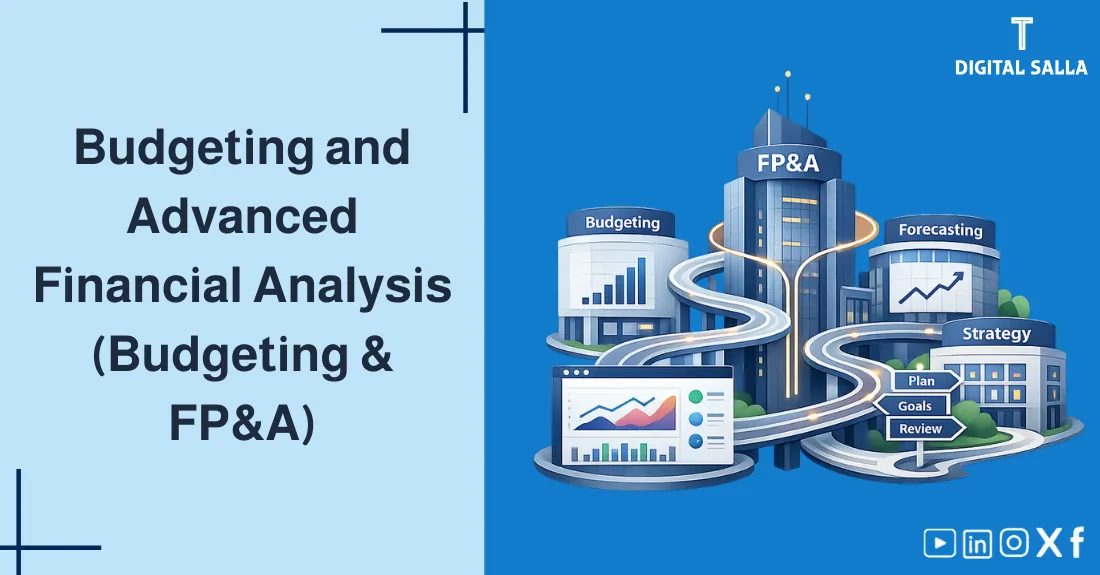
Budgeting and Advanced Financial Analysis (Budgeting & FP&A)
Budgeting: An introduction to Budgeting & FP&A explaining preparation, financial planning, and building master budgets to guide resources, monitor performance, and make proactive decisions—Digital Salla.
- What is Budgeting and why is it a vital tool for management control?
- Structure of the Master Budget: Operational vs. Financial components.
- Preparation steps: From Sales forecasts to the Cash Budget.
- The role of FP&A (Financial Planning & Analysis) in continuous improvement.
- Static vs. Flexible Budgets and why the difference matters in performance evaluation.
1) The Concept of Budgeting & FP&A
Budgeting is the process of translating a company’s strategic goals into a detailed financial and operational plan for a specific period (usually a year). FP&A (Financial Planning & Analysis) is the specialized function that manages this process, analyzes variances, and provides insights for better resource allocation.
2) Anatomy of the Master Budget
The Master Budget is a network of interrelated budgets that culminate in budgeted financial statements. It is divided into two main parts:
3) Components of the Operating Budget
It always starts with the Sales Budget because sales volume drives almost every other expense.
- Sales Budget: Estimated Units × Expected Price.
- Production Budget: Units needed to meet sales + desired ending inventory.
- Direct Resources: Materials, Labor, and Overhead required for that production level.
4) Components of the Financial Budget
The most critical part here is the Cash Budget.
Financial Statements Builder - Excel File
- Cash Receipts: Based on sales and collection cycles.
- Cash Disbursements: Based on payment terms for materials, labor, and taxes.
- Net Financing: Identifying periods where the company will need short-term loans.
5) Steps to Prepare a Professional Budget
Adopt this “Annual Planning Cycle”:
- Set Strategy: Define high-level goals (e.g., 15% revenue growth).
- Forecast Sales: Collaborate with sales and marketing on realistic volumes.
- Determine Capacity: Check if current production can meet the forecast.
- Build Department Budgets: Collect expense estimates from all managers.
- Consolidate: Combine into the Master Budget and check for feasibility.
- Approve & Distribute: Formal sign-off and setting benchmarks for the year.
6) The Core Role of the FP&A Department
The Financial Planning & Analysis team doesn’t just “Add numbers.” They provide:
- Variance Analysis: Explaining Why actual results differ from the plan.
- Scenario Analysis: “What happens if raw material prices increase by 10%?”.
- Financial Modeling: Building tools to predict long-term cash flow and ROI.
- Decision Support: Helping management choose between leasing or buying assets.
7) Static vs. Flexible Budgets
A major error in performance evaluation is using a Static Budget (fixed at one level of activity) to judge managers.
| Aspect | Static Budget | Flexible Budget |
|---|---|---|
| Activity Level | Fixed (e.g., 10,000 units) | Adjusts to Actual level achieved |
| Evaluation | Misleading if volume changes | Fair “Apples-to-Apples” comparison |
| Use Case | Planning stage | Reporting & Evaluation stage |
8) Operational Controls & Readiness Checklist
To ensure your Budgeting & FP&A process is robust:
Planning Quality Gate Checklist
- Are sales assumptions backed by market data or historical trends?
- Is the Master Budget integrated (Change in sales affects materials automatically)?
- Is there a Capital Expenditure (CapEx) approval process?
- Do we perform “Rolling Forecasts” quarterly to update the annual plan?
- Are variances reviewed monthly with department heads?
9) Common Errors and How to Prevent Them
- Budget Padding (Slack): Managers overestimating expenses to make their performance look better. Solution: Benchmarking and detailed justification.
- Ignoring Cash Timing: Budgeting for sales but forgetting that customers pay in 60 days.
- Top-Down Only: Setting targets without input from floor managers (leads to demotivation).
- Rigidity: Refusing to update a budget when a major market shift occurs (e.g., pandemic).
10) Frequently Asked Questions
What is the difference between a Budget and a Forecast?
A Budget is a “Plan” set at the start of the year. A Forecast is an “Update” based on actual performance and current market conditions.
Is FP&A only for large companies?
No. Small businesses need planning even more because their margin for error is smaller. Even a simple Excel cash forecast is a form of FP&A.
What is Zero-Based Budgeting (ZBB)?
It is a method where every expense must be justified from “Zero” for each new period, rather than just adjusting last year’s numbers.
11) Conclusion
Mastering Budgeting & FP&A transforms financial data into a “Strategic Compass.” By building a disciplined Master Budget and utilizing Flexible Budgeting for evaluation, you gain the power to steer the company proactively, identify risks before they become crises, and ensure that every resource is allocated where it generates the highest value.
Action Step Now (30 minutes)
- Compare your actual revenue for the last month with what you planned.
- Identify the 3 largest “Unfavorable Variances” in your expenses.
- Ask the responsible manager for the Root Cause (Is it volume, price, or inefficiency?).