




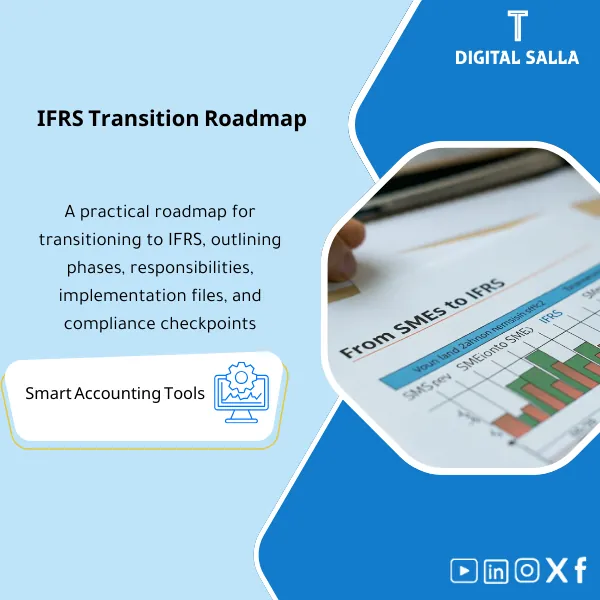
IFRS Transition Roadmap – Practical Workbook
156.65 $
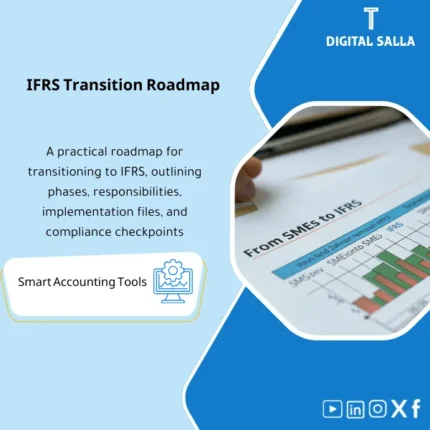
Full IFRS Transition Template (Excel): An advanced workbook guiding the transition from IFRS for SMEs to Full IFRS, including reclassification schedules aligned with IFRS 1. Delivers structured adjustments and conversion documentation.
Transition to International Standards
Practical Conversion Pack: IFRS Adjustments + Opening Balances + Reconciliations + Disclosure List — with a traceable audit file
Value Proposition: Transition to International Standards is not achieved with just a “Policy” document; it succeeds when you have a Conversion File that covers the entire journey: identifying differences, choosing policies, extracting source data, recording conversion entries, and then issuing reviewable outputs such as Reconciliation of Equity/Profit and a Disclosure File. This template builds a practical Pack deliverable to the auditor, linking every decision to Evidence and its impact on the statements.
In 20 seconds: What will you get?
- Operational Differences List (GAAP → IFRS) instead of general discussions without numerical impact.
- Policy Decision Log: Policy decisions + Reference + Reason for choice + Effective date.
- IFRS Adjustments + JE Log: Documented conversion entries with attachments and references (Traceability).
- Opening IFRS Balances: Schedule of opening balances under IFRS linked to the TB and supports.
- Reconciliations: Reconciliation of Equity/Profit from the previous basis to IFRS (Reconciliation of Equity/Profit).
- Disclosure Pack: List of required disclosures/notes + Source of data + Responsible for updates.
- Audit-ready Index: Evidence index linking each Adjustment to the document/contract/supporting schedule.
The download is linked to the outputs: you will receive IFRS JE Log + Opening Balances + Reconciliations + Disclosure List as a package of Working Papers ready for audit.
Suitable for
- Financial Controller / Chief Accountant: You need a conversion file that links IFRS decisions to numerical impact and evidence.
- Closing and Reporting Team: You want to turn the “IFRS project” into actionable monthly/annual steps.
- Audit/Consulting: You need an organized deliverable that accelerates accounting audit under international standards through Traceability.
Not Suitable for
- Those looking for non-accounting topics such as Return of Saudi International Flights or International Tests — this is an IFRS conversion template only.
- Those wanting ready-made results without supporting data/contracts/schedules — transitioning to international standards relies on detailed inputs and evidence.
Without the template / With the template (Short Comparison)
| Item | Without Conversion Pack | With Transition Template |
|---|---|---|
| IFRS Decisions | Scattered memos without linking to impact | Policy Decision Log + Effective date + Numerical impact |
| Conversion Entries | Entries not documented or without attachments | IFRS JE Log + Reference IDs + Evidence index |
| Opening Balances | Opening balances not traceable | Opening IFRS balances linked to TB and reconciliations |
| Disclosures | Compiled at the last minute | Disclosure list + Data source + Owner + Update date |
Before Use: 5 Symptoms That the IFRS Project “Will Struggle During Audit”
- Many differences discussed but no Gap tracker linking “decision ↔ entry ↔ impact on statements”.
- Conversion entries recorded without a unified JE Log or attachments, causing reasons for entries to be lost after two months.
- Opening balances under IFRS undocumented: no one can trace from IFRS number back to previous TB number.
- No official Reconciliations (Equity/Profit) showing the transition from the previous basis to IFRS.
- Disclosures prepared at year-end without a data/responsibilities list, leading to “additional requests” from the auditor.
How is the transition to international standards practically done?
Step 1: Preparation and Gathering Reports and Defining the Basis for Transition
- Establishing the starting point: TB under the current basis + Supporting details (Schedules/Contracts/Prepaid Expenses/Assets/Liabilities).
- Defining the scope of transition: Is it full IFRS or internal reporting requirements? And determining the transition date and Opening balances.
- Reference framework for decisions: Linking policies to the Conceptual Framework for International Financial Reporting Standards where necessary (to justify presentation/measurement at choices).
Step 2: Differences + Policy Decisions + IFRS Adjustments
- Recording differences in the Gap tracker: Defining the difference + Affected accounts + Required data + Responsible for execution.
- Approving Policy decisions: Decision + Reason + Reference + Effective date + Impact on measurement/presentation.
- Recording conversion entries: IFRS JE Log with document references (Contracts/Calculations) and evidence of review.
Step 3: Adjusted TB (IFRS) + Reconciliations + Disclosure Pack
- Issuing Adjusted TB (IFRS) linked to the JE Log and Opening balances.
- Issuing Reconciliations: Reconciliation of Equity/Profit from the previous basis to IFRS (for explanation and audit).
- Completing the Disclosure Pack: List of disclosures + Data source + Owner + Evidence, then preparing a “delivery file for the auditor” to support the audit.
Template Components (Clear Inventory)
-
IFRS Gap Assessment Tracker
- Practical Purpose: Transforming differences into actionable items: difference, affected account, required data, execution status.
- When to Use: From the first week of the project until the end of the annual closing.
- Resulting Evidence: Gap register with status (Open/In progress/Closed) and evidence links.
-
Policy Decision Log
- Practical Purpose: Documenting measurement/presentation decisions and linking them to reference, date, and impact.
- When to Use: Before recording conversion entries, and whenever asked “why did you choose this treatment?”.
- Resulting Evidence: Brief Policy memo + Sign-off + Current version.
-
IFRS Adjustments Journal + JE Log
- Practical Purpose: Record of conversion entries with account attachments (Workpapers) and reference to affected accounts.
- When to Use: During the execution of the transition and when reviewing/approving entries.
- Resulting Evidence: JE Log (Reference ID) + Supporting schedules + Approvals.
-
Opening IFRS Balance Sheet Builder
- Practical Purpose: Building opening balances under IFRS and linking them to the TB and reconciliations.
- When to Use: At first application and the beginning of the comparison/transition year.
- Resulting Evidence: Opening balances schedule + Tie-out to TB + Tie-out to JE Log.
-
Reconciliation Statements (Equity / Profit)
- Practical Purpose: Showing the impact of the transition in a reviewable manner for the auditor and management.
- When to Use: When preparing the statements and with the delivery file for the audit.
- Resulting Evidence: Reconciliation tables + Brief explanation for each category of differences.
-
Disclosure Pack (Data Owners + Sources)
- Practical Purpose: Managing disclosures as data items: Where do they come from? Who owns them? When are they updated?
- When to Use: During Year-End and when preparing disclosures.
- Resulting Evidence: Disclosure checklist + Data source map + Evidence links.
-
Audit Evidence Index
- Practical Purpose: Supporting accounting audit under international standards by linking each Adjustment to its document.
- When to Use: When delivering the auditor’s file, or when any inquiry arises on an entry/disclosure.
- Resulting Evidence: Evidence index (Reference ID ↔ File link ↔ Owner ↔ Date).
-
Versioning + Sign-off Pack
- Practical Purpose: Establishing the “approved version” of the transition and preventing overlap of Workpapers.
- When to Use: At the end of each phase (Gap/Adjustments/Disclosures) and with any update.
- Resulting Evidence: Version register + Change log + Prepared/Reviewed/Approved.
What should be included in the delivery?
- 01-Pack Index: Scope of transition + Transition date + Owners + Version.
- 02-Gap Tracker: Register of differences (GAAP→IFRS) + Status of each item + Evidence links.
- 03-Policy Decisions: Policy memos/decisions + Sign-off + Effective date.
- 04-IFRS JE Log: Record of entries + Reference IDs + Approvals + Links to Workpapers.
- 05-Workpapers: Schedules for each Adjustment (Before/After + Assumptions + Data sources).
- 06-Opening Balances: Opening IFRS balances + Tie-out to TB + Tie-out to JE Log.
- 07-Adjusted TB (IFRS): TB under IFRS + Mapping of statement items if necessary.
- 08-Reconciliations: Equity/Profit reconciliations + Brief explanation of key differences.
- 09-Disclosures: List of disclosures + Data owners + Data sources + Completion status.
- 10-Evidence Index: Evidence index (Contracts/Letters/Accounts/System outputs) linked to each item.
- 11-Change Log: Log of changes in decisions/entries/disclosures with reason and impact.
- 12-Sign-off: Prepared/Reviewed/Approved for the final Pack before audit delivery/publication.
Common Use Cases Within Companies
- Company Growing Internationally: When there is a need for reports under International Accounting Standards instead of a scattered local basis.
- Service/Human Resources Companies: If you operate in environments similar to International Human Resources Company (as a field) and need to standardize revenue/cost presentation and disclosures.
- Companies within a Group/International Brand Identity: Environments similar to Arab International Company (as an example of a traded name) where the presence of multiple data owners requires Owners + Evidence.
After Implementation (Two Points Only)
- Operational Outcome for the Team: The transition becomes a clear path: Gap → Policy → JE → Adjusted TB → Disclosures, with records living with the closing instead of a “one-time” project.
- Control/Audit Outcome: Every number in IFRS linked to a Reference ID, evidence, and approvals, making it easier to test entries and disclosures instead of relying on verbal interpretations.
FAQ — Questions Before Purchase
Is the template suitable for any ERP system?
Yes. Because it is Working Papers: it relies on TB and supporting reports and a JE Log, not on a specific Vendor.
Does it cover the Conceptual Framework for International Financial Reporting Standards?
It uses it as a reference to document the rationale for policy decisions within the Policy Decision Log (when justification for measurement/presentation is needed), but it does not provide an academic explanation of the framework.
Does the product prepare an audit file for the transition?
Yes, from the perspective of evidence: Evidence index + Reconciliations + JE log + Sign-off—this serves accounting audit under international standards as a deliverable.
Is it suitable for a one-time transition or can it be used annually?
It starts as a First-time conversion project, then transitions to an annual/periodic file as policy decisions and disclosures need updating and versioning review.
What is the minimum data required to start?
TB under the current basis + Supporting details for major items (Contracts/Schedules/AP/AR/FA/Leases details if available) + Current policies.
Is this template a complete “International Accounting Standards” or training content?
No. It is an operational and documentation template for transition, not a standards book or training material for international accounting standards.
Does it relate to the return of Saudi international flights or international tests?
No. These are general search terms that may appear with the word “international.” The product pertains only to the transition to international financial reporting standards.
Can it be used for multiple entities within a group?
Yes, by adding an Entity column in the Gap/JE/Disclosures and specifying Owners for each entity, with separate or unified versioning depending on the group’s approach.
Ready to receive the IFRS Conversion Pack instead of scattered files?
Outputs: IFRS JE Log + Opening Balances + Reconciliations + Disclosure Pack + Evidence Index with Version/Sign-off.
| المسمّى الوظيفي | |
|---|---|
| Duration | |
| المستوى | |
| التحديثات | |
| القطاع | |
| الصيغة |



Reviews
Clear filtersThere are no reviews yet.