




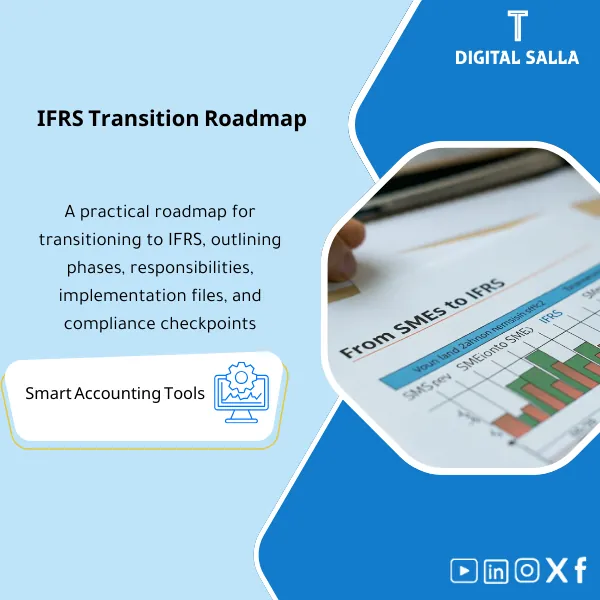
IFRS Transition Roadmap – Practical Workbook
587
Full IFRS Transition Template (Excel): An advanced workbook guiding the transition from IFRS for SMEs to Full IFRS, including reclassification schedules aligned with IFRS 1. Delivers structured adjustments and conversion documentation.
Struggling to Convert Your Financial Statements to Full IFRS Without a Clear Roadmap?
Stop guessing your way through IFRS adoption. This complete IFRS Transition Workbook gives you everything in one pack: Gap Analysis, Policy Decisions, Adjustment Journals, Opening Balances, Reconciliations, and a full Disclosure Kit. A step-by-step practical toolkit designed so you can execute a compliant first-time IFRS conversion with confidence.
🛡️ 7-Day Guarantee
📊 Editable Excel Files
5 Signs You Need This IFRS Transition Workbook
1No Clear Starting Point: You don’t know which local GAAP or IFRS for SMEs policies conflict with Full IFRS, and the differences are piling up with no structured way to track them.
2Adjustment Entries Are a Mess: You’re making IFRS conversion adjustments in scattered spreadsheets with no traceability back to the original accounts.
3Opening Balances Feel Like Guesswork: Building your first IFRS opening statement of financial position is overwhelming without a reliable framework to restate each balance.
4Equity and Profit Reconciliation Gaps: You can’t produce a clean reconciliation between local GAAP equity/profit and IFRS figures — a core IFRS 1 requirement.
5Disclosure Anxiety: You’re unsure which first-time adoption disclosures are mandatory, and assembling them from scratch feels like reinventing the wheel.
What You Get
A complete, ready-to-use toolkit — every component is pre-structured so you can start working immediately:
| Gap Analysis Matrix | Systematically compare your current accounting policies against Full IFRS standards and identify every gap that needs resolution. |
| Policy Decision Log | Document every policy choice in one place: available options, selected treatment, IFRS reference, and management rationale. |
| IFRS Adjustment Journal Log | A structured journal entry log for all conversion adjustments with full traceability to source accounts and IFRS standards. |
| Opening IFRS Balances Builder | Build your IFRS opening statement of financial position by restating each trial balance line with linked adjustments. |
| Equity and Profit Reconciliation | Pre-formatted reconciliation of equity and profit between local GAAP and IFRS, fully aligned with IFRS 1 requirements. |
| Disclosure Pack | Complete first-time adoption disclosure templates: accounting policy notes, transition explanations, and exemption elections. |
How to Use It: Your 4-Step Transition Process
Run the Gap Analysis
Compare your current accounting policies line by line against Full IFRS requirements using the Gap Analysis Matrix. This gives you a clear map of every difference that needs to be addressed.
Set Policies and Record Adjustments
For each gap identified, select your IFRS policy in the Policy Decision Log, then record the corresponding conversion journal entries in the IFRS Adjustment Log with full references.
Build Opening Balances and Reconciliations
Use the Opening Balances Builder to construct your IFRS opening statement of financial position, then complete the equity and profit reconciliation as required by IFRS 1.
Prepare Disclosures and Finalize
Complete the Disclosure Pack with all mandatory first-time adoption notes, compile your transition file, and deliver an audit-ready IFRS conversion package.
Before vs After This Workbook
| Aspect | ❌ Without | ✅ With This Workbook |
|---|---|---|
| Gap Identification | Random guesswork with no structured comparison | Systematic Gap Analysis covering every standard |
| Conversion Adjustments | Scattered entries with no audit trail | Structured JE Log with full traceability |
| Opening Balances | Manual restatement prone to errors and omissions | Linked Opening Balances built from your trial balance |
| IFRS 1 Compliance | Reconciliations and disclosures cobbled together | Complete Reconciliations + Disclosure Pack ready for audit |
You are an accountant, financial controller, or CFO at a company transitioning from local GAAP or IFRS for SMEs to Full IFRS. You need a practical, structured toolkit to execute the conversion methodically and meet IFRS 1 first-time adoption requirements.
Your company already reports under Full IFRS and you are not going through a first-time adoption. This workbook is specifically designed for the transition process, not for ongoing IFRS reporting or annual financial statement preparation.
Does this workbook apply to any company converting to Full IFRS?
Yes. The workbook is designed for any entity transitioning from local GAAP or IFRS for SMEs to Full IFRS. The templates are flexible enough to accommodate different industries and company sizes.
Do I need prior IFRS experience to use it?
A working knowledge of accounting standards is recommended. The workbook guides you through the process step by step, but familiarity with basic IFRS concepts will help you get the most out of it.
What format are the files delivered in?
All files are delivered in fully editable Excel format. You can customize every template to match your company’s specific accounts and reporting needs.
Does it cover IFRS 1 first-time adoption requirements?
Absolutely. The workbook is built around IFRS 1 requirements, including mandatory reconciliations, exemption elections, and all required first-time adoption disclosures.
Ready to Execute Your IFRS Transition the Right Way?
Get the complete toolkit to convert your financial statements to IFRS — structured, traceable, and audit-ready from day one.
| الفئات | IFRS & Financial Consolidation |
|---|---|
| Job Title | Chief Accountant |
| Level | Advanced |
| Format | Excel/Word |
Related products





Consolidated FS Template – Excel File
Consolidated Financial Statements Template is an advanced Excel tool to prepare consolidated financial statements efficiently for a group of subsidiaries in accordance with international accounting standards, with effective consolidation of subsidiary financial data to improve consistency and transparency.
Reviews
Clear filtersThere are no reviews yet.