



Vendor Scorecard – Excel Template
42.29 $
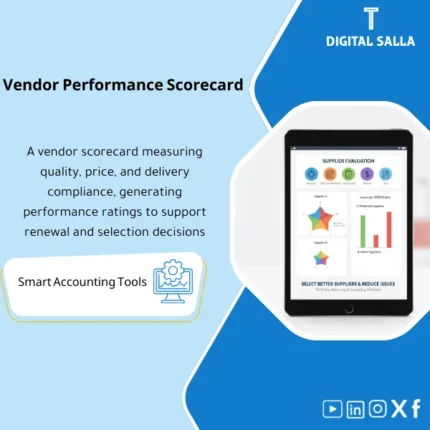
Vendor Scorecard: Measures on-time delivery, quality, invoice accuracy, price volatility, and exception rates. Delivers vendor rankings and performance reports to support contracting and renewal decisions for procurement and finance.
Supplier Evaluation
A practical Vendor Scorecard for measuring supplier performance (Quality/Delivery Commitment/Invoice Accuracy) — with A B C supplier classification and a reviewable Evidence file
Value Proposition: The Supplier Evaluation loses its value when it turns into an “impression” or scores without data. The problem manifests in operations and finance: a supplier delays delivery causing stockouts, or repeatedly makes billing errors leading to exceptions piling up in AP, or fluctuates in quality resulting in increased returns/rejections. This Vendor Scorecard builds the evaluation as a reviewable file: specific indicators, clear data sources (PO/GRN/Invoice/Exceptions), and operational/financial impact that can be tracked—then produces an A B C supplier classification with an action plan (Maintain/Improve/Replace) instead of just “points.”
In 20 Seconds: What Will You Get?
- Vendor Scorecard ready: Indicators + Weights + Scores + Interpretation.
- Supplier Performance Evaluation over a period (month/quarter) with Trend comparison.
- Supplier Quality Measurement through Reject rate/returns/QC issues (based on your data) linked to orders/receipts.
- Delivery Commitment through On-time delivery % and Lead time variance from PO to GRN.
- Supplier Invoice Accuracy through 3‑Way match exceptions: price/qty/tax variance and Invoice holds.
- A B C Supplier Classification automatically based on score + spend/criticality (optional) rather than “gut feeling.”
- Action Plan: For each supplier “What will we do” (Maintain/Improve/Exit) + Owner + Follow-up date.
CTA related to outputs: You will receive Scorecard + KPI Weights + A/B/C Segmentation + Action Plan + Evidence Pack.
Suitable For
- Procurement + Finance Controller: Linking supplier performance to financial impact (delays/returns/invoice exceptions).
- AP / P2P: Reducing invoice exceptions by measuring Supplier Invoice Accuracy and linking it to the supplier.
- Operations / Supply Chain: Measuring Delivery Commitment and quality to make decisions on approvals and replacements.
Not Suitable For
- If you do not have extractable supply/receipt/invoice data (PO/GRN/Invoice) — the evaluation will become too manual.
- If your goal is an “SRM platform” with a supplier portal and tickets and correspondence — this is an evaluation and analysis model, not a communication system.
Without Scorecard / With Scorecard (Brief Comparison)
| Item | Without Data-Driven Evaluation | With Vendor Scorecard |
|---|---|---|
| Approval Decision | “Experience/Impression” decision | Decision based on KPIs + Evidence + Trend |
| Invoice Issues | Recurring exceptions without supplier attribution | Measuring invoice accuracy + Action plan to reduce exceptions |
| Delays and Quality | Becomes apparent after the problem occurs | Measuring On-time + Rejects and linking to operational cost |
Before Use: 5 Symptoms That Supplier Evaluation is Unfeasible
- No clear definition: What does “good supplier” mean? Is it price? Commitment? Or invoice accuracy?
- Supply issues are resolved “every time” without recording KPIs or root cause.
- AP holds and 3‑Way match variances recur but are not attributed to the supplier in the report.
- Quality is mentioned as a complaint with no measurement (Reject/Return rate) linked to receiving processes.
- No fixed classification, leaving the supplier list “long” without focus on impactful suppliers.
How Does Supplier Evaluation Work Practically from PO/GRN/Invoice Data to A B C Classification?
The approach begins by defining KPIs and their definitions (what is counted and how), then uploading PO and delivery/receipt (GRN) data along with invoice data and exceptions. Next, indicators such as on-time delivery%, lead time variance, error rate in invoices (price/qty/tax variances), and quality indicators (rejects/returns) if available are calculated. Then weights are applied to produce the final Vendor Scorecard, followed by A B C supplier classification and issuing an action plan for each supplier with an Owner and review date.
Implementation Method (3 Steps)
Step 1: Preparation and Report Collection
- Identify suppliers within scope (Top spend/critical vendors or all suppliers).
- Extract data: PO (order date, promised date, price) + GRN (receipt date, qty accepted/rejected) + Invoice (invoice date, amounts) + AP exception/hold log.
- Define required KPIs and their weights (e.g., On-time 40%, Invoice accuracy 30%, Quality 20%, Responsiveness 10% — adjusted according to your activity).
Step 2: Measurement + Auditing + Exception Log
- Calculate Delivery Commitment:
- On-time delivery% = deliveries on or before promised date ÷ total deliveries.
- Lead time variance = actual lead time − expected lead time.
- Calculate Supplier Invoice Accuracy:
- 3‑Way match exception rate = number of invoices with variance ÷ total invoices.
- Invoice hold days = average days invoice held due to missing documents/variances.
- Calculate Supplier Quality Measurement (if data is available):
- Reject rate = rejected qty ÷ received qty.
- Return/claim count per period.
- Generate Evidence links: each KPI has a data source (PO/GRN/Invoice/Exception log) to ensure the score is traceable.
Step 3: Classification + Action Plan + Reporting Pack
- Produce the final Vendor Scorecard for each supplier + comparison with a previous period.
- Generate A B C Supplier Classification according to thresholds + considering criticality (optionally).
- Prepare Action plan: item/reason/action/Owner/follow-up date (e.g., improve invoice accuracy, adjust delivery terms, discontinue supplier).
- Prepare Reporting pack: KPIs + assumptions + evidence index + sign‑off (Prepared/Reviewed).
Model Components (Clear Inventory)
-
KPI Dictionary & Weights (Indicator Definitions and Weights)
- Practical Purpose: Standardizing the meaning of each indicator and how it is calculated so that results do not change with different personnel.
- When to Use: During initial setup + quarterly review.
- Resulting Document: Reviewable definitions document.
-
PO/Delivery Dataset (Purchase Order and Delivery Data)
- Practical Purpose: Basis for measuring Delivery Commitment and Lead time.
- When to Use: Monthly/Quarterly.
- Resulting Document: Documented dataset for supply sources.
-
GRN & QC Dataset (Receiving and Quality Data)
- Practical Purpose: Measuring supplier quality through accepted/rejected and returns.
- When to Use: As quality/returns data becomes available.
- Resulting Document: Reject/return register linked to the supplier.
-
Invoice Accuracy Module (Supplier Invoice Accuracy)
- Practical Purpose: Measuring invoice errors through 3‑Way match variances and AP holds.
- When to Use: Monthly, especially for high-volume suppliers.
- Resulting Document: Invoice exceptions report + hold days.
-
Vendor Scorecard Output (Vendor Scorecard)
- Practical Purpose: Producing the final score with KPI breakdown and Trend.
- When to Use: Monthly/Quarterly.
- Resulting Document: Deliverable scorecard for management/purchasing.
-
A/B/C Segmentation (A B C Supplier Classification)
- Practical Purpose: Turning results into decisions: Who do we maintain? Who do we improve? Who do we replace?
- When to Use: After each evaluation cycle.
- Resulting Document: Classification list + documented threshold criteria.
-
Action Plan Tracker (Action Plan)
- Practical Purpose: Managing supplier improvements: actions, Owners, dates, and subsequent improvement measurement.
- When to Use: Monthly for tracking B/C suppliers.
- Resulting Document: Tracking register proving improvement implementation.
-
Evidence Index & Sign‑off Pack
- Practical Purpose: Linking each KPI to its data source and producing a reviewable internal pack.
- When to Use: When delivering evaluation results or within supplier governance.
- Resulting Document: Evidence index + Prepared/Reviewed sign-off.
What Should Be Included in the Delivery?
- 01-Vendor-Scorecard-Model.xlsx: The main evaluation file (KPIs + Weights + Scores + Dashboards).
- 02-KPI-Dictionary-Weights.xlsx: Indicator definitions + weights + thresholds for classification.
- 03-PO-Delivery-Import.xlsx: Upload PO and delivery data (promised vs actual).
- 04-GRN-QC-Import.xlsx: Upload GRN/QC data (accepted/rejected/returns) if available.
- 05-Invoice-Exceptions-Import.xlsx: Supplier invoice accuracy (3‑Way match variances/holds).
- 06-Scorecard-Outputs.xlsx: Scorecards for each supplier + Trend + drilldowns.
- 07-ABC-Segmentation.xlsx: A B C supplier classification + spend/criticality (optional).
- 08-Action-Plan-Tracker.xlsx: Improvement plan for B/C suppliers + Owners + due dates.
- 09-Evidence-Index.xlsx: Evidence index (data sources/PO/GRN/Invoice reports) + links.
- 10-Reporting-Pack.xlsx: Summary of deliverables + sign‑off + executive notes.
- 11-Runbook.pdf: Practical operation (Data → KPIs → Score → A/B/C → Action plan) + control points.
- 12-Archiving-Map.docx: Archiving tree (Year/Quarter/Vendors/Scorecards/Evidence) + Naming convention.
- 13-Signoff-Page.docx: Prepared/Reviewed/Approved + period scope.
After Implementation (Two Points Only)
- Operational Outcome for the Team: Instead of repeating the same issues with suppliers, you have a report that clarifies where the problem lies (Delay? Quality? Invoices?) and an action plan with priorities, improving approval and negotiation decisions.
- Control/Audit Outcome: The evaluation transforms into a reviewable file: KPI definitions + data sources + evidence + sign‑off, allowing internal audit to trace why a supplier is classified as B/C or why a supplier continues despite poor performance (with documentation).
FAQ — Questions Before Purchase
Can the Vendor Scorecard be Applied Without an ERP System?
Yes, if you have PO/receipt/invoice data in Excel, but having an ERP makes data extraction easier and measurement more accurate and consistent.
What Are the Key Indicators Measured by the Model?
It focuses on: Delivery Commitment, Supplier Quality Measurement (if reject/returns data is available), and Supplier Invoice Accuracy through exceptions and holds, with the option to add a responsiveness indicator.
Are the Weights Fixed or Can They Be Adjusted?
The weights and thresholds can be adjusted based on the nature of your activity (e.g., raw materials: higher weight on commitment and quality; services: higher weight on invoice accuracy and responsiveness).
Does It Automatically Support A B C Supplier Classification?
Yes, according to documented thresholds (e.g., A ≥ 85, B between 70–84, C < 70 — an example that can be changed) with the option to consider criticality.
Does It Handle Low-Volume Suppliers?
Yes, and a minimum transaction threshold can be set before evaluation (Minimum sample) or classify them under “Monitor” instead of a final classification.
Can It Be Linked to P2P and AP Aging Packages?
Absolutely: The source of Supplier Invoice Accuracy often comes from the 3‑Way match exception log and AP holds, and the source of commitment comes from PO/GRN.
Is There a Delivery File for Internal Review?
Yes: Reporting pack + evidence index + sign‑off, showing the data source and calculation method for each KPI.
Is the Model a Substitute for the Final Supplier Approval Decision?
No. It is a data-supported decision tool. The final decision may consider strategic factors (single supplier/long-term contract) and is documented in the Action plan.
Ready to Evaluate Suppliers with Numbers and Transform Them into Classification and Action Plan?
Outputs: Vendor Scorecard + KPI breakdown + A/B/C Segmentation + Action plan + Evidence pack.
| المسمّى الوظيفي | |
|---|---|
| Duration | |
| المستوى | |
| التحديثات | |
| القطاع | |
| الصيغة |



Reviews
Clear filtersThere are no reviews yet.