
Taxes, Payroll & Sectors VAT in Saudi Arabia • VAT Accounting • Input & Output Tax
Value Added Tax (VAT): The Comprehensive Accounting Guide (From Invoice to Return)
Value Added Tax: The comprehensive guide for VAT Accounting in Saudi Arabia, from invoice to journal entries, understanding input and output tax, and preparing data for correct tax filing without penalties — Digital Salla.
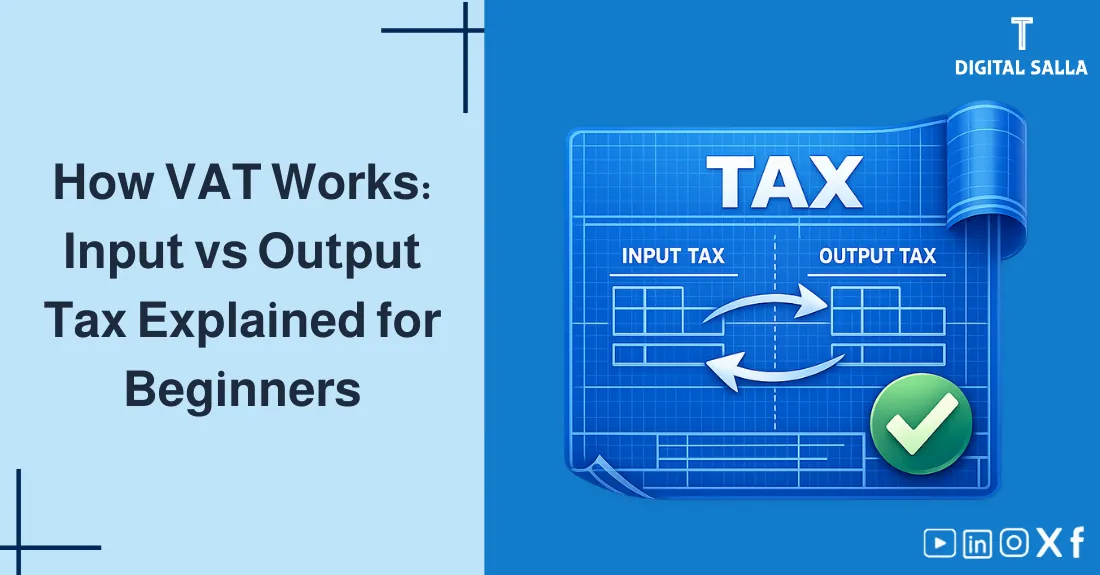
Core Concept: Make VAT a "process" that starts with invoice quality and master data, ending with a strong reconciliation before filing.
What will you learn here?
- How to understand Value Added Tax as an accounting system (not just a percentage on an invoice).
- A clear distinction between Input Tax and Output Tax and how they affect balances.
- Designing VAT accounts in the Chart of Accounts and linking them to entries and reconciliation.
- Common entry scenarios: Sales, purchases, returns, discounts, debit/credit notes.
- From entries to the return: How to prepare data and analyze variances before submission.
Notice: Regulatory details (definitions/exceptions/deadlines) may vary based on your activity and updated regulations. The goal of this article is the Accounting and Practical Path which remains constant regardless of detail changes.
Table of Contents Automatically determined while scrolling
1) What is VAT and why is it managed accounting-wise? 2) Scope of Tax: When does a transaction become "VAT-able"? 3) Taxable/Zero-rated/Exempt: Where does the right to deduct collapse? 4) Tax Invoice: The starting point for any sound VAT Accounting 5) Input and Output Tax: The equation that closes the month 6) Designing VAT accounts in the Chart of Accounts (COA) 7) Common VAT Entries: Sales/Purchases/Returns/Discounts 8) Tools and templates that prove compliance and facilitate reconciliation 9) From Entries to Return: Data preparation and VAT reconciliation 10) Monthly Closing Checklist and error reduction 11) Frequently Asked Questions 12) Conclusion and Next Step
1) What is VAT and why is it managed accounting-wise?
Value Added Tax is an indirect tax added to the supply of goods and services. From an accounting perspective, it's not enough to show the tax on the invoice; you need a "control system" that ensures three things:
- Calculation Accuracy: Rate/Base/Classification (Taxable/Zero-rated/Exempt).
- Eligibility Accuracy: Is Input Tax deductible or not?
- Reconciliation Accuracy: Invoice reports ↔ VAT accounts ↔ Tax Return form.
If you want to dive quickly into the idea (Output/Input) in a simplified way before the details: Deep dive into VAT Explanation
2) Scope of Tax: When does a transaction become "VAT-able"?
In VAT Accounting, the most important question is not "What's the rate?" but "Does the transaction fall within the scope of tax?". Practically, you will need to determine:
- Supply Type: Good/Service/Asset/Rent... etc.
- Place of Supply (Inside/Outside the scope).
- Customer Status (Registered/Unregistered/Special case).
- Evidence Document: Invoice, Credit/Debit Note, Contract, Delivery Note.
To reduce errors starting from data: adopt fixed templates for customer and item master data. You will notice that classification quality improves automatically when "Master Data" is correct.
3) Taxable/Zero-rated/Exempt: Where does the right to deduct collapse?
Supply classification is the number (1) reason for reconciliation and return variances. The fundamental accounting difference is not just in the tax value, but in its impact on the right to deduct input tax.
Practical comparison of classification and its impact on accounts
| Classification | Is tax calculated on outputs? | Is input deduction usually allowed? | Accounting Risk |
|---|---|---|---|
| Taxable (Standard) | Yes | Often yes (if inputs are eligible) | Wrong calculation/Missing invoice → Return variance |
| Zero-rated | At 0% rate | Right may remain according to conditions | Mixing Zero-rated with Exempt → Loss of deduction or compliance risk |
| Exempt | No | Often restricted/excluded | Deducting ineligible inputs → Variances and penalties |
For deep details (with examples of impact on the right to deduct): Detailed Explanation: Difference between Zero-rated and Exempt
4) Tax Invoice: The starting point for any sound VAT Accounting
If an invoice is missing data or is incorrect, you will pay the price later in: (Rejected input deduction) or (Reconciliation variances) or (Post-submission adjustments). Therefore, consider the invoice a "control document" before it is a sales document.
4.1 Simple Operational Rule
- Do not approve any purchase invoice for deduction until VAT data is verified.
- Do not issue a sales invoice except through pricing/tax rules set on the item and customer.
- Make "Credit/Debit Notes" subject to the same controls (as they are the biggest source of monthly variances).
List of detailed invoice requirements (which prevent penalties and deduction rejection): Read Next: Tax Invoice
5) Input and Output Tax: The equation that closes the month
Accounting-wise, you will always deal with three layers:
Standard Chart of Accounts - Excel File
- Output Tax (on Sales): A liability of the entity to the authority.
- Input Tax (on Purchases): A deductible balance if eligible.
- Net Tax: Output − Input (Deductible) = Payable/Refundable.
Diagram showing: Output tax minus deductible input tax equals net tax payable or refundable. Net VAT = Output − Deductible Input Output Tax VAT on Sales Liability Input Tax VAT on Purchases Deductible (if eligible) Net VAT Payable / Refundable Linked to Return
Reconciliation Essence: Ensure "Output/Input" is built on correct and classified invoices, then link it to balances.
6) Designing VAT accounts in the Chart of Accounts (COA)
For VAT Accounting to succeed, do not keep VAT "inside one account". Distribute it so you can explain any variance quickly (Sales/Purchases/Returns/Ineligible... etc.).
Proposed VAT account structure (Expandable)
| Account | Nature | When is it used? | Reconciliation Benefit |
|---|---|---|---|
| VAT Output | Liability | Upon issuing sales invoices/notes | Isolates sales tax from others |
| VAT Input Recoverable | Asset/Debit | Upon recording deductible purchases | Facilitates linking inputs to AP reports |
| VAT Input Non-Recoverable | Expense/Cost | When ineligible inputs exist | Prevents incorrect deduction inflation |
| VAT Clearing / Payable-Receivable | Clearing | Aggregating net tax for Return and Payment | Facilitates Rollforward and Tie-out |
7) Common VAT Entries: Sales/Purchases/Returns/Discounts
Entries are the "language" of the return. The more consistent the entries, the easier the reconciliation. General Rule: Always separate transaction value (Net) from VAT.
If you want a focused guide for all entries (with more examples and branches): Detailed Explanation: VAT Accounting Entries
Typical entries (Guidance) explaining the methodology
| Scenario | Debit | Credit | Control Note |
|---|---|---|---|
| Taxable Sales | Customer (Gross) | Revenue (Net) + VAT Output | Ensure rate/classification on item and customer |
| Deductible Purchases | Inventory/Expense (Net) + VAT Input Recoverable | Vendor (Gross) | Do not record VAT as deductible unless invoices are fulfilled |
| Sales Return / Credit Note | Revenue (Reversal) + VAT Output (Reversal) | Customer | Do not leave returns outside the period — it will blow up reconciliation |
| Purchase Return / Credit Note | Vendor | Inventory/Expense (Reversal) + VAT Input (Reversal) | Ensure "Input Reversal" logic matches its recording |
| Earned/Allowed Discount | Based on discount nature | Based on discount nature + VAT (if affecting base) | Most important: Does the discount change the "Taxable Base"? Document the rule |
Most Costly Mistake: Recording VAT inside the Revenue/Expense account directly without separation, then trying to "correct" it in the return. This creates endless variances.
8) Tools and templates that prove compliance and facilitate reconciliation
In Value Added Tax, most risks are not "purely accounting" but operational: Weak master data + undisciplined documents + lack of reconciliation before the return. These tools help you turn VAT into a repeatable process.
8.1 Applying VAT Accounting Quickly (Ready Templates)
- Zakat and Tax Compliance Pack
- Use VAT Return Preparation Template
- Download VAT Reconciliation Template
- Download VAT Audit File Pack
8.2 Adjusting Data and Documents (Root Cause for Variances)
- Customer Master Data Template
- Ready Item Master Template
- Master Data Change Request and Approval Workflow
- Download Master Data Audit Controls List
- Sales Documents and Approval Controls Pack
8.3 Governance and Compliance (Calendar/Indicators/Guidance)
- Use Comprehensive Annual Financial Calendar
- Zakat and Tax Compliance Calendar
- Compliance Dashboard
- Practical Accounting Guidance Manual for Operations
- Cutover and Go-Live Readiness Plan
8.4 Tax/Operational Links You May Need
- Corporate Income Tax (CIT) Calculation and Settlement Template
- Operating Lease Management and Accounting Template
- Accountant Test Bank for Hiring and Evaluation with Solutions
9) From Entries to Return: Data preparation and VAT reconciliation
A successful return is not a "form to fill" but a result of 4 layers: Correct Invoices → Correct Entries → Correct Reports → Correct Reconciliation. Therefore, adopt this path:
- Collect Invoice Reports (Sales/AP/Returns/CN/DN) for the period.
- Link Reports to VAT Accounts (Output/Input/Clearing) in the General Ledger.
- Analyze Variances (Classification, Dates, Returns, Incomplete Invoices).
- Documented Adjustments before submission (if any) then freeze the return number.
To apply reconciliation practically and quickly: Download VAT Reconciliation Template then link it directly to invoice reports and GL accounts.
If you want to turn this path into ready steps (Preparation/Review/Submission): Deep dive into VAT Return
To expand the picture (especially if linking VAT with other obligations): Explore also: Zakat and Income Tax
Quick Numerical Example (To explain the idea):
Guidance example for Net VAT (without diving into rates/regulations)
| Item | Value | Note |
|---|---|---|
| Output Tax (from Sales reports) | 120,000 | Linked to period sales invoices |
| Deductible Input Tax (from Purchase reports) | 95,000 | After excluding ineligible/missing data |
| Net Tax Payable | 25,000 | Output − Input |
| Verification Point | GL Tie-out | VAT Clearing/Payable balance must equal final figure after adjustments |
10) Monthly Closing Checklist and error reduction
If you want a system that prevents errors instead of discovering them late, adopt a monthly checklist before the return:
10.1 Before Closing (Prevent)
- Review "Outlier Values" in VAT on invoices (unexpected rates/zero-rated without clear reason).
- Verify completeness of invoice data (especially deductible purchases).
- Freeze classification rules on item and customer (Taxable/Zero-rated/Exempt).
10.2 During Closing (Detect)
- Match invoice reports with VAT accounts in GL (Output/Input/Clearing).
- Review Returns, Discounts, and CN/DN notes within the same period.
- Analyze reconciliation variances by cause (Classification/Date/Document/Eligibility).
10.3 After Closing (Document)
- Evidence Pack: Reports + Tie-out + Adjustments + Approvals.
- Link final return number with VAT Payable/Receivable account balance.
To prepare a VAT audit file professionally: Download VAT Audit File Pack
11) Frequently Asked Questions
What is Value Added Tax (VAT) in simple terms?
It is an indirect tax added to the supply of goods and services. Accounting-wise, it is managed through output and input tax to reach net tax payable or refundable.
What is the difference between input and output tax?
Output tax is collected on sales and appears as a liability, and input tax is paid on purchases and may be deductible according to conditions. Net VAT = Output − Deductible Input.
Why do variances occur between reconciliation and the return?
Often due to: Wrong classification (Standard/Zero-rated/Exempt), incomplete invoices, deducting ineligible inputs, inconsistent treatment of returns and discounts, or period Cut-off issues.
Can variances be "settled" with a single entry?
It is preferred not to use a general variance entry before knowing the cause. Correct: Analyze cause, then documented adjustment (if needed) linked to reconciliation report to avoid repetition.
What is the fastest way to build practical VAT Accounting?
Start with three things: (1) Control item/customer Master Data, (2) Adopt invoice templates and approval controls, (3) Use a VAT reconciliation template linking invoice reports to balances and return.
12) Conclusion and Next Step
Value Added Tax is not a "number" calculated at the end of the month; it is an operating system that starts from the Invoice and Data, passes through VAT entries, and ends with a strong reconciliation before filing. If you control (Classification + Document + Accounts + Reconciliation), most variances will disappear automatically.
Start with this step
Download the reconciliation template and start linking it to Sales and Purchase reports: Download VAT Reconciliation Template then move on to prepare the return from the same numbers (without re-entry).
Back to Top • Article Link • Back to VAT Entries
© Digital Salla Articles — General educational content. Review approved VAT regulations for your activity before final application.