


Government Accounting vs Corporate Accounting: 5 Key Differences in Measurement and Reporting

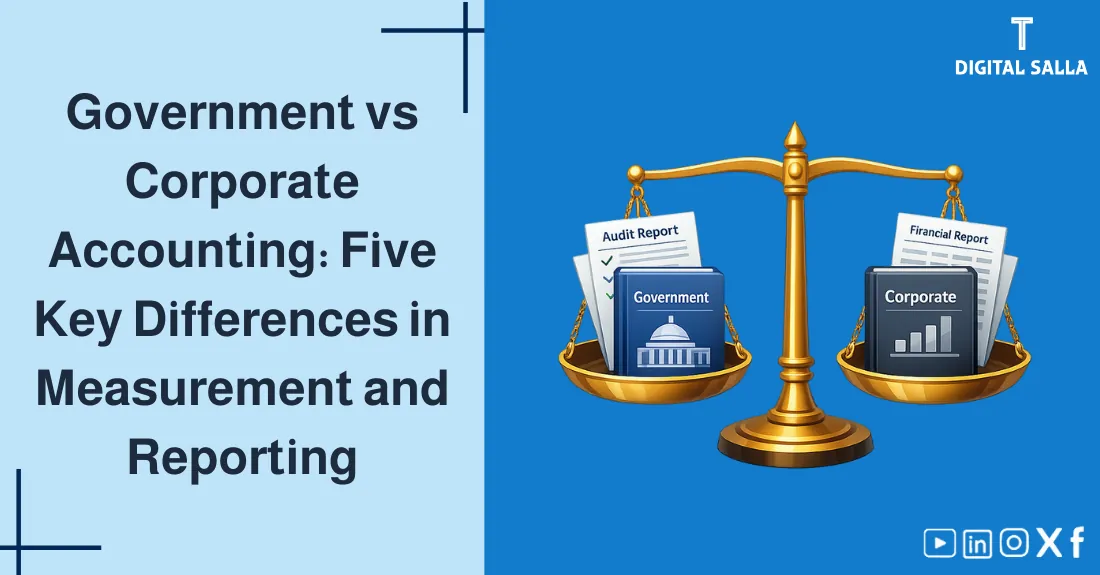
Government Accounting vs. Corporate Accounting: Core Differences Explained
While all accounting follows the same fundamental logic of balanced entries, government accounting and corporate accounting serve entirely different worlds. The first seeks “Responsibility and Service,” while the second seeks “Profit and Efficiency.” This guide provides a comprehensive comparison of the 5 core differences in standards, measurement, and reporting—Digital Salla.
- Profit motive vs. Public service motive.
- Comparison between IPSAS and IFRS standards.
- Ownership differences: Shareholders vs. Taxpayers.
- The shift from Cash basis to Accrual basis in the public sector.
- Budgetary control and the concept of Fund Accounting.
- Summary comparison table and visual roadmap (SVG).
1) Primary Objectives: Service vs. Profit
This is the most fundamental difference. In corporate accounting, the goal is to measure profitability and increase shareholder wealth.
In government accounting, profit is not the goal. The primary objective is Accountability and Public Stewardship: proving that taxpayer money was spent according to the approved budget to provide public services.
2) Standards: IPSAS vs. IFRS
Each sector follows a different rulebook to ensure consistency within its industry:
- Private Sector (IFRS): Focuses on valuation, fair value, and providing information useful for investors.
- Public Sector (IPSAS): Focuses on service potential, budget compliance, and information useful for the public and lenders to the state.
3) Ownership & Revenue Sources
Ownership dictates who the accountant is answering to:
Consolidated FS Template - Excel File
- Corporations: Owned by shareholders. Revenue is earned through the sale of goods or services.
- Government: Owned by the public (citizens). Revenue is primarily derived from Involuntary Contributions (Taxes, Zakat, Customs) and sovereign resources.
4) Comparative Framework: Public vs. Private (SVG)
This diagram summarizes the conceptual split between the two fields.
5) Accounting Basis: Cash vs. Accrual
In the private sector, the Accrual Basis is the only acceptable method. You record revenue when earned and expenses when incurred.
In the government sector, the Cash Basis was traditionally dominant to track the flow of money. However, major reforms (like Saudi Vision 2030) are transitioning the entire public sector to the Accrual Basis to better track state assets and liabilities.
6) Budgetary Control
In a corporation, a budget is a management target. If you exceed it, it’s a variance to be explained.
In government, the budget is law. Spending beyond the approved budget is often a legal violation. This leads to the concept of Encumbrance Accounting—marking funds as “reserved” as soon as a contract is signed, even before any cash is spent.
7) Financial Reporting Differences
- Corporations: Publish annual reports focused on EPS (Earnings per Share), Return on Equity, and Net Income.
- Government: Publishes reports focused on Budget-to-Actual Comparison and the status of various Funds.
8) Summary Comparison Table
| Point of Comparison | Government Accounting | Corporate Accounting |
|---|---|---|
| Primary Goal | Service & Accountability | Profit & Performance |
| Standards | IPSAS / Local State Laws | IFRS / Local GAAP |
| Reporting Unit | Individual Funds | The Consolidated Entity |
| Budget Status | Legal Limitation | Operational Plan |
| Measurement Focus | Financial Resources Flow | Net Income & Valuation |
9) Frequently Asked Questions
Why is the government moving to the accrual basis?
The accrual basis provides a complete picture of the state’s assets (like buildings and infrastructure) and long-term liabilities (like pensions), which the cash basis ignores.
Is government accounting harder than corporate accounting?
It is not necessarily harder, but it is more “procedural” and focused on legal compliance and fund restrictions rather than financial valuation.
What is Fund Accounting?
It is a method of accounting that separates resources into different “buckets” (Funds) based on their specific legal or administrative use.
10) Conclusion & Summary
Understanding the difference between government and corporate accounting is essential for any professional navigating both sectors. While the private sector focuses on growth, the public sector focuses on integrity in managing collective resources.