




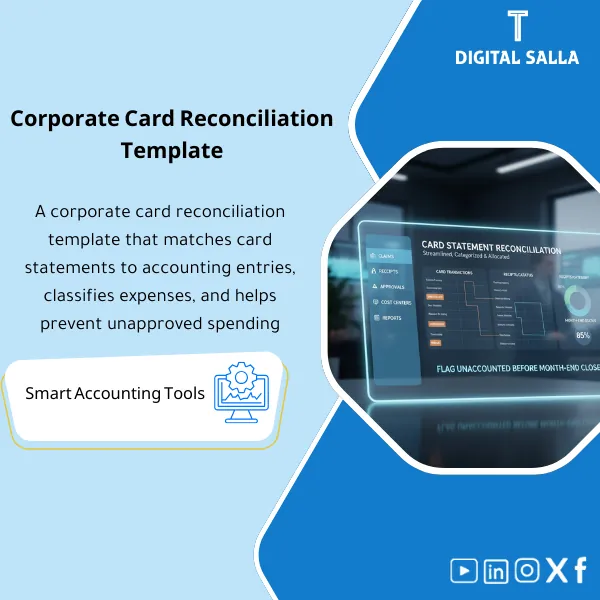
Corporate Card Reconciliation – Excel Template
42.29 $
Corporate Card Reconciliation: Links card statements to transactions, receipts, categories, and cost centers, with exceptions reporting (missing receipt/misclassification). Delivers monthly card settlement and clear expense journals before bank and expense close.
Corporate Card Reconciliation
Transform your card statement into a traceable Reconciliation (Receipts + Cost Centers + JE Log) within the Closing Pack
Value Proposition: Corporate Card Reconciliation is more than just “expense aggregation”; it is a Reconciliation that aligns the card statement with the GL at Month-End. Every transaction in the bank/issuer statement is backed by a receipt or documented reason (Missing/Dispute/Personal/Policy exception), charged to an account and cost center, and posted as a traceable JE batch within the Closing Pack. This Corporate Card Reconciliation creates an operational trail from card statement matching → transaction receipt log → card variance report → JE Log + reviewable delivery pack.
In 20 Seconds: What Will You Get?
- Card statement matching line by line: Posted transactions + status (Matched/Missing/Disputed/Personal/Prepaid).
- Transaction receipts: Receipt index links each transaction to a file/image/invoice and approval date.
- Credit card expenses categorized: Travel/Meals/Accommodation/Subscriptions/Other with account mapping.
- Card variance report: Transactions without receipts + pending transactions + currency/fee variances + potential duplicate transactions.
- Corporate card controls: reason codes + exception tracking + approvals + rules for handling personal spend.
- JE Log: Batch ready for posting to substantiate expenses/liabilities and reconcile intermediary accounts.
- Closing Pack: Reconciliation + evidence index + sign-off linking the card statement to the GL balance in the Adjusted TB.
CTA related to outputs: you will receive Reconciled statement + receipt index + exception logs + JE Log + Month-End pack.
Suitable For
- Accounts / GL: Closing credit card expenses based on documentation and linking to Adjusted TB.
- AP / Admin: Tracking transaction receipts, managing exceptions, and preparing payment/reconciliation files if applicable.
- Controller / Internal Audit: Testing corporate card controls (Approvals/Receipt completeness/Policy exceptions).
Not Suitable For
- If a card statement cannot be obtained in an importable format (CSV/XLSX) or there is no transaction reference number — matching will become manual and weak.
- If you have a Corporate Cards platform with automated Reconciliation + OCR + full Workflow — you may only need the Month-End pack, not the full Template.
Without Reconciliation / With Reconciliation (Brief Comparison)
| Item | Without Corporate Card Reconciliation | With Corporate Card Reconciliation |
|---|---|---|
| Documentation | Scattered receipts not linked to a specific transaction | Receipt index links each transaction to a documented receipt or reason |
| Exceptions | Missing receipts/Personal spend appear after closing | Card variance report + reason codes + approvals before Month-End |
| Month-End | Total entry without trace to the card statement | JE Log + tie-out with GL + Closing Pack within Month-End |
Before Use: 5 Symptoms That Credit Card Expenses Will Disrupt Closing
- The card statement arrives, but there is no record showing the status of each transaction (Receipt/Missing/Disputed/Personal).
- Travel and hospitality transactions are recorded without a business purpose or without a cost center/project.
- Expense approvals occur outside a unified trail (no Approval trail), leading to review failures later.
- There are currency variances and bank fees, but they are not handled as fixed rules (repeating as monthly variances).
- Month-End: The balance of the Corporate Card Payable/clearing account does not match the card statement, and there are no deliverable Reconciliations.
How Does Corporate Card Reconciliation Work Practically from Card Statement to Closing Pack?
The process is managed as a Reconciliation rather than as an “expense aggregation”: it begins with importing the card statement (Card statement) and converting it into a Transaction register. Next, transaction receipts are requested/linked for each line, and incomplete statuses (Missing/Disputed/Personal/Policy exception) are recorded in a documented exceptions log. Then, credit card expenses are categorized and linked to accounts and cost centers, producing a JE Log for posting expenses against the card liability/intermediary account. Finally, the Month-End pack is generated: card statement reconciliation + card variance report + Evidence index + Sign-off within the Closing Pack.
Implementation Steps (3 Steps)
Step 1: Preparation and Report Gathering
- Obtain the card statement reconciliation in CSV/XLSX format (Date, Merchant, Amount, Currency, Cardholder, Transaction ID, Posting date).
- Identify the account(s) in the GL: Corporate Card Payable or Clearing account (depending on your system) + Expenses.
- Define the classification dictionary (Travel/Meals/Accommodation/Subscriptions/Other) + Mapping for accounts and cost centers.
- Establish policy rules: what is acceptable as a receipt? What happens when a receipt is missing? How are personal/non-allowed transactions managed?
Step 2: Matching + Receipts + Exceptions
- Import the statement into the Transaction register and create a Claim/Receipt ID for each transaction.
- Link receipts: upload/link each transaction to an invoice/receipt and record (Received/Not received/Illegible).
- Create a card variance report:
- Missing receipts (by days + responsible/owner)
- Disputes (amount/reason/dispute status)
- Personal/Non-business (decision: refund/deduction/approved exception)
- FX/Fees (fixed processing rules)
- Document corporate card controls through reason codes + approvals + evidence index.
Step 3: JE Log + Month-End Tie-out + Closing Pack
- Produce JE Log for posting:
- Dr Expenses (by classification + Cost center/Project)
- Cr Corporate card payable / clearing (or the applicable clearing account)
- Match GL balance with the total statement for the period (considering Timing: posted vs pending if applicable).
- Generate the Closing Pack: Reconciled statement + exceptions aging + disputes + JE references + Evidence index + Sign-off.
Product Components (Clear Inventory)
-
Statement Import & Transaction Register
- Practical Purpose: Convert the card statement into a searchable and traceable transaction register.
- When Used: Weekly + at Month-End immediately upon receipt of the statement.
- Resulting Evidence: Transaction register + statement snapshot.
-
Receipt Tracker (Transaction Receipts)
- Practical Purpose: Link each transaction to a receipt/invoice/supporting document and record the receipt status.
- When Used: Daily/Weekly operation until period close.
- Resulting Evidence: Receipt index + attachment list for each Claim/Transaction.
-
Expense Categorization & GL Mapping
- Practical Purpose: Categorize credit card expenses and link them to GL accounts consistently.
- When Used: During matching and before JE batch.
- Resulting Evidence: Mapping table + classified spend report.
-
Cost Center / Project Allocation
- Practical Purpose: Charge each transaction to a cost center/project/department instead of a generic untraceable allocation.
- When Used: Immediately before posting (upon claim approval).
- Resulting Evidence: Allocation schedule traceable from transaction to CC.
-
Exception Log (Corporate Card Controls)
- Practical Purpose: Manage exceptions: Missing receipt, over limit, non-business, split bills… with documented decisions and approvals.
- When Used: Throughout the month + Review in Week-4 before closing.
- Resulting Evidence: Exceptions log + approvals trail + reason codes.
-
Dispute Log
- Practical Purpose: Document disputes with the bank/issuer and show their impact on closing (Open/Closed/Credited).
- When Used: As soon as incorrect transactions appear until the dispute is resolved.
- Resulting Evidence: Dispute register + correspondence references (if any).
-
Variance & Aging Report (Card Variance Report)
- Practical Purpose: A clear list of what prevents card closing: variances, overdue receipts, transactions needing decisions.
- When Used: Weekly + before Month-End as a “period close” list.
- Resulting Evidence: Variance list + aging (0–30/31–60/60+).
-
JE Log + Month-End Reconciliation Pack
- Practical Purpose: Produce postable entries and link them to the card statement reconciliation for submission within the Closing Pack.
- When Used: Month-End and Year-End.
- Resulting Evidence: JE batch + tie-out to GL + sign-off.
What Should Be Included in the Delivery?
- 01-Corporate-Card-Reconciliation.xlsx: The main file (Import + Register + Matching + Reports).
- 02-Statement-Import-Template.xlsx: Template for importing the card statement (issuer/bank) + standardizing fields.
- 03-Transaction-Register.xlsx: Transaction register (Transaction ID/Posting/Amount/Cardholder/Status).
- 04-Receipt-Tracker.xlsx: Transaction receipts (Received/Missing/Illegible) + attachment links.
- 05-Receipt-Index.xlsx: Evidence index + Naming convention (TransactionID_Receipt#_Date).
- 06-Expense-Categories-GL-Mapping.xlsx: Mapping credit card expenses to GL + rules.
- 07-CostCenter-Allocation.xlsx: Charging transactions to cost centers/projects + split allocations.
- 08-Approvals-Log.xlsx: Expense approvals log (Reviewer/Approver/Decision/Reason).
- 09-Exceptions-Log.xlsx: Corporate card controls (Missing receipt/Over limit/Non-business) + decisions.
- 10-Dispute-Log.xlsx: Dispute register (Opened/Closed/Credited) + Month-End impact.
- 11-Variance-Aging-Report.xlsx: Card variance report + aging of incomplete items.
- 12-JE-Log-Corporate-Card.xlsx: JE Log for posting (Dr expenses/Cr card payable) + references.
- 13-GL-TieOut-Sheet.xlsx: Tie-out between GL balance and statement total for the period + timing/classification variances.
- 14-MonthEnd-Closing-Pack.xlsx: Final pack: Summary + exceptions + JE refs + sign-off.
- 15-Runbook.pdf: Step-by-step operation (Import → Match → Exceptions → JE → Tie-out → Pack).
- 16-Controls-Checklist.pdf: Control checklist (completeness/approvals/duplicates/personal spend/receipt quality).
- 17-Archiving-Map.docx: Archiving tree (Year/Month/CorporateCards/Statements/Receipts/Approvals/Pack).
- 18-Signoff-Page.docx: Prepared/Reviewed/Approved + period scope (e.g., Dec-2025).
After Implementation (Two Points Only)
- Operational Outcome for the Team: Each card statement transforms into a clear action list: completed transactions + transactions needing receipts + disputed transactions + transactions needing decisions, instead of chasing receipts on the last day of closing.
- Control/Audit Outcome: You have complete Traceability: Statement line → receipt/approval → CC allocation → JE batch → GL tie-out within the Closing Pack, making testing Reconciliations possible without reassembly.
FAQ — Questions Before Purchase
Is it suitable for any ERP system?
Yes. You only need statement export + cost centers/Mapping. Posting occurs within the ERP using the resulting JE Log.
Can multiple cards/multiple cardholders be reconciled?
Yes. The log is built on Cardholder + Card ID and reports can be aggregated by person or by entity/branch.
How does it handle transactions without receipts?
They are recorded as Missing receipts in the Exceptions log with a due date and escalation. A decision (rejection/deduction/approved exception) can be documented instead of leaving it unaddressed.
Does it cover travel and hospitality expenses?
Yes, as a classification + evidence requirements (hotel/tickets/restaurants) linked to the center/project with an Approval trail.
How are personal or non-allowed transactions handled?
They are recorded as Non-business/Personal with a documented decision: employee refund/deduction from entitlements/approved exception, and this appears in the card variance report.
Does it support currency variances and bank fees?
Yes, through fixed classification rules (FX/Fees) linked to the appropriate GL accounts instead of appearing as unexplained variances each month.
Is it suitable for Month-End only or Year-End as well?
Suitable for both. Year-End typically requires stronger Evidence and Aging for older items, and the Pack delivers that within the Closing Pack.
Is there a delivery template for internal/external audit?
Yes: Month-End reconciliation pack + evidence index + sign-off + GL tie-out.
Ready to close the card statement to the GL with documentation instead of a “total entry”?
Outputs: Corporate Card Reconciliation + Receipt index + Exceptions/Disputes + JE Log + Closing Pack.
| المسمّى الوظيفي | |
|---|---|
| Duration | |
| المستوى | |
| التحديثات | |
| القطاع | |
| الصيغة |
Related products







Reviews
Clear filtersThere are no reviews yet.