



Fixed Assets Policy – Editable Word File
55.59 $
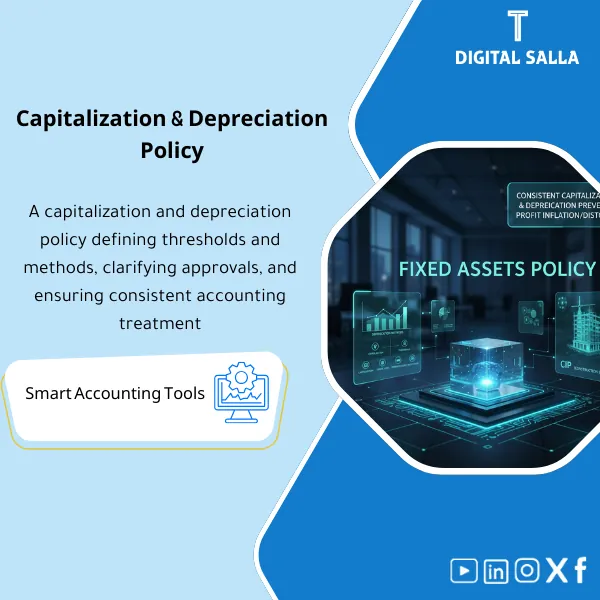
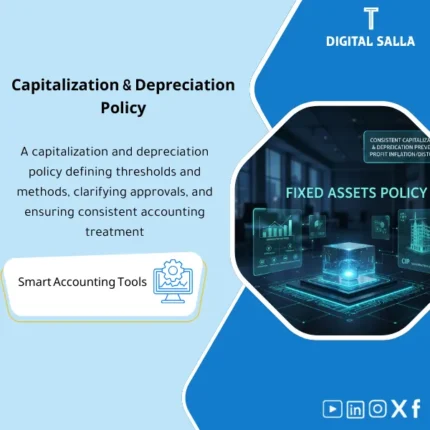
Fixed Asset Accounting Policy: Defines capitalization threshold, useful lives and depreciation methods, CIP treatment, and rules for repairs vs. improvements—linked to required journals. Delivers a consistent policy framework for capitalization and depreciation decisions at year-end close.
Fixed Assets Policy (Capitalization & Depreciation Policy)
An operational policy document designed to regulate the Capitalization Policy and Depreciation Policy by defining the Capitalization Threshold and Useful Lives of assets, along with the CIP policy, the application mechanism for Depreciation Methods (Straight-line/Declining Balance/Units of Production), and linking it to purchasing and receiving procedures, asset records, and audits.
Value Proposition:
This policy prevents four common mistakes found in most companies:
(1) Capitalizing operational expenses, (2) Unjustified or inconsistent depreciation, (3) Leaving CIP open without conversion, (4) Lack of clear impact for disposals/sales/transfers in the books.
The desired output here is not just a “policy text,” but decision rules + procedures + evidence that can be implemented and reviewed.
In 20 seconds: What will you get?
- Capitalization Policy: Clear capitalization rules (What qualifies / What does not).
- Capitalization Threshold: Fixed capitalization threshold + rules for item aggregation.
- Useful Life Matrix: Productive lives for each asset category + annual review of lives.
- Depreciation Methods: Straight-line/Declining Balance/Units of Production + when to use each method.
- CIP Policy: When to open CIP, what is included, and when to convert to a working asset.
- Componentization: Separating essential asset components and determining a life for each component.
- Subsequent Expenditure: Treatment of improvements/developments vs maintenance (Capex vs Opex).
- Disposals & Transfers: Policy for exclusion/sale/transfer with typical constraints.
- Controls & Evidence: Mandatory documents for each decision (PO/GRN/Acceptance/Tagging).
Suitable for
- Companies with diverse assets (equipment/vehicles/technology/buildings) needing annual consistency.
- Entities subject to external audits or with recurring asset observations.
- ERP/digital transformation teams looking to standardize asset master data and depreciation rules.
Not Suitable for
- Entities that do not possess significant tangible assets or do not maintain an asset register at all.
- Those seeking only a “depreciation template” — this is a policy + procedures + evidence product, not a standalone depreciation schedule.
Without Policy / With Policy
| Item | Without Policy | With Policy |
|---|---|---|
| Capitalization Decision | Inconsistent decisions based on person/time | Decision rules + Threshold + Clear examples |
| Depreciation | Unjustified lives/changes without documentation | Useful life matrix + review methodology + specified depreciation methods |
| CIP | CIP accumulates without conversion | Conditions for opening/closing + conversion to working asset + start of depreciation |
| Audit | Difficulty proving existence and decision | Evidence checklist + Workflow + Typical entries |
How to Implement the Fixed Assets Policy Practically?
1) Capitalization Threshold
- Establish a minimum capitalization threshold at the entity level (Per item) with a clear aggregation rule for integrated items.
- Important rule: If items only work together and serve a single asset → they can be treated as a single asset for threshold purposes.
2) What gets capitalized and what gets expensed?
- Capitalized: Purchase of an asset, substantial improvements that increase utility/life, capacity expansion, replacement of a significant component.
- Expensed: Routine maintenance, consumable spare parts, repairs that restore the asset to its normal condition.
3) CIP (Assets Under Construction)
- Open CIP when starting an asset project (construction/installation/development) with only eligible costs loaded.
- Start depreciation when the asset is ready for use and not upon payment of the last invoice.
- Convert CIP to the correct asset category with a delivery/acceptance document (Commissioning/Acceptance).
4) Useful Lives + Annual Review
- Determine a life for each asset category (equipment/vehicles/technology/buildings/furniture…)
- Annual review of lives and residual values when there are significant change indicators.
5) Depreciation Methods
- Straight-line: For assets with a consistent pattern of utility.
- Declining Balance: When utility is higher in the early years.
- Units of Production: When consumption is linked to production/use.
6) Disposals and Transfers
- Define a process: Disposal request → Approval → Sale/Disposal record → Disposal entry → Update asset record.
- Transfers between locations: Update Location/Cost Center/Responsible Owner with oversight impact.
Expected Accounting Output from Policy Implementation
- Consistent Asset Register (FA Register) (Category/Useful life/Method/Location).
- Traceable monthly depreciation expense by categories and centers.
- CIP does not accumulate without a conversion and closure plan.
- Documented exclusion/sale/transfer entries with clear impact on the TB.
Contents Delivered
- Policy: Capitalization & Depreciation Policy (Word/PDF).
- Appendix A: Useful life matrix + methods guidance.
- Appendix B: CIP eligible cost rules + close-out checklist.
- Appendix C: Evidence checklist (PO/GRN/Acceptance/Tagging/Disposal).
- Appendix D: Journal entry templates (Capitalize/Depreciate/Transfer/Dispose).
- Appendix E: Examples (capex vs opex) on common cases.
If you want a Fixed Assets Policy that is easy to implement and based on evidence
| المسمّى الوظيفي | |
|---|---|
| Duration | |
| المستوى | |
| التحديثات | |
| القطاع | |
| الصيغة |
Related products
EOSB Calculator – Excel Template
Reviews
Clear filtersThere are no reviews yet.