


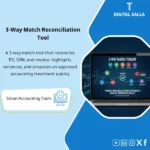


GR/IR Reconciliation – Excel Template
42.29 $
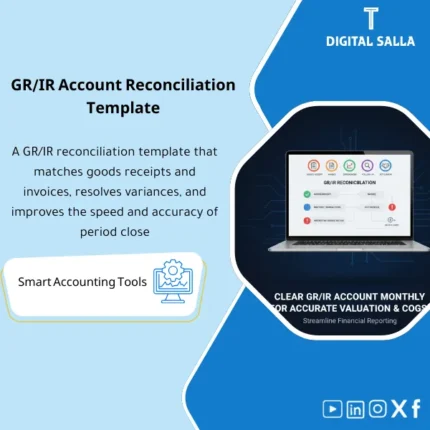
GR/IR Reconciliation: Identifies receipts without invoices and invoices without receipts, categorized by root cause and month-end clearing plan. Delivers an open GR/IR report and documented adjustments impacting inventory and COGS for inventory and accounting teams.
GR/IR Reconciliation
GRIR Reconciliation Toolkit — from Goods Receipt without Invoice to Invoice without Receipt with GR/IR Account Reconciliation and a reviewable Month-End file
Value Proposition: GR/IR Reconciliation is not just a report that we pull from the system and that’s it. It is a closing point that controls three sensitive matters: (1) cut-off between receipts and invoices, (2) accuracy of inventory/COGS, and (3) completeness of payables/AP. The practical problem arises when the GR/IR account accumulates open items that no one knows whether they are Goods Receipt without Invoice or Invoice without Receipt or price/quantity discrepancies. This GRIR Reconciliation builds a clear closing journey: loading receipt and invoice data → matching at the PO/GRN/Invoice level → classifying receipt and invoice discrepancies → preparing GR/IR Account Reconciliation with JE Log and Tie-out within the Closing Pack.
In 20 Seconds: What Will You Get?
- Open GRIR Reports at the PO/GRN/Invoice level with the status of each item (Matched / Open / Needs action).
- Goods Receipt without Invoice (GRNI): List of receipts completed without their corresponding invoice + Aging by receipt date.
- Invoice without Receipt: List of supplier invoices recorded without a matching receipt + Flags for Hold/Investigate.
- GR/IR Account Reconciliation: Tie-out between the total report and the balance of the GR/IR account in the TB.
- Receipt and Invoice Discrepancies: Classification of discrepancies (Timing / Price variance / Qty variance / Wrong PO/GRN / Missing ref).
- JE Log: Proposed entries (Accruals/Reclass/Clearing) with clear references and approval fields.
- Closing Pack: Month-End/Year-End delivery file (Snapshot + Exceptions + Evidence index + Sign-off).
CTA related to outputs: Receive Open GRIR Reports + GRNI + Invoice without Receipt + JE Log + GL Tie-out ready for operation and delivery.
Suitable For
- Head of Accounting / Financial Controller: Reconciling the GR/IR account and linking it to the Adjusted TB and Closing Pack without leaving any “unknown source” items.
- AP + Procurement: Managing invoices without receipts and determining actions (Hold/Request GR/Correct PO/Issue CN) before payment.
- Inventory / Costing: Protecting cut-off and interpreting the impact of discrepancies on inventory/COGS (especially with price and quantity discrepancies).
Not Suitable For
- If your activity is entirely services and does not use GR/IR (no GRN or GR/IR account) — you will need 2-Way match and AP controls instead of GR/IR.
- If the linking references (PO/GRN/Invoice refs) are not present in your data at all — you will first need to adjust the P2P process and number/link the documents.
Without Reconciliation / With Reconciliation (Brief Comparison)
| Item | Without GR/IR Reconciliation | With Toolkit |
|---|---|---|
| Month-End | GR/IR balance “hanging” without explanation | Open GRIR report + classification of reasons + JE Log |
| AP/Payments | Risk of paying Invoice without Receipt or accumulating unclear holds | List of invoices without receipts + processing decision + Owner/ETA |
| Audit | Recurring question: “Explain the GR/IR balance” | Tie-out TB + Evidence index + Sign-off within Closing Pack |
Before Use: 5 Symptoms That GR/IR Has Become a “Discrepancy Storage” Account
- GR/IR balance in TB changes monthly without clear explanation or a reviewable list of open items.
- Accumulation of Goods Receipt without Invoice for several months because no one has an Aging report by receipt date.
- Presence of Invoice without Receipt entered in AP without a matching GRN → dispute with receipt/inventory or risk of overpayment.
- Price/quantity discrepancies between PO and GRN and Invoice are not classified; they appear as general discrepancies with no indication of whether they are Price variance, Qty variance, or Timing.
- At Year-End, large “reconciliation” entries are made on GR/IR without a JE Log or evidence (Traceability is weak).
How is GR/IR Reconciliation Practically Applied at Month-End and Year-End?
The idea is not to “zero out GR/IR” with any entry; rather, it is to explain each open item and determine its fate. It starts with gathering all GR/IR movements (the receipts and associated invoices) and then matching items at the PO/GRN/Invoice level. After matching, each open item is classified: GRNI (Goods Receipt without Invoice), or Invoice without Receipt, or price/quantity discrepancies, or incorrect/missing reference. In the end, it produces GR/IR Account Reconciliation with JE Log and Tie-out to TB within the Closing Pack, making the balance “understandable and supported by evidence” rather than just a number.
Implementation Method (3 Steps)
Step 1: Preparation and Gathering Reports
- Extract GR/IR movements or “GR/IR open items” report from ERP (with PO#/GRN#/Invoice# if available).
- Extract GRN/Receipt lines: receipt date, quantities, value, reference document (PO line/item).
- Extract Invoice/AP lines: invoice/posting date, amount, tax, PO/GRN reference, and payment/hold status.
- Extract Trial Balance for GR/IR account(s) (may be multiple depending on company/branch/warehouses).
Step 2: Reconciliations + Processing Discrepancies + JE Log
- Run GR/IR reconciliation at the reference level (PO line / Item / GRN) to produce a status for each item: Matched / Open.
- Prepare two main operational lists:
- GRNI: Goods Receipt without Invoice + Aging + Owner (Procurement/AP) + Follow-up date.
- Invoice without Receipt: Invoice without receipt + Possible reason (GR not recorded/incorrect reference/duplicate invoice/service) + Decision (Hold/Request GR/Correct reference).
- Classify receipt and invoice discrepancies:
- Timing: Natural timing difference (receipt at month-end and invoice at the beginning of the next month).
- Price variance: Invoice price different from PO or receipt value.
- Qty variance: Different received/invoiced quantity (Partial receipt/over-billing).
- Data issue: Missing/incorrect linking reference (wrong PO/line).
- Prepare JE Log for closing decisions (if needed): accruals, reclass, clearing, or price/quantity discrepancy entries—with PO/GRN/Invoice references and approval fields.
Step 3: Adjusted TB + Open GRIR Reports + Closing Pack
- GL tie-out: Total of open GR/IR items per report ↔ balance of GR/IR account in TB (with explanation of any discrepancies: multiple accounts/branches/currencies/unposted entries).
- Produce a Snapshot for closing: Open GRIR reports classified by reason + Aging + List of critical exceptions.
- Prepare Closing Pack: tie-out notes + JE log (proposed/posted) + evidence index + sign-off (Prepared/Reviewed) for Month-End/Year-End.
Toolkit Components (Clear Inventory)
-
GR/IR Open Items Import
- Practical Purpose: Input GR/IR data as a basis for reconciliation and analysis.
- When to Use: Week-4/Month-End and Year-End.
- Resulting Evidence: Dated Snapshot of open GR/IR items.
-
GRN/Receipts Import
- Practical Purpose: Build a list of Goods Receipt without Invoice and link it to PO/Item.
- When to Use: Monthly, and sometimes weekly if the receipt volume is high.
- Resulting Evidence: GRNI register + Aging by receipt date.
-
Invoice/AP Import
- Practical Purpose: Build a list of Invoice without Receipt and link it to the purchase reference.
- When to Use: Daily in AP + Week-4 for closing.
- Resulting Evidence: Invoice-to-Receipt exceptions list + Holds/Actions.
-
Matching Engine (GRIR Reconciliation)
- Practical Purpose: Match receipts with invoices at the PO/GRN/Line level and produce Match status.
- When to Use: Before closing AP and before preparing accruals.
- Resulting Evidence: Deliverable matching report.
-
Variance Classification (Receipt and Invoice Discrepancies)
- Practical Purpose: Separate discrepancies into Timing/Price/Qty/Data issues instead of categorizing them as general discrepancies.
- When to Use: Monthly, especially when GR/IR is inflated.
- Resulting Evidence: Variance log + Owner + Processing decision.
-
GRNI & Invoice-without-Receipt Lists
- Practical Purpose: Produce two operational lists: Goods Receipt without Invoice and Invoice without Receipt, with Aging and priority.
- When to Use: Weekly/Monthly depending on P2P volume.
- Resulting Evidence: Action lists used to close items before closing.
-
JE Log (Proposed Reconciliation Entries)
- Practical Purpose: Document GR/IR account reconciliation entries (Accrual/Reclass/Clearing) with references and evidence linking.
- When to Use: Month-End and Year-End.
- Resulting Evidence: Reviewable JE log (Proposed/Posted/Rejected + Reason).
-
GL Tie-out Sheet
- Practical Purpose: Tie total reports to the GR/IR balance in TB and produce a list of discrepancies.
- When to Use: Month-End always, and Year-End practically mandatory.
- Resulting Evidence: Tie-out notes + traceable discrepancies.
-
Month-End/Year-End Closing Pack
- Practical Purpose: Compile closing delivery: Open GRIR reports + exceptions + JE log + tie-out + evidence + sign-off.
- When to Use: Week-4/Month-End and Year-End.
- Resulting Evidence: Closing pack section ready for internal/external review.
What Should Be Included in the Delivery?
- 01-GRIR-Reconciliation-Toolkit.xlsx: Main reconciliation file + Match statuses + dashboards.
- 02-GRIR-Open-Items-Import.xlsx: Template for importing open GR/IR items from ERP + mapping.
- 03-GRN-Receipts-Import.xlsx: Template for importing receipts (GRN lines) + date/quantity/value/PO refs.
- 04-Invoice-AP-Import.xlsx: Template for importing invoices (Invoice/AP lines) + refs + tax/holds.
- 05-GRNI-Report.xlsx: Goods Receipt without Invoice + Aging + owner/actions.
- 06-Invoice-Without-Receipt-Report.xlsx: Invoice without Receipt + Possible reasons + Decision (Hold/Investigate).
- 07-Variance-Classification-Log.xlsx: Receipt and invoice discrepancies (Timing/Price/Qty/Data) + closing status.
- 08-JE-Log-Template.xlsx: JE Log for reconciliations (Proposed/Posted) + PO/GRN/Invoice references.
- 09-GL-Tieout-Reconciliation.xlsx: Tying open GRIR reports with TB + notes + discrepancies.
- 10-Exceptions-Owner-Tracker.xlsx: Exceptions log + Owner + ETA + Evidence required.
- 11-Evidence-Index.xlsx: Evidence index (PO/GRN/Invoice/Statements) + links/trails.
- 12-MonthEnd-GRIR-Closing-Pack.xlsx: Closing snapshot + sign-off + summary of discrepancies/actions.
- 13-Runbook.pdf: Practical run (Import → Match → Classify → JE Log → Tie-out → Closing pack).
- 14-Controls-Checklist.pdf: GR/IR controls checklist and cut-off and approval for exceptions.
- 15-Archiving-Map.docx: Archiving tree (Year/Month/GRIR/Inputs/Outputs/Evidence) + Naming convention.
- 16-Signoff-Page.docx: Prepared/Reviewed/Approved + period scope.
After Implementation (Two Points Only)
- Operational Outcome for the Team: You will have a clear action list: GRNI that needs follow-up with suppliers + Invoice without Receipt that requires receipt/correct reference/payment hold, and price and quantity discrepancies appear as actionable files rather than “ambiguous balance”.
- Control/Audit Outcome: The GR/IR balance becomes explainable: Open items report + reason classification + JE Log + Tie-out with TB + Evidence index + Sign-off, which reduces review questions regarding cut-off and completeness.
FAQ — Questions Before Purchase
Is the tool suitable for any ERP system?
Yes, as long as you can extract receipt and invoice data and PO/GRN references (even via CSV/Excel reports). The tool works on top of any system via Exports.
Does it work for multi-branch/warehouse companies?
Yes, if your data includes Company/Branch/Warehouse. You can produce open GRIR reports by branch and then a total with unified tie-out.
Is it suitable for services or only for goods?
It is best used with goods due to the presence of GRN. For services, a “Service Acceptance Report” can be used as an alternative to receipt or apply 2-Way match, but the essence of GR/IR is more evident with inventory.
What is the minimum data required to get started?
GRN/receipt reference + PO reference (if available) + amounts + posting dates, and supplier invoices with PO/GRN references and amounts. The better the quality of the references, the fewer “unmatchable” items.
Is the tool for monthly reconciliation only or also suitable for Year-End?
For both. At Month-End, it focuses on cut-off and producing GRNI/Invoice without Receipt, and at Year-End, it is used to close old items and produce a stronger evidence file.
Does it produce ready accounting entries?
It produces JE Log as “proposed entries” (Accrual/Reclass/Clearing) with clear references. The approval and posting of the entry are done according to your company policy and within the ERP.
How does it handle price and quantity discrepancies?
Discrepancies (Price/Qty) are classified and linked to documents, then allow recording a decision: adjust PO, correct receipt, issue CN, or substantiate the difference according to inventory/cost policy.
Can it be linked with the 3-Way Match Toolkit?
Yes, naturally: 3-Way Match deals with the decision to approve the invoice before payment, and GR/IR Reconciliation ensures that the GR/IR account in GL is consistent and explained at Month-End.
Ready to explain the GR/IR balance and enter the closing with a list of “classified and closed” open items?
Outputs: GRIR Reconciliation + GRNI + Invoice without Receipt + Variance log + JE Log + GL tie-out + Closing Pack.
| المسمّى الوظيفي | |
|---|---|
| Duration | |
| المستوى | |
| التحديثات | |
| القطاع | |
| الصيغة |






Reviews
Clear filtersThere are no reviews yet.