



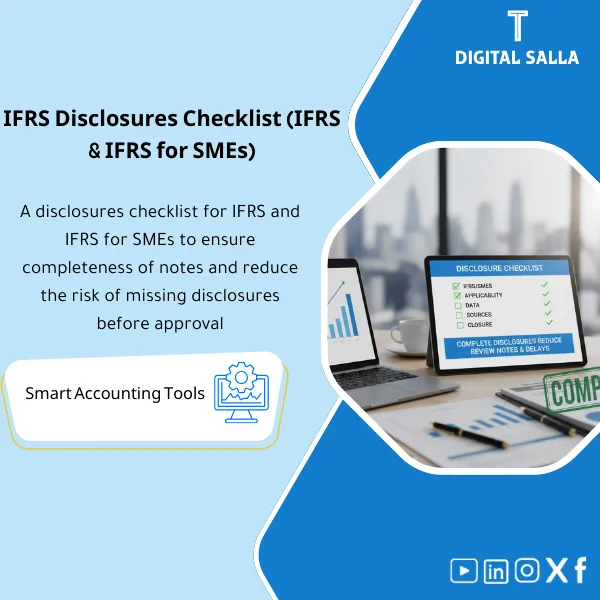
Disclosure Checklist – Excel File
42.29 $
IFRS Disclosures Checklist: Verifies required disclosures (IFRS/IFRS for SMEs), determines applicability, assigns data sources and owners, and tracks completion status. Delivers a complete disclosures file before issuing annual statements.
IFRS / SMEs Disclosure Checklist
Disclosure Checklist + Notes Tracker + Cross-Reference Matrix + Evidence Index + Closing Pack Insert
Value Proposition: A disclosure checklist that transforms “last week’s aggregated notes” into a traceable pathway: Adjusted TB + Schedules → Disclosure Checklist (Applicability) + Owners → Notes Drafts + Cross-Refs → Closing Pack with guidance for each disclosure (source/responsible/status of closure).
In 20 seconds: What will you get?
- IFRS Disclosure Checklist with applicable/non-applicable disclosure items + reason for exclusion.
- IFRS for SMEs Disclosure Checklist (separate pathway) if your company is under SMEs.
- Notes Tracker: for each disclosure/note (Owner + Status + Due Date + Data Source).
- Cross-Reference Matrix: linking each disclosure to its place in the notes + linking numbers to TB/Schedules.
- Evidence & Source Index: Where is the evidence? (Schedule/Report/JE Log/Board Memo) for each sensitive disclosure.
- Sign-off Sheet: Internal approval for key disclosures (Who reviewed? Who approved? What is the reference version?).
- Closing Pack Insert: A ready section within the Closing Pack for disclosures (Checklist + Cross-Refs + Evidence).
CTA related to deliverables: Receive Disclosure Checklist + Cross-Reference Matrix for Year-End disclosures within the Closing Pack with references linked to Adjusted TB.
Suitable for
- Financial Controller needs a “Disclosure Matrix” deliverable for the auditor with an Evidence Index.
- Head of Accounts / GL Lead wants to link numbers to disclosures via TB/Schedules instead of “disclosures without Tie-out.”
- Reporting Accountant writes disclosures and needs a Tracker to distribute responsibilities and maintain the status of each disclosure.
Not suitable for
- Those who want “ready disclosure text” in final wording for each item (the product is Checklist/Tracking and linking sources, not writing a complete report).
- Those expecting the product to determine the regulatory framework of a specific regulator or automatic standard updates (requirements must be aligned with your framework and auditors).
Without the checklist / With the checklist (Quick Comparison)
| Item | Without the checklist | With the checklist |
|---|---|---|
| Identifying disclosures | Relies on memory + late review | Checklist (Applicable/Not applicable) + reason for exclusion |
| Disclosure responsibility | Who writes what? Unclear | Notes Tracker: Owner + Status + Due Date for each disclosure |
| Linking numbers | Disclosure numbers are not linked to TB/Schedules | Cross-Reference Matrix links the note to its source (TB/Schedule) |
| Delivery to the auditor | Evidence distributed + recurring questions “Source of the number?” | Evidence Index + Sign-off + Closing Pack Insert |
Before use: 5 symptoms appearing in disclosures
- Disclosures are written at the last stage because “there is no Tracker” defining the responsibility for each disclosure.
- Discrepancy between disclosure numbers and Adjusted TB due to lack of Cross-Reference.
- No justification for “Not applicable” for some disclosures, leading to repeated auditor questions.
- Data sources (FA/Leases/ECL/Provisions) are not linked to disclosures, resulting in late rework.
- The final delivery lacks an Evidence Index; during the audit, searching begins in multiple folders.
IFRS Disclosure Checklist: Application Method (3 Steps Without Gaps)
Step 1: Preparation and Gathering Inputs for Statements and Disclosures
- Establish Adjusted TB (or a close version for Draft) + Draft statements (P&L/BS/CF/Equity) based on your framework.
- Compile supporting schedules (Schedules) commonly used in disclosures: FA/Depreciation, Leases, ECL/AR, Provisions, Revenue breakdown, Related parties… based on your activity.
- Select one framework for application: IFRS or IFRS for SMEs (to avoid mixing requirements).
Step 2: Running the Checklist + Tracker + Gathering Evidence
- Determine Applicability for each disclosure (Applicable/Not applicable) with a reason for exclusion when not applicable.
- Distribute items via Notes Tracker: Owner + Due Date + Source of the number (TB/Schedule/JE Log/Policy Memo).
- Create Evidence & Source Index for each sensitive disclosure: Where is the document? What is the report? What is the link/file name?
Step 3: Cross-Refs + Approval + Closing Pack
- Build Cross-Reference Matrix: linking each Note to its number and place + linking its numbers to TB/Schedules.
- Record internal approval via Sign-off (Who reviewed/approved + reference version + closure date).
- Insert the disclosure section within the Closing Pack: Checklist + Tracker + Cross-Refs + Evidence Index (within Year-End delivery).
Product Components (Clear Inventory)
-
IFRS Disclosure Checklist
- Practical Purpose: A disclosure checklist with an Applicable/Not applicable system with a “reason for exclusion” field to document the scope of disclosure.
- When to Use: Year-End, and when preparing Draft statements before sending them to the auditor.
- Resulting Evidence: A completed checklist showing what has been addressed and what has been excluded and why.
-
IFRS for SMEs Disclosure Checklist
- Practical Purpose: A separate SMEs disclosure pathway to avoid mixing full IFRS requirements.
- When to Use: If the reporting framework adopted in your company is IFRS for SMEs.
- Resulting Evidence: A completed SMEs checklist with the same applicability and documentation logic.
-
Notes Tracker (Owner / Status / Due Date)
- Practical Purpose: Tracking the writing of disclosures as operational items: Who writes? What is required? When is it closed? What is the source of the number?
- When to Use: Throughout the Year-End cycle until the final version is approved.
- Resulting Evidence: A status log for disclosures showing open items and reasons for delays.
-
Cross-Reference Matrix (TB/Schedule Tie-out)
- Practical Purpose: Linking each disclosure to its place in the notes and linking its numbers to TB/Schedules (practical Tie-out).
- When to Use: Before finalizing the statements and before issuing a “Final” version.
- Resulting Evidence: A matrix showing where the disclosure numbers came from and how they match the TB.
-
Evidence & Source Index (Evidence Index)
- Practical Purpose: Identifying the source of each disclosure (file/report/memo/JE Log) to facilitate delivery to the auditor.
- When to Use: During the compilation of disclosures and when preparing the Closing Pack.
- Resulting Evidence: A ready Evidence Index linking the disclosure to its supporting file.
-
Sign-off Sheet (Disclosure Approval)
- Practical Purpose: Documenting the approval of the reference version of disclosures (Who reviewed/approved + date + notes).
- When to Use: When finalizing the version of the statements and before release.
- Resulting Evidence: An approval form specifying the reference version (Version/Date) within the delivery file.
-
Closing Pack Insert (Disclosure Section for Delivery)
- Practical Purpose: Placing disclosures within the Closing Pack as a separate section: Checklist + Tracker + Cross-Refs + Evidence.
- When to Use: Year-End as a delivery for the auditor/management.
- Resulting Evidence: An indexed delivery section that facilitates reference without searching through separate files.
CTA related to deliverables: Checklist + Notes Tracker + Cross-Reference Matrix for Year-End disclosures within the Closing Pack.
What should be included in the delivery?
- Disclosure Checklist File: A checklist file (IFRS or SMEs) with Applicability + reason for exclusion + notes.
- Notes Tracker File: A file tracking disclosures (Owner/Status/Due Date/Data source/Last update).
- Cross-Reference Matrix: A file linking each Note to the source of the numbers (TB/Schedules) + page/section number within the notes.
- Evidence Index: An evidence index specifying the file/folder/link name for each sensitive disclosure.
- Draft FS Pack: A copy of the statements (Draft/Final) + reference Adjusted TB used for linking.
- Schedules Folder: A folder of supporting schedules (FA/Leases/ECL/Provisions/Revenue… based on your activity) with clear naming.
- JE Log Reference (if needed): If a disclosure relies on specific entries, it is linked to a line/number within the JE Log.
- Sign-off: A form documenting the final approval of disclosures (Who reviewed/approved + date + reference version).
- Closing Pack Section: A consolidated section within the Closing Pack titled “Disclosures” containing all of the above with a single index.
After Application (Two Points Only)
- Operational Outcome for the Team: Disclosures become manageable items (Owner/Status/Due Date) instead of “aggregating notes” at the last stage.
- Regulatory/Audit Outcome (Evidence & Traceability): Each disclosure linked to its source (TB/Schedule/Memo/JE Log) within Cross-Refs and Evidence Index in the Closing Pack, reducing rework during inquiries.
FAQ — Questions Before Purchase
Does the checklist suit IFRS or IFRS for SMEs?
The product contains two pathways: IFRS and IFRS for SMEs. You choose one pathway based on the reporting framework adopted in your company to avoid mixing requirements.
Is the checklist considered a complete compliance confirmation?
No. It is a tool for controlling scope and delivery (Applicability + Sources + Cross-Refs). Professional judgment and interpretation of applicability and updating requirements remain the responsibility of management and its auditors.
Does it work with any accounting system?
Yes. It relies on Adjusted TB and drafts of statements and supporting schedules (Schedules), not on a specific ERP system.
Is it suitable for multi-branch/entities companies?
Yes. You can set up Tracker/Cross-Refs for each entity or segment and then consolidate disclosure outputs at the group level within the Closing Pack.
What is the minimum data required to start?
Draft FS + Adjusted TB (or a close TB) + essential supporting schedules (at least: FA/Revenue/AR/ECL/Provisions if available).
Does it provide textual wording for disclosures?
No, as a complete substitute for wording disclosures. The product focuses on “what needs to be disclosed? Who is responsible? What is the source of the number?” and internal text can be added according to your policies and review.
Is it suitable for monthly (Month-End) use?
It can be used as a checklist when preparing periodic reports or quarterly drafts, but its primary use is Year-End where disclosure requirements are complete and the Closing Pack is consolidated.
Is there a template for auditor delivery?
Yes. Closing Pack Insert + Evidence Index + Sign-off provides an organized delivery linking the disclosure to its source and documenting the reference version.
Ready to organize disclosures as a traceable delivery file?
You will receive: Checklist + Notes Tracker + Cross-Reference Matrix + Evidence Index to prepare Year-End disclosures within the Closing Pack and link them to Adjusted TB.
| المسمّى الوظيفي | |
|---|---|
| Duration | |
| المستوى | |
| التحديثات | |
| القطاع | |
| الصيغة |
Related products



Reviews
Clear filtersThere are no reviews yet.