




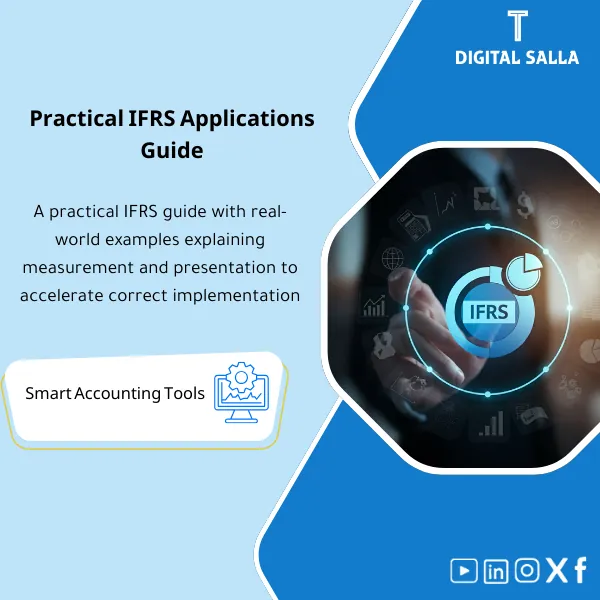
Practical IFRS Applications – PDF File
1,116
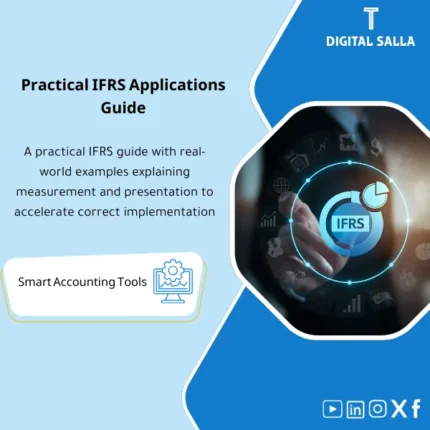
Practical Applications of IFRS: A comprehensive guide to understanding and applying IFRS through actionable guidance and practical examples—enhancing transparency, compliance, and reporting quality.
Still closing your books “manually” without a structured IFRS workflow from start to finish?
This is not just another theory guide. It is a complete practical toolkit that walks you through every stage of IFRS closing — from Workpapers + JE Log + Adjusted TB to the final Closing Pack. Designed for accountants who need a reliable, audit-ready process with built-in Checklists — so nothing slips through the cracks.
🛡️ 7-Day Guarantee
📄 PDF + Excel/Word Templates
5 Signs Your IFRS Closing Process Needs This Toolkit
1No Written Policies: Recognition and Measurement decisions lack a formal Policy Memo with clear ownership — leaving your team guessing every reporting cycle.
2Scattered Calculations: Leases, ECL, and Impairment workpapers live in random spreadsheets with no version control or documented assumptions — a classic “where did that number come from?” problem.
3Missing Audit Trail: IFRS adjustments are posted without a centralized JE Log, so tracing any entry back to its source Workpaper becomes a time-consuming hunt.
4No Reconciliation Framework: Tie-outs between Workpapers and the TB are done ad hoc, and the Adjusted TB is not systematically validated before reporting.
5Disclosure Gaps: Footnotes are drafted from memory without a Checklist, and the final package goes out without formal sign-off — risking incomplete disclosures.
What You Get
A full end-to-end IFRS closing system — from initial Trial Balance all the way to a signed-off Closing Pack. Here is everything included:
| Closing Runbook | A step-by-step IFRS closing guide covering every phase: data gathering, measurement, posting, reconciliation, disclosure, and final sign-off. |
| Policy Memo Templates | Ready-to-use accounting policy memos with Prepared/Reviewed fields, covering Recognition and Measurement for all major IFRS standards. |
| Measurement Workpapers | Detailed calculation templates for Revenue, Leases, ECL, Provisions, Impairment, Taxes, and other standards — with built-in assumptions and references. |
| JE Log + Supporting Docs | A centralized IFRS Journal Entry log with standard references, linking every adjustment back to its source Workpaper or contract. |
| Tie-outs + Adjusted TB | Reconciliation templates connecting Workpapers to TB/GL, producing a validated Adjusted Trial Balance ready for financial statement preparation. |
| Disclosure Checklists | Standard-by-standard disclosure checklists with Done/NA/Pending status tracking and input fields linked to each financial statement note. |
| Closing Pack Index | A master table of contents with version control, sign-off tracking, and a complete reference guide for the entire closing package. |
How to Use This Toolkit in 3 Phases
Set Up Your Baseline and Identify Standards
Export your Trial Balance as a baseline, then map your balances to the applicable IFRS standards (e.g., Revenue, Leases, Financial Instruments, Fixed Assets, Employee Benefits). Use the Runbook to build your IFRS closing timeline with clear ownership for each task.
Measure + Document + Post Adjustments
Complete the Measurement Workpapers for each applicable standard. Draft your Policy Memo to document the basis for each decision. Then post all IFRS adjustments to the JE Log, linking every entry to its supporting Workpaper, contract, or schedule.
Tie-outs + Disclosures + Closing Pack
Run Reconciliations and Tie-outs across Workpapers, JE Log, and TB to produce your Adjusted TB. Then complete the Disclosure Checklists and assemble the Closing Pack with version control and sign-off for final delivery.
Your Closing Process: Before vs. After
| Aspect | ❌ Without This Toolkit | ✅ With This Toolkit |
|---|---|---|
| Measurement | Ad hoc spreadsheets with undocumented assumptions | Structured Workpapers with built-in assumptions and standard references |
| Adjustments | Journal entries scattered across files with no central log | Centralized JE Log with full traceability to source documents |
| Disclosures | Notes drafted from memory, risking incomplete or inaccurate reporting | Disclosure Checklists with Tie-outs ensuring every required note is covered |
| Delivery | Final package assembled last-minute with no version control or sign-off | Closing Pack with master index, version tracking, and formal sign-off |
You are a Chief Accountant, Financial Controller, or Senior Accountant responsible for IFRS reporting. Ideal if you are handling IFRS Conversion or periodic Reporting and need structured Workpapers, audit-ready documentation, or if your Internal Audit team demands full traceability across the closing process.
You work exclusively with public sector standards (IPSAS), or your organization uses a fully automated ERP-based closing module that already generates all IFRS workpapers and disclosures — or you are looking for a basic bookkeeping template rather than a complete IFRS closing framework.
What exactly is included in this “Practical IFRS Applications” toolkit?
The toolkit includes: Measurement Workpapers, Policy Memo Templates, a centralized JE Log, Disclosure Checklists, Tie-out Reconciliations, and a Closing Pack with Index. A detailed Runbook guides you through the entire closing process step by step — so you know exactly what to do and when.
Can I use this toolkit for US GAAP reporting?
This toolkit is designed specifically around IFRS/IAS standards. While many of the structural components (JE Log, Tie-outs, Closing Pack) are universally applicable, the measurement workpapers and disclosure checklists reference IFRS — not FASB guidance.
What data do I need before I start?
You will need your TB/GL export plus supporting schedules for applicable standards: Revenue contracts, Lease Schedules, AR Aging for ECL, and your Fixed Asset Register for Impairment. Each Workpaper specifies exactly what inputs are required.
Can I use this for interim reporting, not just year-end?
Absolutely. Some Workpapers are year-end specific (such as Impairment and Deferred Tax), but the JE Log, Reconciliations, and Closing Pack structure work perfectly for quarterly or interim reporting cycles.
Ready to transform your IFRS closing from stressful guesswork into a structured, audit-ready process?
Get everything you need to close your books with confidence — complete IFRS Workpapers, built-in Checklists, and a professional Closing Pack.
| الفئات | Professional References & Guides |
|---|---|
| Job Title | Accountant |
| Level | Intermediate |
| Format | PDF/Excel |
Related products
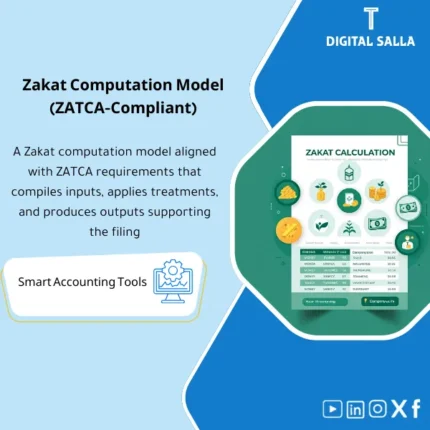
Zakat Computation Model – Excel File
Practical Zakat Calculation Template is a comprehensive Excel program to calculate Zakat accurately in accordance with the Executive Regulations of the Zakat Collection System in the Kingdom of Saudi Arabia. Includes simplified explanations of calculation rules—easy to use even for mid-level accountants.


Reviews
Clear filtersThere are no reviews yet.