



Make vs Buy Decision Model – Excel Template
63.56 $
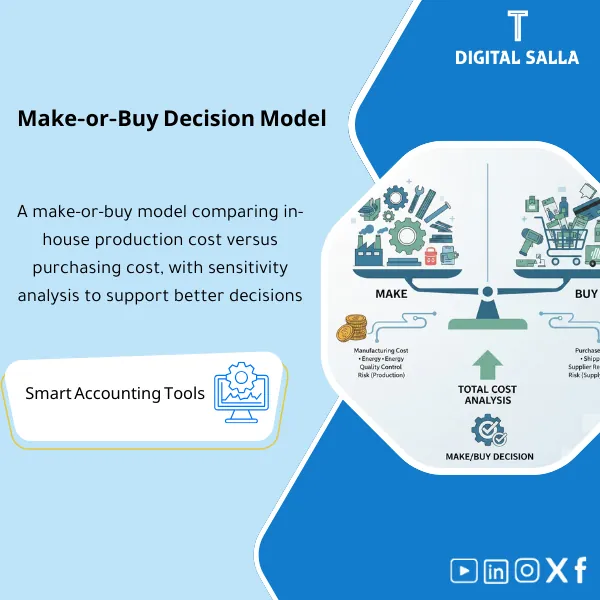
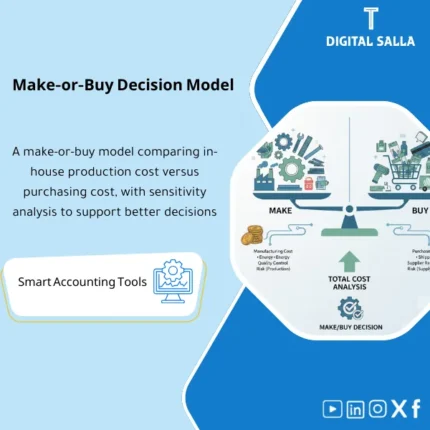
Make vs Buy Analysis: Compares manufacturing cost vs purchasing cost while considering capacity constraints, quality, lead time, and sensitivity to price/volume. Delivers a documented make/buy decision for outsourcing approvals or capacity expansion.
Make vs Buy Template (Manufacturing/Purchasing Decision)
A practical decision template (Excel/Costing Pack) for comparing Internal Manufacturing Costs versus Purchase/Outsourcing Costs using TCO and Capacity Analysis and Sensitivity analysis to produce a defensible decision recommendation (Finance + Ops + Procurement).
Value Proposition: Instead of a decision based on “gut feeling” or merely comparing supplier prices, the template builds the Make vs Buy decision on:
Total Cost of Ownership (TCO) + Capacity Constraints + Risks/Quality/Timing + Sensitivity Analysis.
The result: A clear decision with documented assumptions and scenarios (“What if the supplier price increases by 8%? What if the yield decreases?”).
In 20 Seconds: What Will You Get?
- Cost Model: Comparison of unit costs for Make vs Buy (Materials + Labor + OH + Scrap + Setup + Maintenance…)
- TCO Model: Total cost including (Shipping/Customs/Warehousing/Waste/Warranty/Returns/Quality/Supply Risks)
- Capacity Check: Factory capacity assessment (Hours/Work Centers) and identification of constraints (Bottleneck)
- Outsourcing Decision: Scenarios for full/partial/seasonal outsourcing (Peak)
- Sensitivity Analysis: Sensitivity of the decision to factors (Material Price, Labor, Yield, Lead Time, FX)
- Break-even: Break-even point (Volume/Time) for when manufacturing is preferable to purchasing
- Risk & Qualitative: Qualitative risk assessment (Quality, Flexibility, Confidentiality, Alternative Suppliers)
- Recommendation Output: Final recommendation with confidence level and “Top 3 Influencing Factors”
- Controls: Identification of missing assumptions/illogical values/unintended duplications
- Dashboard: Quick decision summary for management (Unit Cost + TCO + Capacity + Sensitivity)
Delivery associated with the button: Make Cost | Buy Cost | TCO | Capacity | Sensitivity | Decision Dashboard.
Suitable For
- A factory with limited capacity needing to determine what to manufacture in-house and what to outsource.
- A company looking to outsource part of its operations or specific components.
- Procurement/Finance teams wanting a decision based on TCO rather than just price.
- Designing a new product and determining the manufacturing/sourcing strategy from the outset.
Not Suitable For
- If there is absolutely no basic cost data (BOM/Supplier Price/Volume).
- If the decision relies on regulatory constraints/exclusive contracts with a third party (in which case the template becomes merely a helper).
Without the Template / With the Template
| Item | Without the Template | With the Template |
|---|---|---|
| Comparison | “Supplier price is lower/higher” | Unit Cost + TCO + Risks + Capacity |
| Capacity | Not considered | Capacity Check + Bottleneck + Outsourcing Scenario |
| Risks and Quality | Mentioned verbally | Risk Score + Quality Cost + Impact of Warranty/Returns |
| Transparency | Undocumented assumptions | Assumptions Log + Controls + Management Presentation Outputs |
Before Use: 5 Symptoms That Your Make vs Buy Decision Needs a Template
- Outsourcing decisions change quarterly based on capacity pressure without knowing the true cost.
- Internal comparisons rely solely on direct costs and overlook (shipping/customs/inventory/waste/quality).
- Significant margin fluctuations due to changing purchase costs (FX/supplier/lead time) without sensitivity analysis.
- Presence of a bottleneck in one production line but no clear calculation of hourly value or opportunity cost.
- Frequent discussions between Finance, Ops, and Procurement without a unified decision model.
What Does the Make vs Buy Template Cover?
1) Internal Manufacturing Costs (Make Cost)
- Materials: BOM Cost (can be linked with multi-level Cost Roll-up).
- Direct Labor: Hours × Rate + Efficiency Variances (optional).
- Overhead: OH allocation (per hour/per unit/percentage) + Over/Under (optional).
- Setup/Changeover: Setup time and rates.
- Scrap/Yield: Impact of waste on consumption or cost.
- Maintenance/Power/Equipment Usage: If you wish to add usage cost (Machine rate).
2) Purchase/Outsourcing Costs (Buy Cost)
- Supplier Price: Quote + Pricing Terms.
- Logistics: Shipping/Insurance/Customs/Handling.
- Quality: Costs for Inspection/Rejection/Returns/Rework if applicable.
- Inventory: Carrying cost due to longer lead times or MOQ.
- Risks: Supply disruptions/reliance on a single supplier/currency fluctuations.
3) TCO (Total Cost of Ownership)
The template aggregates all “visible and hidden” cost elements to provide you with TCO Make and TCO Buy,
then Cost Difference + Reason for Difference.
4) Factory Capacity Analysis (Capacity)
- Calculate required hours = (Volume × Std Time) + Setup.
- Compare with available hours for each Work Center.
- Identify Bottleneck and show its impact on the decision (you may need to outsource to relieve the constraint).
5) Sensitivity Analysis (Sensitivity)
Tests the decision against reasonable changes in:
- Material/Supplier Price
- Yield/Scrap
- Wage Rate or Operational Efficiency
- Lead Time / MOQ / Inventory Days
- FX Rate (if importing)
Product Components (Clear Inventory)
-
Inputs & Assumptions
- Volume / Horizon / FX / Carrying % / Defect % / Warranty rate.
- Assumptions Log to document the source of each number.
-
Make Cost Model
- Materials + Labor + OH + Setup + Scrap/Yield + Machine rate (optional).
- Unit Cost & Total Cost by period.
-
Buy Cost Model
- Supplier Price + Freight/Duties + Quality Cost + Inventory Cost.
- Unit Cost & Total Cost by vendor/scenario.
-
TCO Summary
- TCO Make vs TCO Buy + Delta + Drivers.
-
Capacity & Bottleneck Check
- Required/Available hours by Work Center + Impact of outsourcing on relieving the constraint.
-
Break-even
- Break-even volume/time based on fixed and variable cost differences.
-
Sensitivity & Scenarios
- Changes ±% for key factors + “Best/Base/Worst” matrix.
-
Decision Dashboard
- Recommendation + Scorecard + Key Drivers + Risk flags.
-
Controls
- Missing/Negative values/Duplicates/Unit conflicts/FX warnings.
Suggested Tabs Within the Delivery File
- Inputs | Make Cost | Buy Cost | TCO | Capacity | Break-even | Sensitivity | Dashboard | Controls.
After Implementation (Only Two Points)
- Operational Outcome: The outsourcing decision becomes based on actual capacity constraints (Bottleneck) rather than immediate pressure.
- Financial Outcome: The decision becomes defensible to management/audit as every number is linked to a source and documented assumption, with sensitivity analysis showing when the decision changes.
FAQ — Questions Before Purchase
Does the template only compare “Supplier Price”?
No. It compares TCO (price + shipping/customs + inventory + quality + risks + other elements as per your choice).
Can it be linked with a multi-level BOM Cost Roll-up?
Yes. You can pull material costs from the Cost Roll-up template (Product 88) to reduce manual input and improve the accuracy of Make Cost.
How do I handle investment/Capex if manufacturing requires new equipment?
The template supports inputting Capex and converting it to cost per unit (Depreciation per unit) or annual cost within TCO,
then comparing its impact on Break-even.
Does the template support partial outsourcing?
Yes. You can allocate Make/Buy ratios or distribute volumes between (In-house + Supplier) and test the impact on capacity and cost.
What are the top 3 factors that often change the Make vs Buy decision?
Often: Yield/Scrap, Capacity/Bottleneck, Inventory Cost and Lead Time (especially if MOQ or importing).
The template illustrates this numerically for each case.
If You Want a Clear Manufacturing/Purchasing Decision with Numbers (Unit Cost + TCO + Capacity + Sensitivity)
Outputs: Recommendation + TCO Gap + Break-even + Sensitivity + Capacity Constraints.
| المسمّى الوظيفي | |
|---|---|
| Duration | |
| المستوى | |
| التحديثات | |
| القطاع | |
| الصيغة |
Related products
DOA Matrix – Excel Template




Reviews
Clear filtersThere are no reviews yet.