


Master Data Governance & RACI – Word & Excel Files
84.84 $
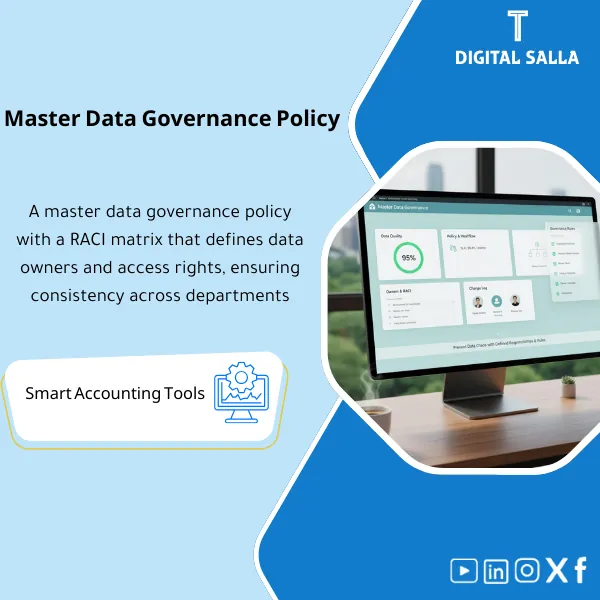
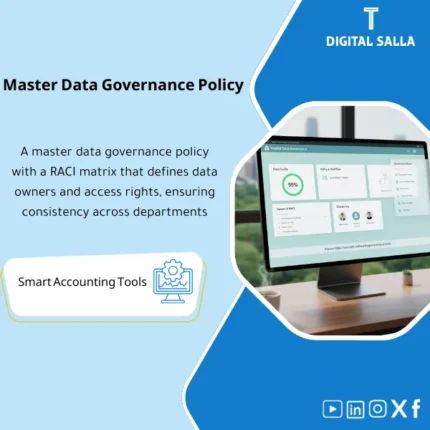
Master Data Governance Policy: Defines data owners, RACI, quality standards, and creation rules for customers, vendors, and items. Delivers a governance framework that prevents duplication and improves data quality after go-live.
Master Data Governance
Policy + RACI + Owners/Stewards + Data Quality Rules — Operating governance that is traceable and auditable
Value Proposition: Master Data Governance is not a “document” that is stored; it is an operating system that defines who owns the decision to create/modify the Master, what the mandatory rules are, and what evidence proves that the change was made with approval and a clear audit trail instead of invisible modifications that affect AP/AR/Inventory and Month-End later.
In 20 seconds: What will you get?
- Data Governance Policy defines the Lifecycle of the Master: Create / Change / Block / Merge / Deactivate.
- Data RACI for each Domain: Who is Responsible? Who is Accountable? Who is Consulted? Who is Informed?
- Assigning Data Owners & Stewards + Authority limits + Backup + Escalation path.
- Master Data Creation Rules (Naming/Coding + Mandatory fields + Duplicate prevention) as acceptance/rejection criteria.
- Data Quality Management: Measurable Data Quality Rules + DQ issues log + Aging + Closing plan.
- Exception log: Why was the exception accepted? What is the compensating control? When is it closed? Who is responsible?
- Operating guidelines package: Versioning + Sign-off + Review calendar to prove periodic reviews.
CTA related to outputs: You will receive Policy + RACI + Registers + Data Quality Rules ready for approval and operation.
Suitable for
- Multi-user ERP: When changes to customers/vendors/items lead to operational errors and rejects and subsequent reconciliations.
- Multi-branch/entity companies: Need standardized rules for the Master with exception management without breaking reports.
- Regulatory/audit environment: Requires proof of “who approved and why” for each change and its impact on operations and reports.
Not suitable for
- A very small company with a single owner who creates, approves, and operates without role separation—the governance would be an unjustified burden.
- Those who do not want Owners, approvals, or periodic reviews—without accountability, governance will not work practically.
Without governance / With governance (short comparison)
| Item | Without Master Data Governance | With the Pack |
|---|---|---|
| Create/Modify | Direct changes within ERP without reasons/attachments | Policy + RACI + Acceptance rules + Change log |
| Duplicates | Duplicates accumulate and appear in AR/AP | Duplicate prevention rules + DQ log + Documented Merge decisions |
| Accountability | No clear Owner when an error occurs | Data Owners & Stewards + Data RACI |
| Evidence | No traceability as to why the field was changed | Change/Exception registers + Versioning + Sign-off |
Before use: 5 symptoms that Master Data “causes operational errors”
- The same customer/vendor appears with multiple codes (Duplicates), leading to discrepancies in Aging or control account reconciliations.
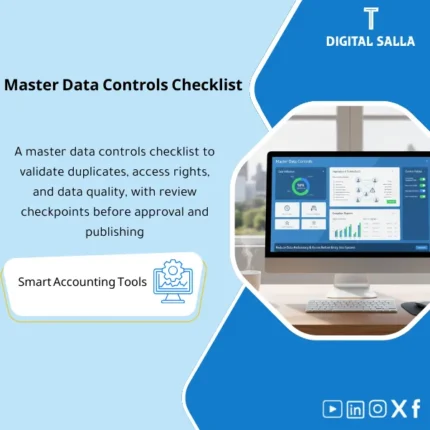
- Sensitive fields (Tax ID / Payment terms / Bank / UoM / Valuation flags) are left incomplete and then addressed during operations.
- Modifications to COA/Cost Centers occur without clear reasons or impact on reports (Mapping/Dimensions).
- The same person requests, approves, and executes (SoD not achieved), or there is no one to approve at all.
- No periodic review of data quality and no log showing what has been closed and what remains open.
Master Data Governance: Implementation Method (3 Steps Without Gaps)
Step 1: Define Scope and Assign Data Owners & Stewards
- Identify Domains: Customers/Vendors/Items/COA/CC/FA/Employees and define “sensitive fields” for each Domain.
- Assign Data Owners & Stewards + Backup + Escalation path for conflicts.
- Classify changes: Low/Medium/High sensitivity to determine the level of approvals required.
Step 2: Approve Data Governance Policy + Data RACI + Master Data Creation Rules
- Issue a Data Governance Policy that defines the Lifecycle and evidence requirements for each type of change.
- Approve Data RACI (Create/Change/Deactivate/Merge/Review) and link it to ERP permissions or ticketing system.
- Activate Master Data Creation Rules: Naming/Coding + Mandatory fields + Duplicate prevention + Evidence requirements.
Step 3: Operate Data Quality Management + Evidence Logs + Periodic Reviews
- Operate Data Quality Management: DQ rules + Periodic checks + DQ issues log with Aging and Closure responsibility.
- Operate the Exception register for any Override with compensating control and closure date.
- Monthly/Quarterly review: Summary of change requests + Quality indicators + Merge/Stop decisions + Update Version/Sign-off.
Package Components (Clear Inventory)
-
Master Data Governance Policy
- Practical Purpose: Transform governance into operational rules: Lifecycle + Approval levels + Evidence requirements.
- When to Use: As a daily reference for any creation/modification, and as a reference when investigating an operational error or audit observation.
- Resulting Evidence: Policy document with Version number + Approval page + Change log for the policy itself.
-
Data RACI (Data RACI for each Domain)
- Practical Purpose: Precisely define responsibility: Who requests? Who executes? Who reviews? Who approves? Who is informed?
- When to Use: When designing permissions and during task handover and when requests conflict.
- Resulting Evidence: Signed RACI matrix + linked to roles within ERP or ticketing system.
-
Owners & Stewards Register
- Practical Purpose: An official register that defines Owner/Steward/Backup for each Domain and escalation path.
- When to Use: When organizational structure changes, or when the responsible person is absent, or during audit review.
- Resulting Evidence: Register with review date + Management/Finance approval.
-
Master Data Creation Rules
- Practical Purpose: Acceptance/rejection rules that prevent: Duplicate codes, missing mandatory fields, entering invalid values affecting AP/AR/Inventory.
- When to Use: When creating a new customer/vendor/item/cost center, and when modifying sensitive fields.
- Resulting Evidence: Rules library + Checklists + Completeness audit outputs.
-
Data Quality Rules + Monitoring Pack
- Practical Purpose: Transform “quality” into verifiable rules: Completeness/Validity/Uniqueness/Consistency.
- When to Use: Periodically (Monthly/Quarterly) or before major changes (Migration/Go-Live/Restructuring).
- Resulting Evidence: DQ issues log + Aging + Closure plan + Reviewable quality indicators.
-
Exception Register
- Practical Purpose: Manage Overrides instead of leaving them invisible: Why was the exception accepted? What is the compensating control? Who is responsible? When is it closed?
- When to Use: When temporarily accepting an incomplete record or overriding naming/mandatory fields or accepting a “special” code.
- Resulting Evidence: Exception register + Owner approval + Effective date + Closure date.
-
Review Calendar + Minutes Template
- Practical Purpose: Prove that governance “works” through periodic reviews and documented decisions.
- When to Use: Monthly meeting to review change requests and quality issues + Quarterly review of rules.
- Resulting Evidence: Review minutes + Decision list + Follow-up items.
What should be included in the delivery?
- 01-Pack Index: Scope of Domains + Version copy + Owners + Archiving method.
- 02-Governance Policy: Data Governance Policy (Lifecycle + Approval levels + Evidence requirements + Exceptions).
- 03-RACI Matrix: Data RACI for each Domain and each process (Create/Change/Deactivate/Merge/Review).
- 04-Owners & Stewards Register: Roles register (Owner/Steward/Backup) + Escalation path + Review date.
- 05-Creation/Change Rules Library: Master Data creation rules + Mandatory fields + Naming/Coding + Duplicate prevention.
- 06-Data Quality Rules: Data Quality rules library (DQ rules) + Measurement definition + Acceptance limits.
- 07-DQ Monitoring: DQ issues log + Aging + Closure plan + Closure responsibilities.
- 08-Exception Register: Exception register + Compensating controls + Target close dates.
- 09-Review Calendar: Review calendar (Monthly/Quarterly) + Minutes template + Decision register.
- 10-Versioning & Sign-off: Version register + Change log + Prepared/Reviewed/Approved for documents and records.
After implementation (two points only)
- Operational outcome for the team: Any creation/modification of Master Data goes through clear acceptance rules + Defined Owner + Change/Exception log, reducing “late corrections” in AP/AR/Inventory as the decision is closed at the point of entry.
- Regulatory/audit outcome: You can provide evidence: Approved Policy + RACI + Owners register + DQ logs + Exception register + Review minutes—any change has become traceable instead of “a modification within the system” without a story.
FAQ — Questions Before Purchase
Is the pack tied to a specific ERP system?
No. It is Master Data Governance as procedures, roles, and records. It can be linked to ERP permissions or operated through a ticketing system.
Does it include Customers/Vendors/Items/COA/Cost Centers?
The structure supports all of them. The final scope is confirmed within the Pack Index based on the Masters you have.
What is the difference between Data Owner and Data Steward?
Owner has the decision to approve/reject/exception. Steward executes according to the rules, conducts quality checks, and updates records.
Does the Data RACI replace the Change Request Workflow?
The RACI defines responsibility, but daily operations require a Change Request form and Change log. The pack provides operational logs that can be linked to a Change Request form if desired.
How does the pack handle exceptions (Override)?
Through the Exception register: Reason, compensating control, Owner approval, effective date, and closure date—instead of invisible exceptions within the system.
Is there measurable Data Quality Management?
Yes: Data Quality Management relies on verifiable DQ rules (Completeness/Validity/Uniqueness/Consistency) + DQ issues log with problem aging.
Is it suitable before migration (Data Migration)?
Yes, especially to establish Master Data creation rules and Owners before migrating “the same errors” to the new system.
Does it comply with SoD/DOA?
It integrates with them: SoD controls conflicting permissions, and DOA controls financial approval limits, while the pack governs “who owns the Master Data and how it is managed.”
Ready to establish ownership of Master Data and close the door on undocumented changes?
Outputs: Data Governance Policy + Data RACI + Data Owners & Stewards + Master Data Creation Rules + Data Quality Management with evidence logs and approvals.
| المسمّى الوظيفي | |
|---|---|
| Duration | |
| المستوى | |
| التحديثات | |
| القطاع | |
| الصيغة |


Reviews
Clear filtersThere are no reviews yet.