



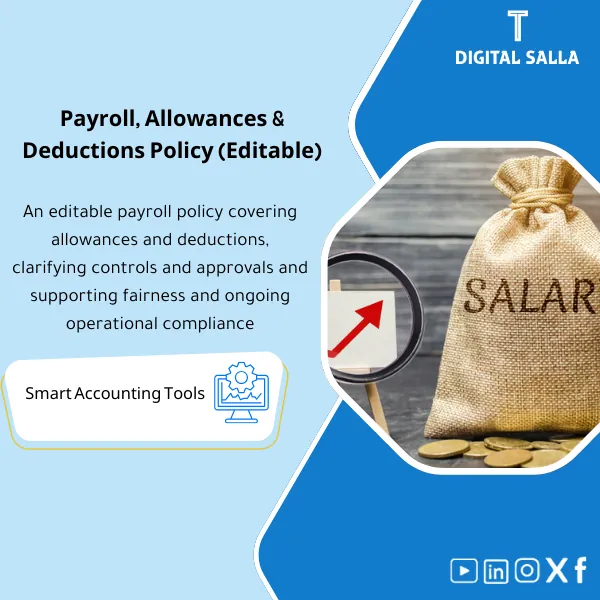
Payroll Policy – Editable Word File
55.59 $
Payroll Policy: Defines salary components, allowances, deductions, cut-off rules, approvals, and adjustment governance—integrated with GOSI/WPS requirements. Delivers a unified operating reference that reduces payroll disputes and standardizes monthly processing.
Payroll Policy
The Payroll Policy regulates allowances, deductions, payroll cut-off, overtime, advances, and loans, producing applicable and reviewable operating manuals.
Value Proposition: The Payroll Policy is not a generic “Human Resources” document; it is the document that prevents payroll from becoming a monthly negotiation and exceptions project. The real scenario: allowances are disbursed without criteria, deductions are applied without rules, undocumented overtime, and an unstable cut-off result in retroactive adjustments and recurring discrepancies between Payroll and GL. This package operationalizes the Payroll Policy: a clear definition of payroll elements, allowances and deductions policy (when they are disbursed/deducted/how they are documented), deductions rules and limits and approvals, payroll cut-off (when the month closes and what is included/excluded), overtime policy (approval/calculation/impact on Payroll), and advances and loans policy (request/approval/deduction scheduling/reconciliation). The goal: to reduce exceptions because the rule is written and applicable, and to provide the accountant/Payroll with a traceable path for any inquiry or review.
In 20 Seconds: What Will You Get?
- Payroll Policy written in operational language: “What happens? Who approves? What is the evidence?”.
- Allowances and Deductions Policy: Definition of each allowance/deduction + eligibility criteria + required documentation + system entry point.
- Deductions Rules: Deduction limits, permissible cases, handling of late deductions, and deduction scheduling.
- Payroll Cut-off: Payroll cut-off schedule + what is included/excluded + how to handle arrears and retroactive adjustments.
- Overtime Policy: Documentation of hours, manager approval, calculation mechanism, and disbursement limits.
- Advances and Loans Policy: Request form + approval + repayment schedule + linking deduction to salary + reconciliation upon exit.
- Forms and Records Package: Forms + Trackers + Exception log + Sign-off.
CTA linked to outputs: Receive Policy + Approval Forms + Cut-off Calendar + Trackers + Controls Checklist.
Suitable For
- Payroll Lead / HR Ops: Standardizing rules, reducing exceptions, and maintaining evidence before/after the month.
- Financial Controller / GL: Controlling payroll elements and linking them to GL accounts, reducing recurring adjustment entries.
- Internal Audit / Compliance: Having a testable policy: rules + approvals + evidence + exception log.
Not Suitable For
- If a generic “HR Policy” is required that does not include operational forms, approvals, and evidence — this package is operational and payroll-focused.
- If payroll is fully outsourced and there is no ability to apply cut-off or manage exceptions internally — you will first need to define your scope of responsibilities.
Without Policy / With Policy (Brief Comparison)
| Item | Without Payroll Policy | With Payroll Policy Pack |
|---|---|---|
| Allowances/Deductions | Ad-hoc decisions + undocumented exceptions | Allowances and Deductions Policy + request/approval form + guide |
| Cut-off | Delays and recurring retroactive adjustments due to unstable cut-off | Documented payroll cut-off + list of what is included/excluded + path for arrears |
| Evidence | Difficult to prove why disbursed/deducted | Exception log + approvals + trackers ready for delivery |
Before Use: 5 Symptoms That Payroll Will Remain Full of Exceptions
- Every month, new allowances/deductions appear because rules are unwritten or unapproved.
- Deductions are made without clear deductions rules (limits/priorities/scheduling), leading to disputes.
- Payroll cut-off is unstable, resulting in frequent requests to “add this month” and increased retroactive adjustments.
- Overtime is disbursed without documentation of hours and approval, or with different calculation methods between departments.
- Advances and loans are managed manually without a repayment schedule and log, leading to unexplained balances.
How is the Payroll Policy Practically Applied Throughout the Month?
Implementation begins before the month: establishing payroll elements and their corresponding documentation and approvals, then establishing payroll cut-off (dates for receiving changes, deadline, closing date, payment date). During the month, requests are managed through forms: allowance/deduction/overtime/advance/loan, and each request goes through a specified approval and is saved as evidence. Before the Payroll run, a pre-checklist is performed on inputs (completeness) and deductions rules and limits are applied. After the run, an evidence file is issued: approved changes, exceptions, advances and loans logs, and Prepared/Reviewed sign-off. This way, the policy becomes “operational” rather than a Word file on the server.
Implementation Method (3 Steps)
Step 1: Preparation and Gathering Reports
- List of current payroll elements (Earnings/Deductions/Overtime/Allowances).
- Approval limits (DOA) for payroll/advances/deductions (if any) or definition of who approves each type.
- Payroll calendar + closing dates + data review cycle before the run.
- Linking payroll elements to GL accounts (High-level mapping) to reduce misclassifications.
Step 2: Applying Rules (Allowances/Deductions/Overtime/Advances)
- Implementing allowances and deductions policy: for each element (eligibility criteria + documentation + approval + effective date).
- Implementing deductions rules: deduction priorities, limits, and how to handle late deductions.
- Implementing overtime policy: what is accepted as evidence of hours, who approves, and how it is calculated and recorded.
- Implementing advances and loans policy: request/approval form, repayment schedule, linking deduction to salary, and closing upon exit.
- Recording any exception in the Exception log with reason and approval (instead of “verbal exception”).
Step 3: Cut-off + Month-End Closing + Archiving Evidence
- Establishing payroll cut-off: what is approved before closing enters the month, and what comes after is carried over to the next month/retro with a clear rule.
- Issuing a Payroll evidence package: change log + approvals + exception log + advances/loans schedules.
- Preparing sign-off (Prepared/Reviewed) and archiving files according to a fixed retention tree.
Product Components (Clear Inventory)
-
Payroll Policy (DOCX/PDF)
- Practical Purpose: Payroll policy document: elements/rules/approvals/evidence and operations.
- When to Use: During establishment + whenever there is a change in payroll elements or controls.
- Resulting Evidence: Approved policy with issuance date and signature.
-
Allowances & Deductions Rules Matrix (Allowances and Deductions Policy)
- Practical Purpose: Table for each allowance/deduction: eligibility criteria, documentation, approving entity, effective date, and system coding.
- When to Use: Before each month for review or when adding a new element.
- Resulting Evidence: Auditable rules matrix.
-
Deductions Rules & Caps (Deductions Rules)
- Practical Purpose: Deduction limits, priorities, handling of arrears, and dispute resolution path.
- When to Use: When there are multiple deductions or late deductions.
- Resulting Evidence: Rules + application examples + application log.
-
Payroll Cut-off Calendar (Payroll Cut-off)
- Practical Purpose: Clear calendar: last date for changes, closing date, review date, payment date.
- When to Use: Monthly to adjust what is included and what is postponed.
- Resulting Evidence: Calendar + sign-off on adherence to the cut-off.
-
Overtime Policy + Timesheet Approval (Overtime Policy)
- Practical Purpose: Definition of acceptable overtime, evidence, approval, and calculation.
- When to Use: Monthly before entering overtime into payroll.
- Resulting Evidence: Timesheet approvals + overtime register.
-
Advances & Loans Policy + Schedule (Advances and Loans Policy)
- Practical Purpose: Request/approval/repayment schedule/deduction/reconciliation upon exit.
- When to Use: When granting an advance/loan + monthly to track deductions.
- Resulting Evidence: Loan register + repayment schedule + approvals.
-
Exception Log + Evidence Index
- Practical Purpose: Documenting exceptions and linking them to approval and evidence instead of verbal decisions.
- When to Use: Monthly, especially close to the cut-off.
- Resulting Evidence: Closed exception log + links to evidence.
-
Payroll Pre-Run Checklist + Sign-off
- Practical Purpose: Pre-run checklist (completeness/approvals/cut-off adherence).
- When to Use: Before each Payroll run every month.
- Resulting Evidence: Signed checklist + date.
-
GL Mapping Summary (High-level)
- Practical Purpose: Linking payroll elements to main accounts to reduce misclassification.
- When to Use: When establishing the policy + when adding a new element.
- Resulting Evidence: Mapping table + owner.
What Should Be Included in the Delivery?
- 01-Payroll-Policy.pdf: Payroll Policy (final approved version).
- 02-Payroll-Policy.docx: Editable version (for customization within your company).
- 03-Allowances-Deductions-Rules-Matrix.xlsx: Allowances and Deductions Policy as an operational table.
- 04-Deductions-Rules-Caps.xlsx: Deductions rules (limits/priority/arrears handling) + examples.
- 05-Payroll-Cutoff-Calendar.xlsx: Payroll cut-off (dates + responsibilities + cut-off points).
- 06-Overtime-Policy-Timesheet-Forms.xlsx: Overtime Policy + documentation and approval forms for hours.
- 07-Advances-Loans-Policy-Forms.xlsx: Advances and Loans Policy + request/approval forms.
- 08-Loans-Repayment-Schedule.xlsx: Repayment schedule and deduction for advances/loans + balance tracking.
- 09-Exception-Log.xlsx: Payroll exception log + justification + approval + impact.
- 10-Pre-Run-Checklist.pdf: Pre-run checklist + control points.
- 11-Signoff-Templates.docx: Prepared/Reviewed/Approved sign-off templates.
- 12-GL-Mapping-Summary.xlsx: Linking payroll elements to main GL accounts.
- 13-RACI-Payroll-Process.xlsx: Distribution of responsibilities (Owner/Reviewer/Approver) within the payroll cycle.
- 14-Evidence-Index.xlsx: Monthly evidence index (approvals/forms/reports) + links/storage paths.
- 15-Runbook.pdf: Step-by-step operation: requests → approvals → cut-off → run → evidence.
- 16-Archiving-Map.docx: Retention tree (Year/Month/Payroll/Policy/Approvals) + naming convention.
After Implementation (Two Points Only)
- Operational Outcome for the Team: Exceptions decrease because each allowance/deduction/overtime/advance has a rule, form, and approval, making cut-off a corporate decision rather than a monthly negotiation.
- Control/Audit Outcome: Every payroll movement has a traceable impact: request → approval → entry → run → preserved evidence (Exception log + evidence index).
FAQ — Questions Before Purchase
Is this a generic policy or customizable?
Customizable: You will receive an editable DOCX version + operational tables (Matrices) to apply your company’s policy to actual payroll elements.
Does it fit any Payroll system?
Yes. The policy and forms do not rely on a specific system; the important thing is to apply the rules within your system or through your procedures.
Does it practically include payroll cut-off?
Yes: cut-off calendar + what is included/excluded + path for late requests (carryover/retro) with documentation.
Does it cover overtime policy?
Yes: definition of overtime, required documentation (timesheets), approvals, and calculation rules and limits.
Does it fully cover advances and loans policy?
Yes: request/approval, limits, repayment schedule, linking deduction to salary, and reconciliation upon exit.
Does it help in controlling multiple deductions?
Yes, through deductions rules (priority/caps/arrears) and an exception log to prevent unjustified deductions.
Are there ready approval forms?
Yes: request/approval forms for allowances/deductions/overtime/advances, along with sign-off templates.
What is the minimum requirement for implementation?
A list of current payroll elements + definition of who approves each type + payroll calendar + high-level mapping with GL (optional but beneficial).
Ready to finalize payroll with clear rules and reduce retroactive adjustments and exceptions?
Outputs: Payroll Policy + Allowances and Deductions Policy + Deductions Rules + Cut-off Calendar + Overtime Forms + Advances and Loans Forms + Exception log.
| المسمّى الوظيفي | |
|---|---|
| Duration | |
| المستوى | |
| التحديثات | |
| القطاع | |
| الصيغة |
Related products


Reviews
Clear filtersThere are no reviews yet.