

ECL Model – Excel File
111.44 $
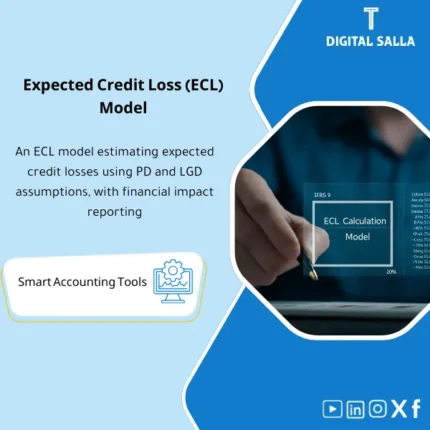
Expected Credit Loss (ECL) Study Template is an advanced Excel tool to calculate ECL provisions in line with IFRS 9, with automated schedules and required calculations—supporting accurate results and effective implementation.
Method of Calculating ECL
IFRS 9 ECL Workbook: Provision Matrix + Staging + ECL Allowance Rollforward + JE Log + Closing Pack (Excel)
Value Proposition: The method of calculating ECL is not substantiated in the audit merely by a “provision percentage”; what is actually required at Month-End/Year-End is a file that links: AR/Aging data → Methodology (Segmentation + PD/LGD or Provision Matrix) → Traceable provision outcome → Provision movement (Rollforward) → JE documented within the JE Log → Reconciliations to TB/GL. This template is designed as an Operating Pack to transition from calculation to delivery (Closing Pack) that can be tested by sample.
In 20 Seconds: What Will You Get?
- Ready Data Pack: AR Aging input sheet + Linking Customer/Portfolio/Terms.
- Segmentation Builder: Customer/Portfolio segmentation (Retail/Wholesale/Key accounts… according to your company) as input for the matrix.
- Provision Matrix / PD-LGD: Building loss ratios based on write-off history + buckets (Days Past Due).
- ECL Calculation Engine: Calculating Allowance at the customer/invoice/portfolio level with Traceable logic.
- Allowance Rollforward: Provision movement (Opening → Charge/Release → Write-offs → Closing) to support Year-End.
- JE Template + JE Log: Provision/Reverse/Write-off entry with Reference to the file.
- Reconciliation + Closing Pack: Matching provision to GL/TB + Delivery file (Index + Sign-off).
CTA related to outputs: Receive ECL Calculation + Allowance Rollforward + JE Template/JE Log + GL Reconciliation + Closing Pack.
Suitable For
- GL / Financial Reporting: To produce expected credit loss provisions supported by schedules and memos (IFRS 9).
- Controller / Chief Accountant: To close Allowance monthly/yearly with Rollforward and Reconciliations before Adjusted TB.
- Internal/External Audit: For obtaining Traceability: Data → Methodology → Outcome → Entry → GL.
Not Suitable For
- Those seeking individual services such as Citizen Account or Citizen Account Calculator or Citizen Account Login or Citizen Account Inquiry or Create Gmail Account or Open Al Rajhi Account.
- Banks/finance subject to advanced Regulatory ECL models (Basel/IRB) — this template is aimed at Corporate companies and operational AR/Loans portfolios for IFRS 9 and financial statement closure purposes.
Without the Template / With the Template (Short Comparison)
| Item | Without ECL Study File | With ECL Study Template |
|---|---|---|
| Provision Methodology | General percentage not understood in its sources | Provision matrix/PD-LGD with documented Segmentation and Assumptions |
| Provision Movement | Year-End rollforward done manually and late | Ready allowance rollforward + Write-off/Recovery/Increase/Reverse |
| Audit | Difficult to link provision amount to AR data | Traceability: Aging → calc → JE → GL + Closing Pack |
Before Use: 5 Symptoms That the Provision File Will Not Pass at Year-End
- The provision is determined “as a percentage” without a Provision Matrix or portfolio segmentation, leaving no testable logic.
- No matching between the AR Aging used in the calculation and the customer/provision balance in TB/GL.
- Write-offs and recoveries are not reflected in the provision movement, resulting in an illogical Rollforward.
- Policy changes or credit events are not documented as Overlay/Assumptions, leading to unexplained jumps in the provision.
- No JE Template or JE Log references, making the provision amount “present in the sheet” but not linked to an entry and closure.
Method of Calculating ECL Practically Within the Closure
Step 1: Preparation and Report Gathering
- Extract AR Aging with the same Cut-off as Month-End/Year-End (including Customer ID/Invoice/DPD).
- Compile write-off and recovery history for an appropriate period + any Credit terms/limits data.
- Define practical Segmentation: by customer type/activity/region/credit policy, with clear Mapping within the file.
Step 2: Build the Study (Matrix/Assumptions) + Calculation + Reasonable Tests
- Create a Provision Matrix or PD/LGD based on the nature of your portfolio (Buckets according to Days Past Due) with documentation of the ratio-building method.
- Run the ECL engine to produce Allowance at the customer/invoice/portfolio level, identifying clear exceptions (Specific provisions).
- Apply Forward-looking overlay (if used by the company) as an Assumptions memo: what is the adjustment? Why? On which Segment?
Step 3: Month-End/Year-End Outputs (JE + Reconciliations + Closing Pack)
- Produce Allowance Rollforward showing movement (Opening/Charge/Release/Write-offs/Closing).
- Issue JE Template and record the entry within JE Log with Reference to the file, then match the provision to TB/GL before Adjusted TB.
- Compile Closing Pack: Data pack + Matrix + Calculations + Rollforward + Reconciliations + Sign-off for delivery to audit.
Template Components (Clear Inventory)
-
AR Data Input Pack (Aging Input File)
- Practical Purpose: Input AR Aging with the same Cut-off and the same Customer IDs to facilitate linking with GL.
- When Used: Monthly before calculating the provision.
- Resulting Evidence: Data snapshot for the month + report source (ERP export) + extraction date.
-
Segmentation & Mapping Sheet (Portfolio Segmentation)
- Practical Purpose: Identify portfolios with differing risks (e.g., Key accounts vs SME) instead of a single percentage for all.
- When Used: At establishment and then periodically reviewed when policy/portfolio changes.
- Resulting Evidence: Segmentation logic + Mapping table linking each customer/invoice to a Segment.
-
Write-offs / Recoveries History
- Practical Purpose: Build Loss rates based on actual data rather than a general estimate.
- When Used: Monthly/quarterly updates based on data availability.
- Resulting Evidence: Write-off/Recovery log + linking to write-off/recovery entry references if possible.
-
Provision Matrix Builder
- Practical Purpose: Generate Loss rate for each Bucket (0-30/31-60/… according to your policy) for each Segment.
- When Used: When preparing the study and then updated periodically.
- Resulting Evidence: Versioned Matrix + source of ratios + internal approval date.
-
ECL Calculation Engine
- Practical Purpose: Apply the matrix/assumptions to AR Aging to produce detailed Allowance.
- When Used: Every Month-End/Year-End.
- Resulting Evidence: Calculation output + identification of Specific items + list of exceptions.
-
Management Overlay & Assumptions Memo
- Practical Purpose: Document any Forward-looking adjustments or credit events instead of adjusting “within the provision amount.”
- When Used: As needed (market/customer/policy changes) + often at Year-End.
- Resulting Evidence: Assumptions memo + numerical impact on the provision + internal approvals (if any).
-
Allowance Rollforward
- Practical Purpose: Document the movement of the provision: Opening → Charge/Release → Write-offs → Closing.
- When Used: Monthly and essential at Year-End.
- Resulting Evidence: Rollforward schedule + explanation of main reasons for changes.
-
Sensitivity / Reasonableness Checks
- Practical Purpose: Test results: Compare the month’s provision with previous months, impact of changing Loss rates, and significant items needing review.
- When Used: Before approving the entry and before delivering the Closing Pack.
- Resulting Evidence: Reasonableness sheet + list of review points (Review notes).
-
JE Templates + JE Log
- Practical Purpose: Issue an entry to record/reverse the provision and link it to the rollforward movement and calculation outputs.
- When Used: Every Month-End/Year-End, and for significant write-offs/special settlements.
- Resulting Evidence: JE Template + entry number after posting + Reference within JE Log.
-
Reconciliation to GL/TB
- Practical Purpose: Link the Allowance balance in schedules with the provision account in TB/GL (and sometimes link AR Aging with customer balance).
- When Used: Monthly before Adjusted TB + annually for delivery.
- Resulting Evidence: Reconciliation schedule + classified discrepancies + remediation plan.
-
Disclosure Support
- Practical Purpose: Prepare supporting numbers/tables for the ECL note (Rollforward/aging split/credit risk) according to your template.
- When Used: Quarter-End/Year-End.
- Resulting Evidence: Note support pack linked to the Rollforward and Recs.
-
ECL Closing Pack Index + Sign-off
- Practical Purpose: Organized delivery: What does the ECL file contain? Who prepared it? Who reviewed it? What is the month’s version?
- When Used: Month-End and Year-End.
- Resulting Evidence: Pack index + Prepared/Reviewed/Approved + Version.
What Should Be Included in the Delivery?
- 01-Pack Index: Delivery index + Owners + Version + Sign-off.
- 02-Data Snapshot: Export AR Aging (month) + report source + extraction date.
- 03-Segmentation: Segmentation rules + mapping table + any changes from the previous month.
- 04-Loss History: Write-offs/Recoveries log + methodology for calculating Loss rates.
- 05-Provision Matrix / PD-LGD: Matrix/parameters + approved issue + Assumptions.
- 06-ECL Calculations: Detailed calculation outputs + list of exceptions (Specific items).
- 07-Overlay Memo: (if any) Forward-looking adjustment memo + numerical impact + approvals.
- 08-Rollforward: Provision movement + explanation of major changes.
- 09-JE Pack: JE Templates + JE Log + posting numbers + References to schedules.
- 10-Reconciliations: Matching Allowance to GL/TB + explanation of discrepancies + corrective actions.
- 11-Disclosure Support: Disclosure support file (Year-End/Quarter-End) linked to the numbers.
- 12-Archiving Map: Folder structure and file naming linking Version to the correct folder.
After Implementation (Two Points Only)
- Operational Outcome for the Team: Provision calculation becomes a consistent monthly pathway: Aging snapshot → Matrix/Assumptions → Calculation → Rollforward → JE.
- Control/Audit Outcome: Complete Traceability: AR data → Methodology → Outcome → Entry → GL/TB, within the Closing Pack with versions and Sign-off reduces repeated auditor requests.
FAQ — Questions Before Purchase
Is the template suitable for any ERP system?
Yes. Because the primary inputs are Export (AR Aging + TB/GL) and the outputs are Schedules and Reconciliations and JE Templates without technical integration.
Is it the “Expected Credit Loss Model” for receivables only or does it include loans?
The basis is designed for Trade Receivables/Contract Assets (Provision Matrix), and it can be adapted for simple Corporate loan portfolios. For banks or advanced Regulatory ECL models, this is out of scope.
Does it support Simplified Approach or General Approach?
It practically supports simplified through the Provision Matrix for receivables. If you need stage logic and 12-month/Lifetime ECL, that can be included as fields/methodology within the file according to your company policy.
What is the minimum data required to get started?
AR Aging at Cut-off + provision balance in TB/GL. To enhance the quality of the study: write-offs/recoveries history and portfolio segmentation and aging periods (Days Past Due).
What if the company is new and there is insufficient write-off history?
A preliminary version can be run using internally approved Loss rates with a clear Assumptions memo, then the matrix can be updated gradually as actual data becomes available (with version documentation).
Is there a ready delivery file for the auditor?
Yes: ECL Closing Pack Index + Data snapshot + Matrix + Calculation + Rollforward + JE references + Reconciliations.
Does it relate to Citizen Account or opening Al Rajhi Account or creating Gmail Account?
No. These are general search terms unrelated. The product is accounting-focused for companies to apply IFRS 9 ECL and close provisions.
Can it be used for Month-End only or Year-End as well?
It serves both: Month-End for producing the calculation and entry and reconciliation, and Year-End for producing Rollforward and supporting disclosures within the Closing Pack.
Ready to Transform the ECL Study into a Reviewable Delivery Instead of a “Provision Percentage”?
Outputs: Provision Matrix + ECL Calculation + Allowance Rollforward + JE Log + GL/TB Reconciliations + Closing Pack.
| المسمّى الوظيفي | |
|---|---|
| Duration | |
| المستوى | |
| التحديثات | |
| القطاع | |
| الصيغة |

Reviews
Clear filtersThere are no reviews yet.