

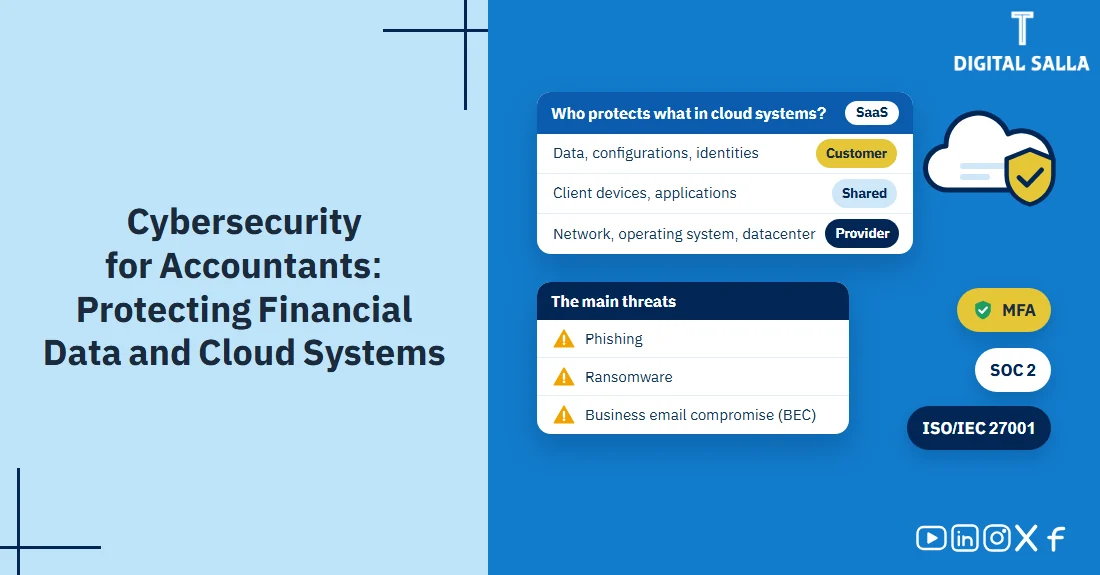
Accounting information security means protecting financial data, and the systems that process it, from unauthorised access, tampering and loss. It works at three levels: the accountant's daily behaviour against phishing, ransomware and business email compromise; the controls inside the accounting system, such as permissions, segregation of duties and the audit trail; and the split of responsibility with the provider when the system runs in the cloud.
Why finance teams are targeted
Accountants hold privileges attackers want: access to bank accounts, payment approval, and payroll and employee data. Microsoft notes that business email compromise attackers zero in on roles with financial authority or high-level access, and lists among the key targets finance employees, such as controllers and accounts payable staff who have banking details, payment methods and account numbers, alongside executives, HR professionals, IT administrators, and new or entry-level employees.
The main threats
| Threat | How it happens | Aim |
|---|---|---|
| Phishing | A fake message posing as a bank or service provider asks you to sign in through a link | Stealing credentials |
| Ransomware | Malware encrypts files and databases and demands a ransom to decrypt them | Extortion for the data |
| Business email compromise (BEC) | Someone impersonates an executive or supplier, or takes over a real mailbox, to request an urgent transfer or a bank account change | Diverting funds or obtaining sensitive data |
Microsoft describes BEC as highly targeted, personalised attacks in which scammers do their homework, mimicking specific people and processes to gain trust, and focus on high-value assets such as wire transfers or sensitive data. One form is account compromise: attackers break into a real mailbox with stolen passwords, then monitor email traffic for weeks and strike when a major payment is due.
Who protects what in cloud systems?
Moving the accounting system to the cloud does not move all security to the provider. In the shared responsibility model Microsoft publishes for its services, for all cloud deployment types the customer owns its data and identities and is responsible for protecting the security of its data and identities, on-premises resources and the cloud components it controls. For software as a service (SaaS), meaning ready-made applications, Microsoft's matrix splits responsibility as follows:
| Responsibility area | SaaS (Microsoft's matrix) |
|---|---|
| Customer data, configurations and settings, identities and users | Customer |
| Client devices, applications | Shared between the customer and Microsoft |
| Network controls, operating system, physical hosts, physical network, physical datacenter | Microsoft |
Whatever the deployment type, the customer always retains four responsibilities:
- Data: including data classification, data protection, encryption decisions and compliance with data governance requirements.
- Endpoints: protecting the client devices that access cloud services, such as mobile devices, laptops and desktops.
- Accounts: managing user accounts, including creating, managing and removing user access.
- Access management: implementing and managing access controls, including role-based access control (RBAC), multifactor authentication and conditional access policies.
This is Microsoft's split for its own services, which Microsoft calls illustrative guidance not intended to modify or contradict the terms of any agreement with Microsoft, so ask your accounting system's provider for its own written split. To weigh the two options, see Cloud vs traditional accounting systems.
Identity, access and segregation of duties
The key question in any system: who can do what, when, and with whose approval?
- Multifactor authentication (MFA) for every account, especially finance and management accounts; Microsoft notes it adds an extra layer of security even if attackers obtain credentials.
- Role-based permissions limited to what the job needs, with a periodic review of users and roles.
- Remove leavers' access immediately, and disable unused accounts.
COSO's internal control framework states that segregation of duties is typically built into the selection and development of control activities, and that where it is not practical, management selects and develops alternative control activities. In finance, for example, the four tasks below should be split among different users, with an alternative control where a split is not practical:
| Task | What separating it prevents |
|---|---|
| Creating a new supplier | A fictitious supplier set up and then paid |
| Changing a supplier's bank details | A real supplier's payments diverted to another account |
| Approving the invoice or payment | People approving what they prepared themselves |
| Executing the payment | A payment prepared and released by one person without review |
The same idea extends to post-closing adjustments, user management and data export. For more, see Designing control procedures: segregation of duties and approval authorities.
Controls inside the accounting system
COSO's framework gives technology its own principle within the control activities component: "The organization selects and develops general control activities over technology to support the achievement of objectives" (Principle 11). In the framework, control activities may be preventive or detective and may encompass a range of manual and automated activities such as authorisations and approvals, verifications, reconciliations and business performance reviews. Inside the accounting system itself, two such control activities are:
- Audit trail: a record of who created, edited, approved or deleted an entry and when, and of changes to sensitive data such as a supplier's bank account or a customer's credit limit, with permanent deletion blocked or restricted where the system allows.
- Period lock: once a period is closed it is locked, and any change after the lock needs a reason, an approval and documentation.
| Threat | Control | Evidence for the auditor |
|---|---|---|
| Supplier bank account changed before payment | Dual approval, automatic notification and a change log | Supplier change log, approval log and exception report |
| Export of sensitive financial data | Restricted export and download, with event logging | Export logs and the role permissions list |
| Entries posted after closing | Period locks and an exception approval workflow | List of entries after the lock with reasons and approvals |
| Old or unused accounts | Periodic review and automatic disabling | User report and the disable and role-change log |
For the full framework, see COSO internal control framework; for fraud warning signs, Financial fraud and red flags.
Daily protection steps for accountants
- Turn on multifactor authentication for email and the accounting system.
- Verify unusual requests, such as a change to the account that receives payments or an urgent, confidential transfer. An article on Microsoft's On the Issues blog (2020) says: "It is very important that you have actual confirmation before you change the account where money is being wired or before you provide log-in credentials." It recommends an alternative channel, such as the phone, designed to reach the authentic person, and warns that confirming by email is always dangerous, since you may unknowingly be writing to the criminal.
- Learn the warning signs: Microsoft lists three that everyone should be able to spot: phishing links, a domain and email address mismatch, and suspiciously urgent requests.
- Do not postpone updates: Microsoft counts frequent software updates among the ways to patch vulnerabilities and stay protected against new exploits.
- Keep a backup and test restoring it, as described under "Backup and recovery: RTO and RPO".
Backup and recovery: RTO and RPO
Among the examples Microsoft gives of unmet responsibilities in traditional on-premises environments, backups might be infrequent, untested or stored on-site, which leaves data vulnerable to ransomware or physical disasters. The counterpart is regular backups, an off-site copy and restore testing.
Backup and restore are set against two recovery targets that Microsoft defines:
- Recovery time objective (RTO): the maximum acceptable time that an application can be unavailable after an incident.
- Recovery point objective (RPO): the maximum acceptable duration of data loss during an incident.
Microsoft treats recovery targets, namely RTO and RPO together with mean time to recover (MTTR) and mean time between failure (MTBF), as metrics that quantify the effectiveness of business continuity and disaster recovery plans and testing. To set reliability targets, business stakeholders define the broad requirements; technical experts then assess the current state and work towards the targets, and both parties must agree on realistic targets. So "how many hours of entries can we lose?" and "how long can collections and payments stop?" are questions for finance first. A backup that has never been restored is not known to work, so test restores periodically and document the result.
Checking the provider before you sign
You do not need to be a security expert, but you do need clear questions:
- Assurance reports: does the provider have a SOC 2 report? It reports on an examination of controls at a service organisation relevant to security, availability, processing integrity, confidentiality or privacy. SOC is a suite of services CPAs may provide, and they can use it to issue assurance reports that give users information needed to assess and address the risks associated with outsourcing services; the American Institute of Certified Public Accountants (AICPA) promulgates the professional standards for SOC engagements.
- Certification: does it hold ISO/IEC 27001 certification, the international standard that sets requirements for information security management systems? Does the certificate's scope cover the service you will use?
- Data location: where are the data and backups stored, and can you choose the region?
- Logs: is there an event and audit log that can be exported?
- Recovery: what are the backup policy and retention period, and which RTO and RPO does it commit to?
- Access: does it support multifactor authentication, single sign-on (SSO) and role-based access?
- Exit: how are the data returned when the contract ends, in what format, and when are they securely deleted?
Integrations and migration
Treat every integration that reads from or writes to the accounting system like a user: give its API key only the permissions its role needs, read-only where that is enough; record it in an internal register showing its owner, purpose and the data it reads or writes; and review it with the user review. Moving balances and data to a new system has controls of its own: see Accounting data migration.
Monthly checklist
- Review users and roles, and remove leavers' access.
- Review exception reports: supplier data changes, exports and entries after the lock.
- Confirm that devices and software are up to date.
- Test restoring a backup and document the result.
- Review the integrations register and its permissions.
Frequently asked questions
Are files in cloud storage safe?
In Microsoft's model, the SaaS provider is responsible for the datacenter and the physical hosts and network, but your data and accounts remain your responsibility in every deployment type. If your credentials are stolen, an attacker can reach your files, which is why accounts are protected with multifactor authentication.
What should I do if I suspect my mailbox is compromised, or suspect a BEC attack?
If you believe your email account has been compromised, the Microsoft blog article advises checking its forwarding rules for outbound mail to an unknown account; if there is any, disable those rules and change your password, and if your account has an administrator, let that person know. For a suspected BEC attack, Microsoft's BEC page says speed is critical: if a wire transfer has been initiated, contact your bank immediately to halt or reverse the payment; alert your IT team so it can investigate the email's source and block further communications from the attacker; and look for gaps in your existing security protocols and strengthen them.
Are cloud accounting systems safer than on-premises ones?
Microsoft says the cloud offers significant advantages for solving long-standing information security challenges: in its model, under SaaS the physical infrastructure, operating system and network controls move to the provider, and among the unmet responsibilities it lists for traditional on-premises environments is delayed patching, where security updates are not applied promptly because of limited IT staff or concerns about downtime. But data, accounts and access management stay with you, so the outcome also depends on the provider and on how well you handle your share.
A practical tool
To document segregation of duties and approval authorities, see Financial Policies and Procedures Manual with Authority Matrix and Internal Controls: a Word manual with procedures for eleven cycles, including document retention and system permissions, and an Excel file with an authority matrix for thirty processes (who prepares, reviews and approves), a segregation-of-duties conflict check, a matrix of 52 controls and a register of 29 risks. Its content is a proposal to be adapted and then approved by the authorised person, and it is written for companies, with no content specific to non-profit organisations.
Sources
- Microsoft Learn: Shared responsibility in the cloud, last updated 24 August 2026.
- Microsoft Learn: Architecture strategies for defining reliability targets (Azure Well-Architected Framework).
- Microsoft Security: What is Business Email Compromise (BEC)?
- Microsoft On the Issues: Business Email Compromise: What it is, and how to stop it, 23 July 2020.
- Committee of Sponsoring Organizations of the Treadway Commission (COSO): Internal Control — Integrated Framework: Executive Summary, May 2013.
- AICPA & CIMA: System and Organization Controls: SOC Suite of Services and the guide SOC 2® Reporting on an Examination of Controls at a Service Organization Relevant to Security, Availability, Processing Integrity, Confidentiality, or Privacy.
- International Organization for Standardization (ISO): ISO/IEC 27001:2022 Information security, cybersecurity and privacy protection — Information security management systems — Requirements.