
Core Financial Statements Cash Liquidity • Interactive TOC
Profit is an opinion, but Cash is a fact. The Statement of Cash Flows is the tool that reveals the truth about a company's liquidity. It strips away accruals and non-cash estimates to show exactly how much money entered and left the bank account. Without it, a profitable company could go bankrupt simply because it ran out of cash—Digital Salla.
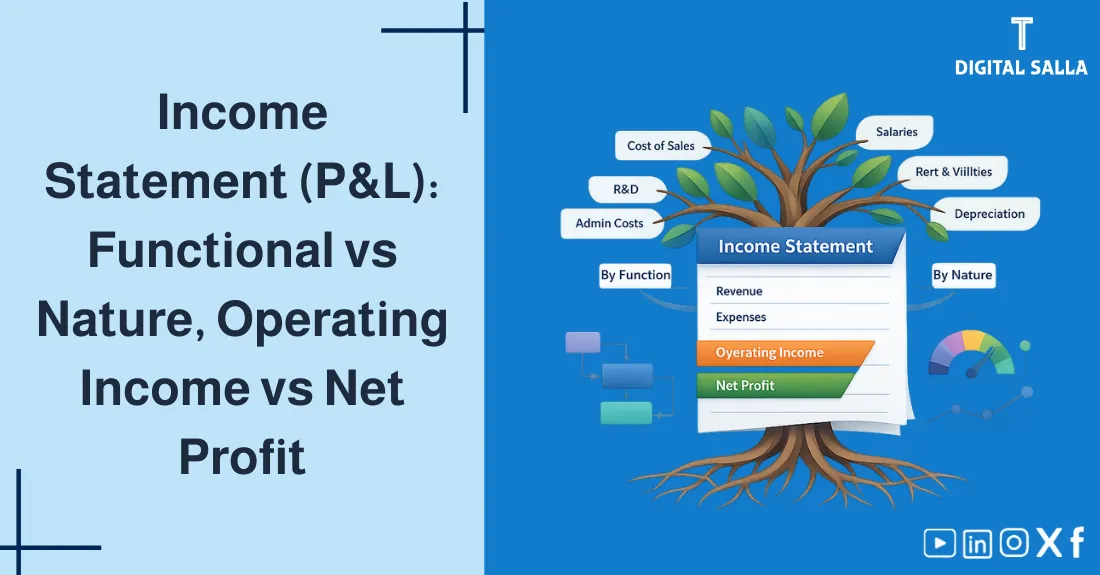
The Cash Flow Statement classifies every dollar into one of three activities: Operating, Investing, or Financing.
Key Takeaways from this Article:
- Understand the 3 sections: Operating, Investing, and Financing.
- Master the Indirect Method for calculating operating cash flow.
- Differentiate between "Profitability" (Income Statement) and "Liquidity" (Cash Flow).
- Learn the concept of Free Cash Flow (FCF).
- Interactive Tool to calculate your Net Cash Flow instantly.
Table of Contents
1) What is the Statement of Cash Flows? 2) The Three Activities (Structure) 3) Cash Flow Logic Map (SVG) 4) Deep Dive: Operating Activities 5) Investing & Financing Activities 6) The Indirect Method Explained 7) Interactive Cash Flow Calculator 8) Free Cash Flow (FCF) Analysis 9) Frequently Asked Questions 10) Summary & Final Word
1) What is the Statement of Cash Flows? (The Reality Check)
It is a financial statement that reports the cash receipts and cash payments of a business during a period. It answers three vital questions: Where did the cash come from? What was it used for? And what was the change in the cash balance?
The Linkage: This statement links the cash balance at the beginning of the year (Balance Sheet) to the cash balance at the end of the year.
2) The Three Activities (Structure)
Cash flows are categorized into three distinct buckets:
- Operating Activities: Cash from core business operations (e.g., selling goods, paying salaries).
- Investing Activities: Cash from buying/selling long-term assets (e.g., buying machinery, selling land).
- Financing Activities: Cash from owners and lenders (e.g., issuing shares, taking loans, paying dividends).
3) Cash Flow Logic Map: The Water Tank (SVG)
Visualizing how the cash tank fills up and drains out.
OPERATING Day-to-Day Cash INVESTING Buying Assets FINANCING Loans & Equity CASH TANK Net Change in Cash Ending Balance
A healthy company usually has positive Operating cash flow, negative Investing (growth), and mixed Financing.
4) Deep Dive: Operating Activities (The Core Engine)
This section is the most critical indicator of business health. If a company cannot generate cash from its core operations, it is not sustainable. It includes cash received from customers minus cash paid to suppliers, employees, and tax authorities.
Monthly Management Pack - Excel File
5) Investing & Financing Activities
These sections explain the long-term strategy:
- Investing (Uses of Cash): Usually negative for growing companies because they are buying equipment (CapEx) to expand.
- Financing (Sources/Uses): Shows how the company is funded. Positive means borrowing/new equity; Negative means repaying debt/dividends.
6) The Indirect Method: Reconciling Profit to Cash
Most companies use the Indirect Method because it's easier to prepare from existing records. It starts with Net Profit and adjusts it for non-cash items:
- Start with Net Profit (Income Statement).
- ADD back non-cash expenses (Depreciation, Amortization).
- Adjust for changes in Working Capital (e.g., Deduct increase in Inventory, Add increase in Payables).
Why add Depreciation? Because it was subtracted to find Net Profit, but no cash actually left the bank. Adding it back restores the cash view.
7) Interactive Cash Flow Calculator (Indirect)
Estimate your Net Cash Flow from Operations.
Net Profit ($)
Depreciation (+)
Increase in AR (-)
Increase in AP (+)
8) Free Cash Flow (FCF): The Real Value
Investors love FCF. It represents the cash a company generates after spending the money required to maintain or expand its asset base.
Formula: $$FCF = Operating Cash Flow - Capital Expenditures (CapEx)$$
9) Frequently Asked Questions
Why is 'Increase in Inventory' a subtraction from cash?
Because buying more inventory consumes cash. Even if you haven't sold it yet, the cash is tied up in stock.
Can a company have negative cash flow but positive profit?
Yes, absolutely. If a company sells on credit (high profit) but fails to collect the money (low cash), it can face a liquidity crisis.
Is interest paid Operating or Financing?
Under US GAAP, it is Operating. Under IFRS, companies have the choice to classify it as Operating or Financing, provided they are consistent.
10) Summary & Final Word
The Statement of Cash Flows is the truth-teller of financial reporting. While the Income Statement shows potential, the Cash Flow Statement shows capability. By mastering the separation of activities and the logic of the indirect method, you gain the ability to predict solvency and fund future growth—Digital Salla.
© Digital Salla Articles — General educational content. For complex cash flow preparation involving foreign currencies or subsidiaries, consult a Certified Public Accountant (CPA).