
Interim Financial Reporting (IAS 34): How do Quarterly Statements Differ from Annual?
Investors don't want to wait 12 months to know if the company is succeeding. Interim Financial Reporting (IAS 34) bridges the gap between annual years. But be careful: interim statements are not just "mini-annual statements"; they have special rules for measurement, condensation, and tax estimation. This guide explains the difference between the "Discrete" and "Integral" views and how to prepare them professionally—Digital Salla.
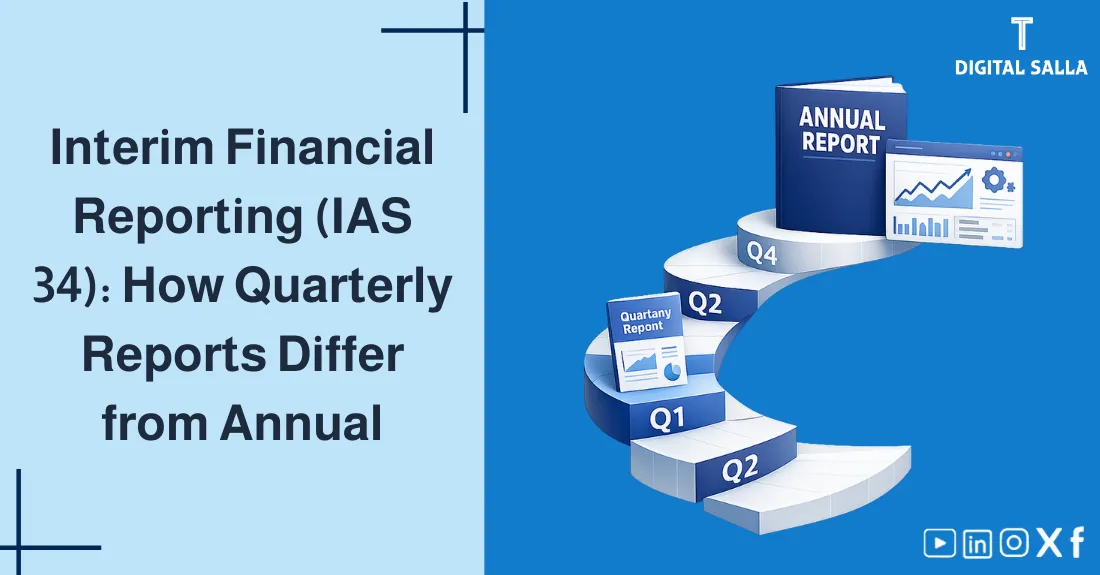
Interim reports are the "speedometer" reading during the journey; Annual reports are the full "trip log".
What will you learn in this article?
- The fundamental difference between Annual and Interim reports.
- What are Condensed Financial Statements? (Minimum content).
- The debate: Integral View vs. Discrete View (and what IAS 34 chose).
- How to handle Seasonality (e.g., retail sales in Ramadan/Christmas).
- Interactive Tool: Estimating Quarterly Tax using Effective Annual Rate.
Related Reference: Preparing Full Annual Statements (IAS 1)
IAS 34 relies on the same principles as IAS 1 but allows for presentation shortcuts (Condensation).
Table of Contents Updates automatically during scroll
1) What is Interim Reporting? 2) Discrete vs. Integral View (The Core Logic) 3) Minimum Content: "Condensed" Statements 4) Materiality in Interim Periods 5) Seasonality & Uneven Costs 6) Interactive Tool: Tax Estimator 7) Frequently Asked Questions 8) Conclusion
1) What is Interim Reporting?
It is the preparation of financial statements for a period shorter than a full financial year (usually Quarterly or Half-yearly). The goal is not "perfect accuracy" like the annual audit, but rather Timeliness to provide updated information to stakeholders.
Monthly Management Pack - Excel File
2) Discrete vs. Integral View (The Core Logic)
How do we treat the interim period? Is it a standalone island or a piece of a larger puzzle?
Accounting Views for Interim Periods
| View | Concept | IAS 34 Position |
|---|---|---|
| Discrete View | Treats the quarter as a separate accounting period. Assets/Liabilities are measured as if books are closed today. | Adopted for most items (Assets, Liabilities, Revenue). |
| Integral View | Treats the quarter as an integral part of the annual period. Costs are allocated based on annual estimates. | Adopted mainly for Income Tax (using weighted average annual rate). |
Practical Impact: You cannot defer a marketing expense incurred in Q1 just to smooth earnings over the year. If it happened in Q1, it hits Q1 (Discrete). However, you calculate tax based on the expected Annual rate, not just Q1 profit (Integral).
3) Minimum Content: "Condensed" Statements
IAS 34 does not require a full set of statements. It allows Condensed Financial Statements containing at least:
- Condensed Statement of Financial Position.
- Condensed Statement of Profit or Loss (and OCI).
- Condensed Statement of Changes in Equity.
- Condensed Statement of Cash Flows.
- Selected Explanatory Notes (Focusing on significant events since last year).
Presentation Rule: You must include headings and subtotals that were included in the most recent annual financial statements.
4) Materiality in Interim Periods
Materiality is assessed in relation to the Interim Period financial data, not the forecasted annual data. Meaning: An error of $10k might be immaterial for the full year, but material for Q1 alone. Therefore, recognition policies must be strict during the quarter.
5) Seasonality & Uneven Costs
Revenues: Seasonal revenue (like retail in holidays) is recognized when it occurs. It is NOT anticipated or deferred. Uneven Costs: Costs incurred unevenly during the year (like periodic maintenance) should be anticipated or deferred for interim purposes only if it is appropriate to do so at year-end.
6) Interactive Tool: Quarterly Tax Estimator (Integral View)
Estimate the Income Tax Expense for the current quarter based on the estimated Annual Effective Tax Rate.
YTD Profit before Tax ($):
Est. Annual Tax Rate (%):
Tax Expensed in Prev Quarters ($):
Enter values to see the required tax entry...
7) Frequently Asked Questions
Are interim reports required to be audited?
Usually, they are subject to a Review Engagement (Limited Assurance) rather than a full Audit. This is faster and less costly but provides a lower level of assurance than annual statements.
Can I defer annual maintenance costs to spread them over quarters?
No. Under IAS 34, costs are recognized when incurred. If you have a legal obligation for maintenance, you might provision for it, but you cannot simply "smooth" expenses to make profit look stable.
Do I need to disclose everything again in the notes?
No. The notes should focus on updates. If a policy hasn't changed since the annual report, you don't need to repeat it. Focus on new events, seasonal effects, and segment updates.
8) Conclusion
Interim Financial Reporting is about balancing "Speed" with "Reliability". By adopting the Discrete View for most items and the Integral View for tax, IAS 34 ensures that quarterly reports reflect the economic reality of the period without artificial smoothing. Remember: Condensed doesn't mean incomplete; it means focused on what's new.
© Digital Salla Articles — General educational content. Accounting standards may vary by jurisdiction (IFRS vs GAAP). Consult a professional for listed company reporting.