

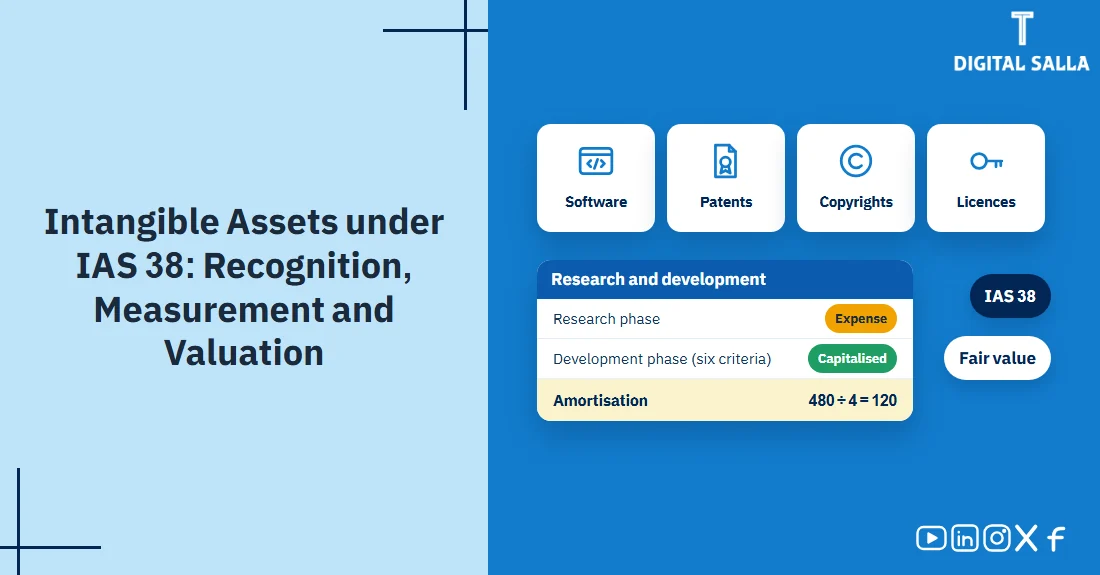
Under IFRS Accounting Standards, an intangible asset is an identifiable non-monetary asset without physical substance (IAS 38.8), such as computer software, patents, copyrights, customer lists, licences and franchises (IAS 38.9). It is governed by IAS 38 Intangible Assets.
The difficulty of valuing intangibles starts before measurement: much of what creates an entity's value never appears in its statements because it fails the recognition requirements, and what does appear depends on estimates of useful life, fair value and recoverable amount. This article covers when an intangible is recognised, how it is measured, amortised and tested for impairment, and where the valuation challenges lie, with a worked example.
When is an item an intangible asset?
The item must meet both the definition and the recognition criteria, whether acquired or internally generated (IAS 38.18):
- Identifiability: it is separable — capable of being sold, transferred, licensed, rented or exchanged, individually or together with a related contract, asset or liability, regardless of whether the entity intends to do so — or it arises from contractual or other legal rights (IAS 38.12).
- Control: the power to obtain the future economic benefits from the resource and to restrict others' access to them, which normally stems from legal rights enforceable in a court of law (IAS 38.13).
- Recognition criteria: it is probable that the expected future economic benefits attributable to the asset will flow to the entity, and its cost can be measured reliably (IAS 38.21); probability is assessed using reasonable and supportable assumptions representing management's best estimate of conditions over the asset's useful life (IAS 38.22).
The asset is measured initially at cost (IAS 38.24). For the practical line between capitalising and expensing, see Asset or expense?.
Three routes to recognition
Acquisition in a business combination
The cost of an intangible asset acquired in a business combination is its fair value at the acquisition date (IAS 38.33). The acquirer recognises it separately from goodwill, even if the acquiree had not recognised it, including an in-process research and development project that meets the definition (IAS 38.34). Meeting either the separability criterion or the contractual-legal criterion makes it identifiable (IFRS 3.B31).
Identifiable assets acquired and liabilities assumed are measured at acquisition-date fair values (IFRS 3.18), and goodwill is the excess of the consideration transferred, the amount of any non-controlling interest and any previously held equity interest over the net acquisition-date amounts of the identifiable assets acquired and liabilities assumed (IFRS 3.32). See IFRS 3 Business Combinations and The impact of acquisitions on financial statements.
Internal generation: research and development
- Internally generated goodwill is not recognised (IAS 38.48), nor are internally generated brands, mastheads, publishing titles, customer lists and items similar in substance (IAS 38.63).
- Two phases: an internal project is split into a research phase and a development phase (IAS 38.52). Research is original and planned investigation to gain new scientific or technical knowledge; development is the application of research findings or other knowledge to a plan or design for new or substantially improved materials, products, processes or systems before commercial production or use (IAS 38.8).
- Research is always expensed when incurred (IAS 38.54).
- Development is capitalised if, and only if, the entity can demonstrate all six of the following (IAS 38.57):
- the technical feasibility of completing the asset so that it will be available for use or sale;
- its intention to complete the asset and use or sell it;
- its ability to use or sell it;
- how it will generate probable future economic benefits — for example, a market for its output or for the asset itself, or its usefulness if used internally;
- adequate technical, financial and other resources to complete development and use or sell it; and
- its ability to measure reliably the expenditure attributable to it during development.
The cost of an internally generated asset is the expenditure incurred from the date the recognition criteria are first met (IAS 38.65) and comprises directly attributable costs such as materials and services, employee benefits and fees to register a legal right (IAS 38.66). Excluded items include general overheads not directly attributable to preparing the asset for use and staff training to operate it (IAS 38.67). Expenditure previously recognised as an expense is not reinstated (IAS 38.71).
Spending that is never capitalised
Examples of expenditure expensed when incurred are start-up costs, training, advertising and promotion, and relocating or reorganising part or all of an entity (IAS 38.69).
Worked example: capitalising and amortising development costs (illustrative figures)
In 2026 a company develops software for internal use. The research phase (January–March) costs 150 and development before the six criteria are demonstrated (April–June) costs 200. From 1 July 2026 all criteria are demonstrated, and directly attributable costs to 31 December are 480 (materials and services 180, employee benefits 300); staff training on the system in December costs 30. The system is available for use on 1 January 2027, with an estimated useful life of 4 years, a consumption pattern that cannot be determined reliably, and a residual value of zero.
| Entry | Debit | Credit |
|---|---|---|
| 2026: Research and development expense (150 + 200) | 350 | |
| 2026: Training expense | 30 | |
| 2026: Intangible assets under development | 480 | |
| Cash / payables | 860 | |
| 2027: Amortisation expense (480 ÷ 4) | 120 | |
| Accumulated amortisation | 120 |
- 350 is expensed: research is never capitalised (IAS 38.54) and development spending before 1 July is not reinstated (IAS 38.71); it is disclosed as research and development expenditure recognised as an expense (IAS 38.126).
- 30 of training is not part of cost (IAS 38.67).
- Amortisation starts when the asset is available for use, on a straight-line basis because the pattern cannot be determined reliably (IAS 38.97), with a zero residual value (IAS 38.100). The carrying amount at 31 December 2027 is 480 − 120 = 360.
- At 31 December 2026 the asset is not yet available for use, so it is tested for impairment annually even without an indication (IAS 36.10). We assume its recoverable amount is at least 480.
After recognition: cost or revaluation
An entity chooses the cost model or the revaluation model as its accounting policy; if an asset is revalued, all assets in its class are too, unless there is no active market for them (IAS 38.72). Under revaluation, fair value is measured by reference to an active market (IAS 38.75), and an asset in a revalued class that has no active market is carried at cost less amortisation and impairment (IAS 38.81).
This is one of the main valuation challenges: an active market for an intangible asset is uncommon, and cannot exist for brands, newspaper mastheads, music and film publishing rights, patents or trademarks because each is unique; transactions are negotiated individually, infrequent, and prices are often not public (IAS 38.78). Without an active market, the revaluation model cannot be applied to the asset, which is carried at cost (IAS 38.75, 81).
Useful life and amortisation
- Finite or indefinite? A useful life is indefinite when, based on all relevant factors, there is no foreseeable limit to the period over which the asset is expected to generate net cash inflows (IAS 38.88).
- Finite-life assets are amortised systematically from when they are available for use, using a method that reflects the pattern of consumption of benefits, or straight-line if the pattern cannot be determined reliably (IAS 38.97). There is a rebuttable presumption that a revenue-based amortisation method is inappropriate (IAS 38.98A).
- Residual value is zero unless a third party has committed to buy the asset at the end of its life, or there is an active market from which it can be determined and that is probable to exist at the end of the life (IAS 38.100).
- Review: the amortisation period and method are reviewed at least at each financial year-end (IAS 38.104).
- Indefinite-life assets are not amortised (IAS 38.107), and the indefinite-life assessment is reviewed each period (IAS 38.109).
Impairment: when is an annual test required?
IAS 36 determines whether an intangible asset is impaired (IAS 38.111). Irrespective of any indication, intangible assets with indefinite useful lives or not yet available for use, and goodwill acquired in a business combination, are tested annually (IAS 36.10). For other assets, the entity assesses at the end of each reporting period whether there is any indication of impairment and, if so, estimates the recoverable amount (IAS 36.9).
Valuation challenges at fair value
When fair value must be measured, as in a business combination, it is the price that would be received to sell the asset in an orderly transaction between market participants at the measurement date (IFRS 13.9). The three widely used valuation techniques are the market, cost and income approaches (IFRS 13.62).
Inputs are categorised into a three-level fair value hierarchy, giving the highest priority to unadjusted quoted prices in active markets for identical assets (IFRS 13.72, 76), then other observable inputs (IFRS 13.81), then unobservable inputs at Level 3 (IFRS 13.86). Where relevant observable inputs are not available, unobservable inputs are used, while the measurement objective stays the same (IFRS 13.87). See IFRS 13 Fair Value Measurement and Sensitivity analysis.
Disclosure
For each class, distinguishing internally generated assets from others, entities disclose useful lives or amortisation rates, amortisation methods, gross carrying amount and accumulated amortisation at the start and end of the period, the line items that include amortisation, and a reconciliation of the carrying amount showing additions from internal development, separate acquisition and business combinations, among other movements (IAS 38.118). They also disclose the carrying amount of each indefinite-life asset and the reasons for that assessment (IAS 38.122), and the total research and development expenditure expensed in the period (IAS 38.126).
Current status and the IAS 38 review
The International Accounting Standards Board (IASB) adopted IAS 38 in April 2001, revised it in March 2004 and amended it in January 2008 as part of its Business Combinations project, and in May 2014 clarified when a revenue-based amortisation method is appropriate; recent consequential amendments include those made by IFRS 18, issued in April 2024 (IFRS Foundation: IAS 38 page), which is effective for annual reporting periods beginning on or after 1 January 2027, with earlier application permitted (IFRS Foundation: Changes in this edition 2026).
The IASB aims to comprehensively review IAS 38 and has started with two streams: assessing user needs for information about recognised and unrecognised intangible assets and related expenditure, and considering whether to update the definition of an intangible asset, its guidance and some aspects of the recognition criteria, using as test cases application issues related to newer types of intangible assets and new ways of using them. At its 22 September 2026 meeting it discussed a model for customer accounting for intellectual property licensing contracts, using a cloud-based "Software as a Service" contract as the test case, with no decisions; the next milestone is to decide the project direction (IFRS Foundation: project page). In a March 2019 agenda decision, the IFRS Interpretations Committee had noted that a customer in such an arrangement receives a software asset at contract commencement if the contract contains a software lease or the customer otherwise obtains control of the software, and concluded that a contract conveying only the right to receive access to the supplier's software in the future is a service contract.
A practical tool
To prepare the intangible assets note within an entity's statements, see Financial Statements and Notes from the Trial Balance, an Excel file that produces the four statements for both years and the notes, including an intangible assets note. It covers a single entity and does not include consolidated statements, deferred tax, earnings per share, segment reporting or discontinued operations.
Sources
- IFRS Foundation: IAS 38 Intangible Assets. References in brackets are to paragraphs of the Standards; the history is from this page.
- IFRS Foundation: IAS 36, IFRS 3 and IFRS 13.
- IFRS Foundation: Intangible Assets project and Changes in this edition (2026).
- IFRS Foundation: IAS 38, free 2026 Issued edition (includes amendments not yet in force), source of the March 2019 agenda decision text.