
GAAP vs IFRS: The Key Differences
In the world of accounting, there are two giants: US GAAP (Rules-based) and IFRS (Principles-based). Understanding the differences between them is crucial for anyone working in multinationals or investment. From inventory valuation (LIFO) to development costs, this guide explains the core differences simply—Digital Salla.
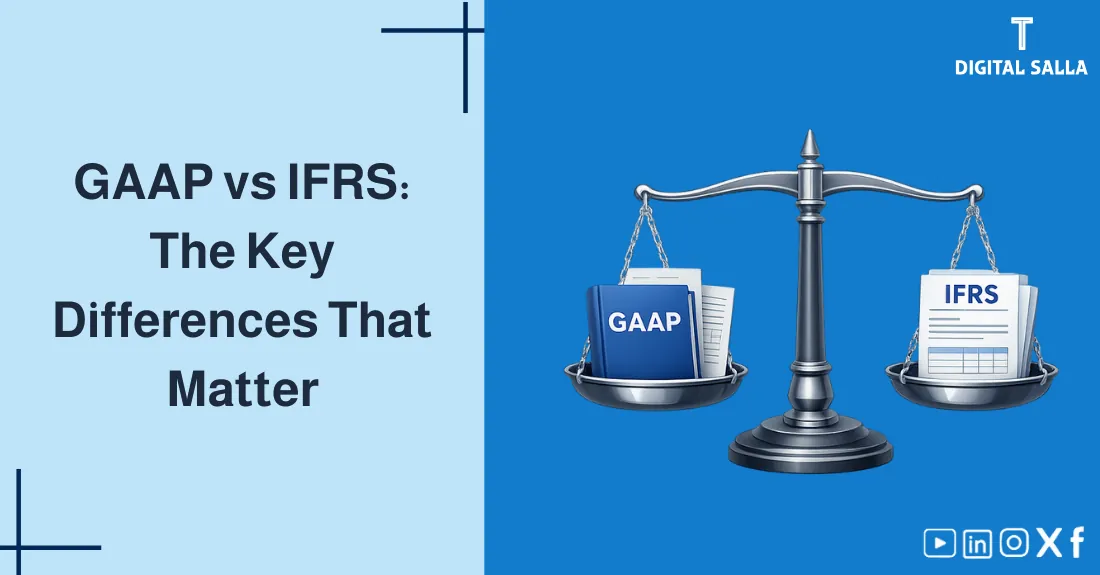
GAAP focuses on strict rules, while IFRS focuses on the economic substance of the transaction.
What will you learn in this article?
- Philosophy: Rules (GAAP) vs Principles (IFRS).
- Inventory: Why is LIFO banned in IFRS?.
- Development Costs: Expense (GAAP) vs Capitalization (IFRS).
- Reversal of Write-downs: Allowed in IFRS, Prohibited in GAAP.
- Interactive Tool: Difference Finder (Select topic to see comparison).
Related Reference: Accounting Policies Manual
Your company's policies must clearly state whether they follow IFRS or GAAP.
Table of Contents Updates automatically during scroll
1) What are GAAP and IFRS? 2) Comparison Table (Summary) 3) Inventory: The LIFO Controversy 4) Development Costs: Expense or Asset? 5) Reversal of Inventory Write-downs 6) Interactive Tool: Difference Finder 7) Frequently Asked Questions 8) Conclusion
1) What are GAAP and IFRS? (The Philosophy)
GAAP (Generally Accepted Accounting Principles): Used primarily in the USA. It is Rules-based, meaning it provides specific and strict instructions for every scenario to reduce legal ambiguity. IFRS (International Financial Reporting Standards): Used in +140 countries (including EU, GCC, Canada). It is Principles-based, focusing on the economic substance and professional judgment.
2) Comparison Table (Quick Summary)
Key Differences Summary
| Area | US GAAP | IFRS |
|---|---|---|
| Inventory Method | Allows LIFO, FIFO, Weighted Avg | Bans LIFO (Only FIFO, W. Avg) |
| Development Costs | Expensed immediately (mostly) | Capitalized if criteria met (Asset) |
| Inventory Write-down | Cannot be reversed | Can be reversed if value recovers |
| Fixed Assets | Historical Cost Model only | Allows Revaluation Model (Fair Value) |
3) Inventory: The LIFO Controversy
LIFO (Last-In, First-Out): Assumes the newest items are sold first. In times of inflation, this increases COGS and reduces taxes. IFRS View: Bans LIFO because it does not reflect the physical flow of goods and distorts the balance sheet. GAAP View: Allows LIFO (popular for tax benefits in the US).
4) Development Costs: Expense or Asset?
When developing a new product (e.g., software): GAAP: Treats development costs as Expenses (conservative approach) to avoid manipulating asset values. IFRS: Requires Capitalization (recording as an Asset) if the company proves technical feasibility and ability to sell the product.
5) Reversal of Inventory Write-downs
If you wrote down inventory from $100 to $80 due to a price drop, and later the price goes back to $100: IFRS: Allows reversing the write-down (booking a gain) to reflect current value. GAAP: Prohibits reversal. The new lower cost basis ($80) is permanent until sale.
IFRS Comparison Guide - PDF File
6) Interactive Tool: Difference Finder
Select a topic to see the specific treatment under each standard.
Select Topic: -- Choose Topic -- Inventory (LIFO) Development Costs Reversal of Write-downs Fixed Asset Revaluation
Select a topic to view details...
7) Frequently Asked Questions
Why doesn't the US switch to IFRS?
The US SEC allows foreign companies to use IFRS, but domestic companies must use GAAP. The shift is complex due to legal and tax implications tied to LIFO and other rules.
Which standard is "better"?
Neither is "better". GAAP is more detailed and leaves less room for interpretation (Good for consistency). IFRS represents economic reality better in some cases (Good for logic).
Do small businesses need to worry about this?
Most SMEs follow local tax laws or "IFRS for SMEs". However, if you plan to attract foreign investors, understanding IFRS is essential.
8) Conclusion
Whether you follow GAAP or IFRS, the goal is the same: providing useful information to users. However, the path differs. GAAP relies on "Rules", while IFRS relies on "Principles". Knowing these nuances (like LIFO and Capitalization) prevents major surprises when analyzing international companies—Digital Salla.
© Digital Salla Articles — General educational content. For official reporting, always refer to the specific standards (FASB/IASB) applicable to your jurisdiction.