

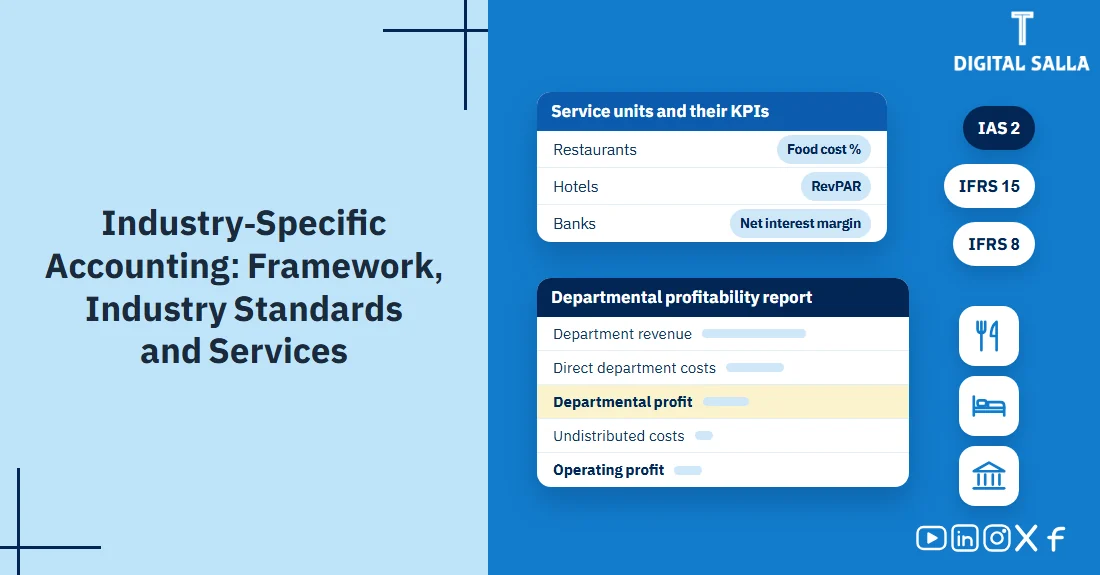
Industry-specific (niche sector) accounting adapts the accounting system to a particular industry: when revenue arises, what the unit of cost is, how inventory and assets are measured, and which indicators explain profit. Some IFRS Accounting Standards address particular industries' activities, such as agriculture, mineral exploration and insurance contracts; elsewhere, what changes is how the general Standards apply to the business model. Below: one framework for building an "industry file", the industry-specific Standards, and an application to services: restaurants, hotels and banks.
An important distinction: a sector here is an industry, whereas an operating segment under IFRS 8 is a component of an entity that engages in business activities from which it may earn revenues and incur expenses (including those relating to transactions with other components of the same entity), whose operating results are regularly reviewed by the entity's chief operating decision maker to make decisions about resources to be allocated to the segment and assess its performance, and for which discrete financial information is available (IFRS 8.5). So an entity in a single industry may have several operating segments; for more: IFRS 8 Operating Segments.
Why accounting differs between industries
The differences have five roots: revenue timing (delivery of goods, a continuing service or a long contract), cost structure (materials, labour, operations, depreciation), the nature of inventory (expiry, batches, spare parts), assets (fleets, equipment, farms) and regulation (healthcare, banking, transport, mining). Each root changes part of the system: invoicing and deferred revenue, cost centres, inventory controls, the depreciation method or regulatory reports.
Quick rule: start with two questions, "what is the unit of revenue?" and "what is the unit of cost?", then build the chart of accounts and reports around them.
One framework for any industry's accounting system
- Business model: one page on the sources of revenue, cost and risk.
- Operating units and their data: an order, trip, room-night, hour or patient, and the source of each figure.
- Key accounting policies: revenue, inventory, assets and allocation.
- Costing and control system: cost centres, allocation bases and controls.
- Reports and KPIs that link operations to results.
Rule: do not design the chart of accounts before defining the operating units; they determine the cost centres and the measurement method.
Policies that change by industry
| Area | Questions to answer | Industry examples |
|---|---|---|
| Revenue | What is transferred to the customer, and when? Any advance payments? | Retail: discounts and returns · Hospitals: treatment packages · Services: advances |
| Costing | Which allocation base fits best? | Transport: km or hour · Professional firms: billable hour · Restaurants: recipe |
| Inventory | Are batch and expiry tracking needed? | Healthcare: medicines · Transport: spare parts · Mining: ore |
| Assets and depreciation | Does depreciation follow time or use? | Fleet: kilometres · Medical equipment: operating hours |
| Compliance | Which regulatory reports are required? | Healthcare: insurance claims · Transport: licences · Mining: environment and safety |
On assets: the depreciation method used shall reflect the pattern in which the asset's future economic benefits are expected to be consumed by the entity (IAS 16.60), and the available methods include the units of production method, which results in a charge based on the expected use or output (IAS 16.62). So depreciation by kilometres or operating hours may suit a fleet.
Standards specific to certain industries
| Industry | Standard | Key requirement |
|---|---|---|
| Agriculture | IAS 41 | A biological asset shall be measured on initial recognition and at the end of each reporting period at fair value less costs to sell, except in the case described in paragraph 30 where fair value cannot be measured reliably (IAS 41.12); harvested agricultural produce shall be measured at its fair value less costs to sell at the point of harvest, which is its cost at that date when applying IAS 2 or another applicable Standard (IAS 41.13). Scope exclusions include bearer plants (see IAS 16), but not their produce (IAS 41.2). |
| Mineral exploration | IFRS 6 | Specifies the financial reporting for the exploration for and evaluation of mineral resources (IFRS 6.1) and an entity shall apply it to the exploration and evaluation expenditures it incurs (IFRS 6.3). |
| Insurance | IFRS 17 | An entity shall apply it to insurance contracts it issues, including reinsurance contracts, to reinsurance contracts it holds, and to investment contracts with discretionary participation features it issues, provided it also issues insurance contracts (IFRS 17.3). |
| Rate-regulated activities | IFRS 20 | Issued by the International Accounting Standards Board (IASB) on 27 May 2026 for companies subject to a specific type of rate regulation; it requires them to account in their financial statements for the effects of "differences in timing" between when they supply regulatory goods and services and when they charge customers for them. Effective for annual reporting periods beginning on or after 1 January 2029 (earlier application permitted); it will replace IFRS 14. |
For banks: IFRS 9 Financial Instruments covers classification, measurement and expected credit losses.
Industry KPIs that link operations to results
| Industry | Operating unit | Operating KPIs | Financial link |
|---|---|---|---|
| Retail | Invoice or branch | Inventory turnover, average basket, return rate | Gross margin and working capital |
| Transport | Kilometre or trip | Cost per km, load factor, breakdowns | Depreciation, maintenance, route profitability |
| Hospitals | Visit or case | Cost per case, medicine turnover, bed occupancy | Service margin and package pricing |
| Professional services | Hour | Billable hours, utilisation, collection rate | Client and team profitability |
| Mining | Tonne | Cost per tonne, waste ratio | Inventory valuation |
Industry map: detailed articles
- Retail and e-commerce accounting
- Restaurant costs
- Hotel accounting and USALI
- Bank and insurance company accounting
- Hospital and healthcare accounting
- Professional services accounting
- Transport company accounting
- Agricultural accounting (IAS 41)
- IFRS 6 exploration and evaluation
- Construction and real estate accounting
- Non-profit organisation accounting
Service accounting: restaurants, hotels and banks
Service businesses sell capacity: a seat in a restaurant, a room in a hotel, a transaction in a bank, an hour of team time. Unused capacity cannot be stored: an hour lost today cannot be sold tomorrow. Measurement therefore revolves around the service unit, available capacity and departmental profitability. The cost formulas, allocation bases, departmental report and KPIs below are management-accounting tools, not requirements of IFRS Accounting Standards, and each entity sets its own KPI definitions.
Cost per service unit
Service cost = direct labour (hours × hourly rate) + supplies used for the service + the department's direct expenses + the service's share of shared costs on a suitable allocation base.
Cost per service unit = total service cost ÷ number of service units in the period (meals, occupied room-nights, transactions or hours).
Materials and supplies to be consumed in the production process or in rendering services, such as meal ingredients and room supplies, are inventories (IAS 2.6). Costs incurred to fulfil a contract with a customer that do not give rise to inventories, or to assets within the scope of another Standard, are accounted for under IFRS 15 (IAS 2.8).
| Shared cost | Allocation base | Why |
|---|---|---|
| Utilities | Floor area, operating hours or occupancy | Consumption follows space and activity |
| Rent | Space used (seats, rooms, offices) | Rent is the price of available capacity |
| Management and supervision | Headcount or hours | Follows the volume of activity managed |
| Maintenance | Equipment hours, or number of rooms and seats | The assets used cause the cost |
Quick test: if one department's volume changes, does its share of cost change logically? If not, revisit the base. For traditional versus activity-based allocation: cost allocation.
Departmental profitability report
Show each department's revenue less its direct costs to reach departmental profit, then deduct costs not distributed to departments (administration, marketing, maintenance, shared utilities) on a separate line to reach the entity's operating profit, so one department's loss is not hidden in another's profit.
| Line | Restaurant | Rooms | Total |
|---|---|---|---|
| Department revenue | XXX | XXX | XXX |
| Direct department costs | (XX) | (XX) | (XX) |
| Departmental profit | XX | XX | XX |
| Undistributed costs | (X) | ||
| Operating profit | X |
Service units and their KPIs
| Industry | Service unit | Key KPIs |
|---|---|---|
| Restaurants | Order or meal | Food cost % = food cost ÷ food revenue; waste; theoretical recipe cost versus actual |
| Hotels | Occupied room-night | Occupancy = rooms sold ÷ rooms available; average daily rate (ADR) = rooms revenue ÷ rooms sold; revenue per available room (RevPAR) = rooms revenue ÷ rooms available (= occupancy × ADR) |
| Banks | Product or transaction | Net interest margin = net interest income ÷ average interest-earning assets; cost-to-income = operating expenses ÷ operating income |
Service revenue under IFRS 15: time and unbilled work
An entity transfers control of a service, and so recognises revenue, over time if one of three criteria is met: the customer simultaneously receives and consumes the benefits of the entity's performance as it performs; the performance creates or enhances an asset that the customer controls as it is created or enhanced; or the performance does not create an asset with an alternative use to the entity and the entity has an enforceable right to payment for performance completed to date (IFRS 15.35). If the entity has a right to consideration from the customer in an amount that corresponds directly with the value to the customer of its performance completed to date, such as a service contract billed at a fixed amount per hour, it may, as a practical expedient, recognise revenue in the amount to which it has a right to invoice (IFRS 15.B16).
What professional firms call "work in progress" is analysed with these rules:
- Work performed but not billed: a contract asset if the entity's right to consideration is conditioned on something other than the passage of time (IFRS 15, Appendix A), which shall be assessed for impairment under IFRS 9 (IFRS 15.107); a receivable if the right is unconditional, that is, only the passage of time is required before payment is due (IFRS 15.108).
- Advance payments: if the customer pays, or the entity has an unconditional right to consideration (a receivable), before the service is transferred, the contract shall be presented as a contract liability when the payment is made or due, whichever is earlier (IFRS 15.106).
- Costs to fulfil a contract: if they are not within the scope of another Standard, an entity shall recognise an asset from them only if they meet all three criteria: they relate directly to a contract or to an anticipated contract that the entity can specifically identify, they generate or enhance resources of the entity that will be used in satisfying (or in continuing to satisfy) performance obligations in the future, and they are expected to be recovered (IFRS 15.95). Four categories of costs shall be expensed when incurred, among them costs that relate to satisfied or partially satisfied performance obligations, that is, to past performance (IFRS 15.98).
For the full framework: IFRS 15 Revenue from Contracts with Customers.
Chart of accounts and cost centres
Capture industry detail without bloat:
- Stable general ledger accounts, with industry sub-accounts only where needed.
- Cost centres that mirror real operations: branch, department, clinic, truck, project or case.
- Allocation bases for shared costs (operating hours, floor area, transaction counts).
- Analysis tags for product, customer or route instead of new accounts.
A three-part structure: GL account (maintenance expense) + cost centre (the truck) + tag (the route).
To start: Sector Chart of Accounts Mapped to Financial Statement Line Items and the Zakat Base, an Excel file with four charts (trading, services, contracting and industrial), each with 100 to 110 sub-accounts, every account mapped to the financial statement line item it rolls into and to its zakat base classification. It is a suggested starting chart, not one mandated by any official body, and it covers these four sectors only. Some zakat classifications are conditional (investments, partners' loans, overdue government dues): the chart suggests the usual case, so review them for your entity.
A monthly close pack by industry
- Reconcile operating units (orders, trips, hours, patients) to invoices and revenue.
- Reconcile inventory, its differences and their causes.
- Allocate costs by industry.
- Variance analysis against budget.
- Profitability report by branch, route, service or customer.
Industry reports are built from operating data, so weak data keep them superficial.
How to build an industry file and choose your niche
Choose an industry you understand, with measurable operating units and demand for its reports, then build its file in a week, testing each output:
- Business model on one page: can a non-accountant follow it?
- Operating data dictionary and its sources: can it be extracted monthly without effort?
- Three to five short policies: does each have examples and documents?
- Chart of accounts, cost centres and allocation bases: do they produce useful profitability reports?
- KPI dashboard and profitability report: do two or three KPIs explain the statements?
- A trial monthly close: is the close time predictable?
Frequently asked questions
Is industry accounting the same as IFRS 8 (operating segments)?
No. IFRS 8 is a disclosure Standard on operating segments within an entity as management views them. It shall apply to the separate or individual financial statements of an entity, and to the consolidated financial statements of a group with a parent, whose debt or equity instruments are traded in a public market, or that files, or is in the process of filing, its financial statements with a securities commission or other regulatory organisation for the purpose of issuing any class of instruments in a public market (IFRS 8.2). Industry accounting adapts policies, costing and reports to a particular industry.
Sources
- IFRS Foundation: IFRS 8 Operating Segments. References in brackets are to paragraphs of the Standards.
- IFRS Foundation: IFRS 15 Revenue from Contracts with Customers, IAS 2 Inventories and IAS 16 Property, Plant and Equipment.
- IFRS Foundation: IAS 41 Agriculture, IFRS 6 Exploration for and Evaluation of Mineral Resources and IFRS 17 Insurance Contracts.
- IFRS Foundation: IASB issues IFRS 20 to improve financial reporting for companies subject to rate regulation (news, 27 May 2026).